Prelims : Current events of National and International Importance | Environment
Why is in news?
Assam chief minister Himanta Biswa Sarma said the state government’s move to reduce the eco-sensitive zone (ESZ) around Kaziranga National Park and Tiger Reserve (KNPTR) from 10 km to 1 km would follow Supreme Court guidelines.
- The ESZ about Kaziranga National Park and Tiger Reserve (KNPTR) was 10 km ‘by default’.
- The SC guidelines specify that the ESZ should be 1 km, but it can extend to 3 km depending on circumstances.
About ESZ
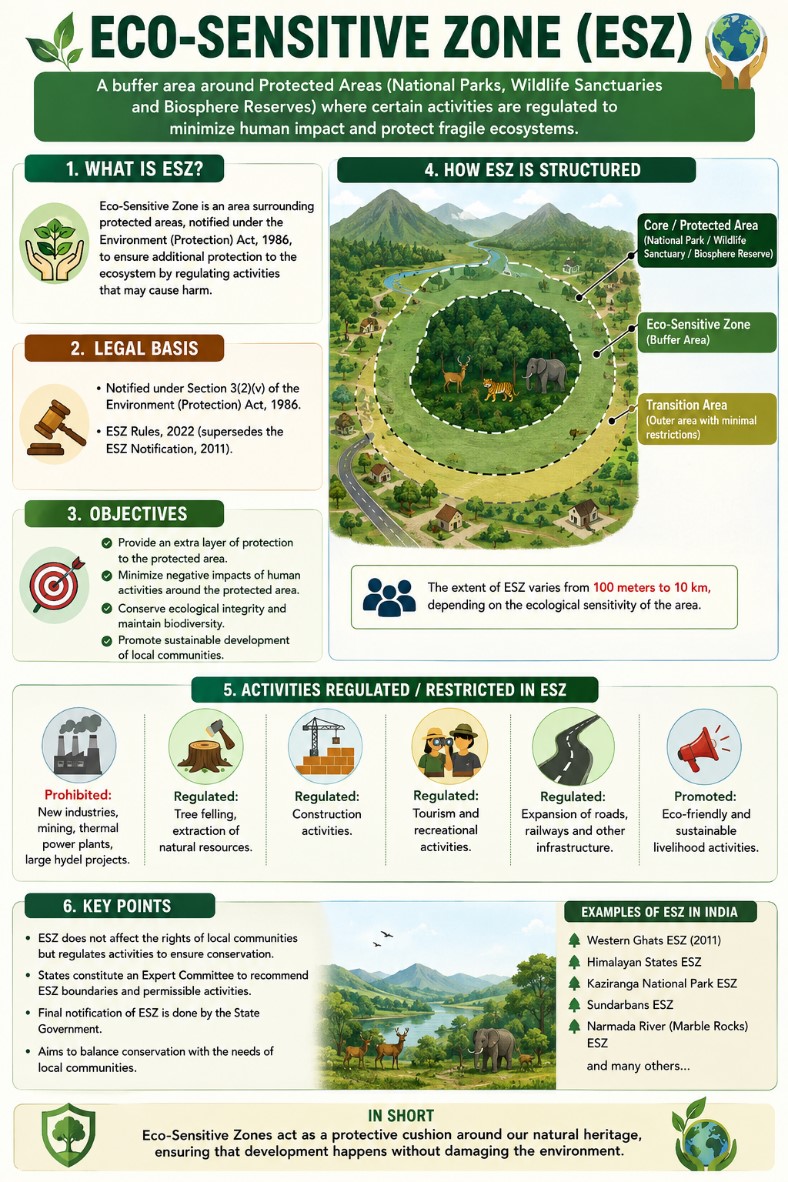
- Eco-Sensitive Zones (ESZs) are also known as Ecologically Fragile Areas (EFAs) under the Environment (Protection) Act, 1986.
- These are areas notified by the MoEFCC around Protected Areas, National Parks and Wildlife Sanctuaries.
- The purpose of declaring ESZs is to create some kind of “shock absorbers” to the protected areas by regulating and managing the activities around such areas.
- As per the National Board for Wildlife NBWL, the delineation of eco-sensitive zones has to be site-specific, and the activities should be regulative in nature and not prohibitive unless required.
- The 10-km general rule for ESZs has its genesis in a resolution adopted during a meeting of the National Board for Wildlife in 2002 under a wildlife conservation strategy.
Declared by
- Survey and identification of ESZs are conducted by the respective State Governments for consideration of the Central Government for declaration of the ESZs in respective States around National Parks and Wildlife Sanctuaries
- It is as per the guidelines formulated by the Ministry of Environment, Forest and Climate Change (MoEF&CC).
- On the basis of proposals and recommendations of the State Government, Ministry notifies the ESZs under the Environment (Protection) Act, 1986.
SC on ESZ
- The 10-km guideline was challenged in the Supreme Court
- In June 2022, the SC had ordered that ESZs of a minimum of 1 km should be declared around protected forests, national parks and wildlife sanctuaries.
- But in April 2023, following submissions from states and the Centre that such a uniform practice was not feasible, the SC modified its order.
- It was stating that a stringent observance of its earlier order was not feasible as it could lead to more man-animal conflict and hamper the day-to-day activities of citizens.
- It, however, stipulated that no mining activity would be allowed within the 1 km boundary of the protected areas.
About KNPTR
- Kaziranga National Park is a national park and World Heritage Site in Assam.
- It is the largest habitat of the endangered one-horned rhinos.
- It is home to more than 2200 Indian one-horned rhinoceros, approximately 2/3rd of their total world population.
- Located on the edge of the Brahmaputra River, it encompasses dense tropical moist broadleaf forests.
- It is recognized as an Important Bird Area and was declared a Tiger Reserve in 2006.
Reference
Hindustan Times | Kaziranga eco-sensitive zone



