Mains: GS Paper III | Environment
Why is in news?
According to the latest Global Coal Mine Tracker (GCMT) from Global Energy Monitor (GEM), Global coal mine pipeline rises 11% to 2,521 Mtpa (million tonnes per annum)
What are the Main findings?
- According to the International Energy Agency (IEA), Global coal demand grew by less than 0.5 per cent in 2025 and is expected to plateau through 2030.
- Global coal mine proposals climbed 11% to 2,521 Mtpa in 2025 even as demand plateaued and new mine additions hit a decade low.
- At the same time, wind and solar generation overtook coal in the global electricity mix for the first time in 2025, while coal-fired electricity generation fell by 0.6 per cent.
- The report notes that projects already under construction are generally more difficult to halt, but most proposed capacity has not reached that stage and still requires permits, financing and final investment decisions.
- The increase in proposed mining capacity was driven almost entirely by India.
- India nearly doubled its pipeline to 638 Mtpa, while China held at 1,321 Mtpa.
- About 70% of projects remain pre-construction, raising concerns over stranded assets as wind and solar overtake coal in global power generation.
- Five countries, China, India, Australia, Russia and South Africa, accounted for nearly 92 per cent of proposed global coal mining capacity.
Why India’s performance is poor?
- The report attributes the sharp increase largely to Jharkhand and Odisha, where proposed mine projects doubled.
- India’s greenfield projects account for 80 per cent of its proposed capacity.
- India’s pipeline is almost entirely thermal coal.
- It is accounting for nearly one third of the global thermal coal pipeline and 94 per cent of India’s proposed capacity.
- The analysis also highlights India’s growing push to use coal as an industrial feedstock.
- In India, around 90 per cent of its 101 Mtpa late-stage capacity consists of surface mines, which can generally be brought into operation more quickly.
What is India’s Coal gasification Plan?
- The government’s National Coal Gasification Mission, launched in 2021, set a target of gasifying 100 million tonnes of coal per annum by 2030 to reduce dependence on imported liquefied natural gas, urea, ammonia and methanol.
- Indian coal generally has high ash content, making gasification more difficult and costly than using lower ash coal.
- Large-scale coal gasification projects also require substantial capital and typically take five to eight years to build.
What about Future path?
- Around three quarters of the global proposed coal mining capacity consists of new greenfield mines.
- Thermal coal proposals dominate the global pipeline.
- Coal mining capacity additions fell by 44 per cent in China and 96 per cent in Australia in 2025.
- China’s decline was partly due to the growing contribution of solar and wind to electricity generation, alongside tighter safety inspections and approvals for capacity expansions.
- China and India are the world’s two largest coal producers.
- They report very limited operating capacity scheduled for retirement before 2035.
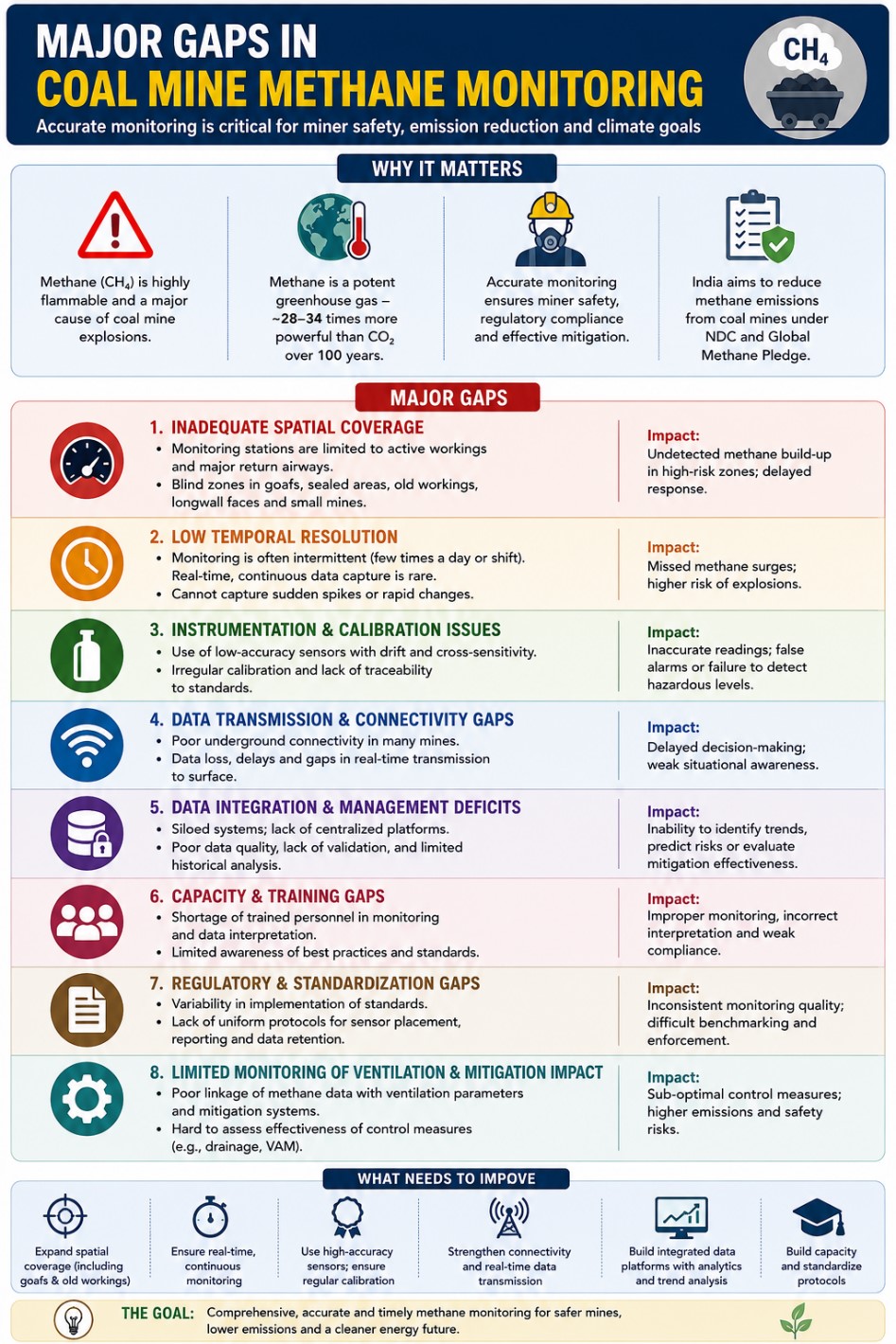
Why there are Methane monitoring gaps?
- The report also identifies major gaps in coal mine methane monitoring.
- No country currently requires direct monitoring of methane emissions from surface mines.
- The report cites evidence that individual surface mines can be major methane emitters.
- In India, operators are allowed to vent methane drained during mine construction directly into the atmosphere without mitigation.
- China and New South Wales in Australia have recently introduced legislation requiring or incentivizing coal mine methane utilization.
Reference
Down to Earth | Global coal mine pipeline rises



