Mains: GS III – Environmental Conservation
World Elephant Day, observed annually on 12 August, highlights the need for sustained global action to address habitat loss, fragmentation, poaching, and illegal wildlife trade etc.
India is home to nearly 60% of the world’s wild Asian elephants, highlighting its vital role in global elephant conservation.
Population estimation – The Synchronous All India Population Estimation of Elephants (SAIEE) 2021–25 estimates India’s wild elephant population at 22,446.
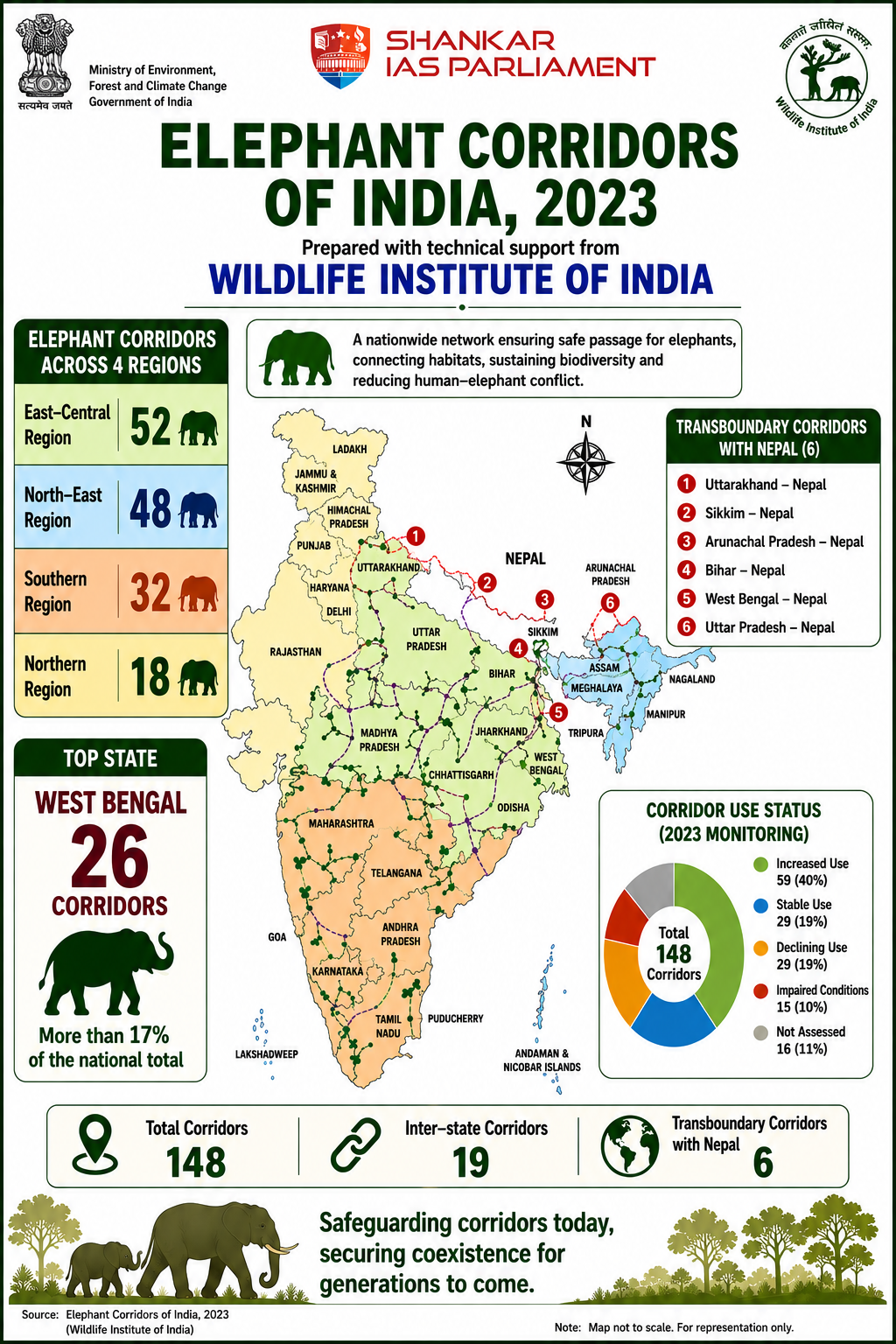
These elephants are protected across 33 Elephant Reserves and 150 identified corridors.
Project Elephant – It is the Government of India's flagship initiative for elephant conservation.
Implemented by – Ministry of Environment, Forest and Climate Change (MoEFCC).
Objective – To provide financial and technical support to States for protecting elephant habitats, conserving captive elephants and mitigating human-elephant conflict.
It also promotes science-driven conservation through AI-enabled monitoring, radio-collaring, genetic databases and early warning systems.
Securing India's Elephant Corridors – Under Project Elephant, the Government has identified and validated elephant corridors across 14 elephant-range states.
It ensures habitat connectivity, sustain genetic diversity, secure population viability, and reduce human–elephant conflict, thereby reinforcing conservation outcomes.
Growing the Reserve Network
Expansion of Reserves – Coverage increased to 80,777 km² across 14 states, adding 8,610 km² under protection, strengthening habitats and ecological connectivity.
Integrated Approach – Project Elephant, scientific estimation, reserves, and corridors together form a landscape‑level programme, blending traditional conservation with modern science for Asian elephant survival.
|
DNA‑Based Sampling |
|
Landscape-Based Management
2023 Framework – Management Effectiveness Evaluation piloted in Shivalik, Kaziranga–Karbi Anglong, Mayurbhanj, Nilgiri; expanded via CAMPA funding.
Regional Action Plans – Cross‑state coordination on habitat connectivity, conflict mitigation, adaptive management at landscape scale.
Railway Corridor Safety
Tech Integration – Optical‑fibre intrusion detection, seismic sensors, thermal cameras complement structures.
AI Alerts – Distributed Acoustic Sensing provides real‑time warnings to loco pilots, station masters, and control rooms.
Joint Investigations – Every collision probed with State Forest Departments.
Impact – Train‑hit elephant deaths reduced from 26 (2013) to 12 (2024), a >50% decline.
Genetic Safeguards for Captive Elephants – The Government has strengthened safeguards against the illegal trade and movement of captive elephants through science-based monitoring.
Wildlife (Protection) Act, 1972 – It mandates State Chief Wildlife Wardens to act on cases of sale, transport, and procurement.
Gajah Suchana mobile app – It maintains a national genetic database with DNA profiles, morphological traits, and ownership details.
Captive Elephant (Transfer or Transport) Rules, 2024
Government notified rules (as per SC order, Mar 2023) with a High‑Powered Committee to regulate interstate transfers, ensuring transparency and curbing illegal movement of captive elephants.
Identity Verification & Enforcement
Movement Control – Database verifies identity before any elephant movement.
Forensic Evidence – Provides reliable proof during legal proceedings, strengthening action against illegal trade.
Community Support & Compensation
Ex‑gratia Assistance under Project Tiger/Elephant & Wildlife Habitats:
Conflict Management & Guidelines
Human‑Wildlife Conflict Advisory – Hotspot mapping, rapid response teams, review committees, faster compensation
Elephant‑specific Guidelines (2023) - Improved coordination among stakeholders which strengthens coexistence, protects both elephants & communities across landscapes.
Habitat loss and fragmentation – Infrastructure development, mining, and agriculture disrupt and divide elephant habitats.
Human–elephant conflict – Overlapping ranges result in human fatalities, injuries, crop damage, property loss, and elephant deaths.
Railway and road accidents – Roads and railways intersect traditional elephant movement routes, increasing the risk of collisions.
Electrocution – Power lines and electric fencing are significant causes of elephant mortality.
Poaching and illegal trade – Despite legal protections, poaching and wildlife trafficking continue.
Corridor degradation – Many identified corridors are experiencing reduced use or deteriorating conditions.
Governance gaps – Elephants cross state boundaries, which requires coordinated management at both interstate and landscape levels.
Population estimation limits – Traditional counting methods are hindered by visibility, terrain, and detection challenges, highlighting the need for robust scientific approaches.
Foundational Species Role – Elephants play a critical role in shaping forest structure and maintaining ecosystem functioning.
Its presence significantly influences biodiversity and maintains ecological balance.
Migratory Behaviour – Elephants have home ranges that span between 100 and 3,000 square kilometres.
Their movements create pathways and water holes, which benefit a variety of other wildlife species.
Nutrient Cycling & Seed Dispersal – Elephants' feeding habits facilitate the recycling of nutrients into the soil.
Seed dispersal by elephants’ aids forest regeneration and sustains plant diversity.
Connectivity of Forests – Long-distance movements by elephants help connect fragmented forest habitats.
This connectivity promotes genetic diversity and enhances the resilience of ecosystems.
Biodiversity Strengthening – Protecting elephant populations ensures ecological connectivity, supports healthier forests, and sustains thriving wildlife populations.
Religious and Cultural Symbolism – Elephants are revered as Lord Ganesha, symbols of royalty and temple rituals, and are integral to festivals and worship practices across regions.
Community Identity and Respect – In several communities, elephants are regarded as elders and as symbols of wisdom.
This deep cultural reverence underscores the enduring role of elephants in India’s heritage and social life.
India’s bond with elephants blends civilisational reverence with modern conservation, strengthened today through science, technology, institutions, and community participation to safeguard nature and ecological balance.



