16. "The centre of global trade is gradually shifting from the Atlantic region to the Indo-Pacific region." Examine this statement. (250 words, 15 marks)
Directions: Intro------Reason for this shift + Challenges------Conclusion.
Introduction:
Brief about the Atlantic and Indo-Pacific regions from the perspective of trade.
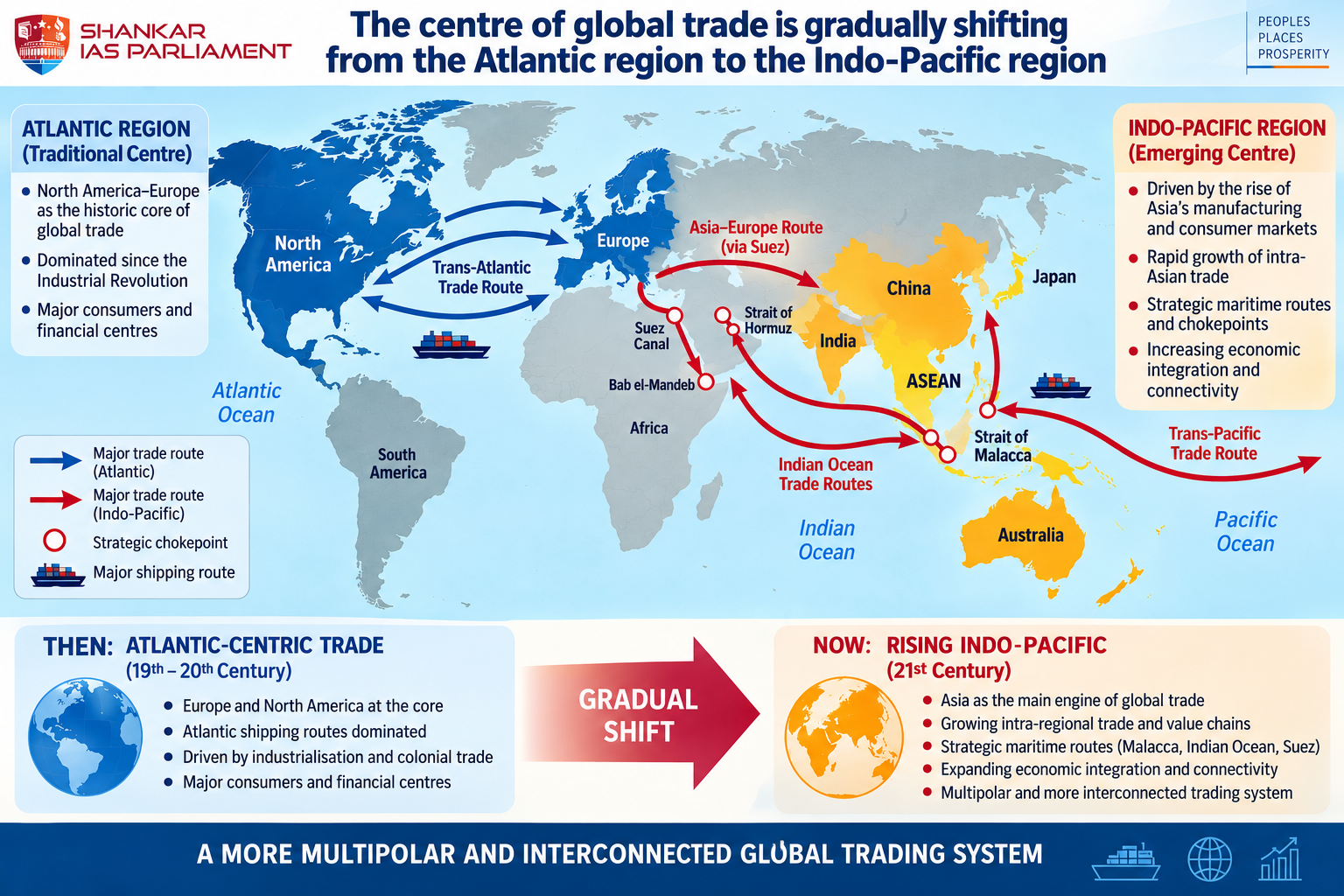
The past years were dominated by the Atlantic region, but at present the Indo-Pacific region is emerging as a dominant one because of the diversified nature of the region.
Main Body
Reasons/drivers for the shift:
- Change in demography – Indo-Pacific is home to over 60% of the world's population.
- Growth of consumer markets – Due to rapid urbanisation and a booming middle class in nations (like India, China, and Indonesia), the region has transformed from a manufacturing hub into a consumer market.
- Rise of Major Economic Powerhouses – China (largest trading nation), India (fastest-growing major economy), Industrial giants like Japan, South Korea, and Taiwan.
- Changing manufacturing geography – East & Southeast Asia, a major global manufacturing hub. The “China+1” strategy - diversification of production towards India, Vietnam, Indonesia and other Indo-Pacific economies.
- Vibrant Maritime Trade Routes – Roughly one-third of global shipping passes through the South China Sea; over 60% of global maritime trade transits through the Strait of Malacca.
- Regional Trade Agreements – The Indo-Pacific has pioneered massive modern trade pacts: RCEP (Regional Comprehensive Economic Partnership) (the world’s largest free trade bloc), CPTPP (Comprehensive and Progressive Agreement for Trans-Pacific Partnership), etc.
Challenges to this shift:
- Geopolitical tensions – Issues with China, Korea, the South China Sea, India-Pakistan, etc.
- Financial dominance – US Dollar and the Euro remain the primary global reserve currencies & Western institutions (IMF, World Bank, SWIFT) still dictate global economic governance.
- Unstable geography – In the Indo-Pacific region - Volcanos, earthquakes, etc.
- Navigation conflicts – South China Sea.
- Environmental threats
- Resource conflicts & extraction.
But the shift is not absolute
- The Atlantic economy remains highly influential, with the US and EU retaining enormous shares of global consumption, finance, technology and high-value services.
- Transatlantic trade and investment remain substantial.
- Global supply chains are multipolar rather than simply moving from West to East.
- Energy trade involving the Middle East, European markets and Atlantic economies demonstrates the continued importance of regions outside the Indo-Pacific.
Conclusion:
Give a balanced conclusion with some way forward measures.
The 21st century is witnessing a “maritime and economic reorientation” towards the Indo-Pacific.
The future global trading system is likely to be multipolar, with the Indo-Pacific becoming its principal growth centre while the Atlantic remains a major pillar.
17. Analyze the major drivers of human-induced land-use changes in India and their geographical consequences. (250 words, 15 marks)
Direction: Intro------Major drivers + Geographical consequences-------Conclusion.
Introduction:
Brief about land-use changes – natural and human-induced.
Main Body
Major drivers:
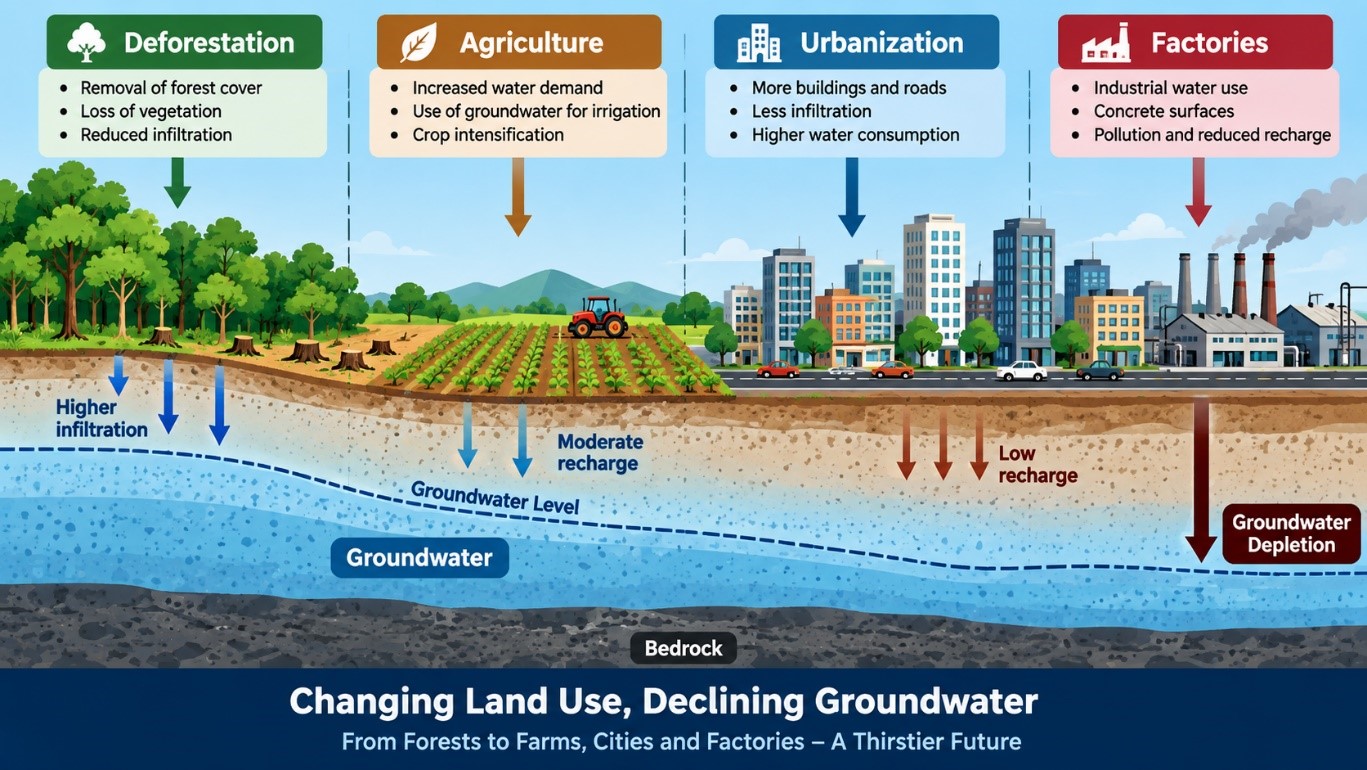
- Population growth
- Infrastructure development – Construction of highways, railways, airports, dams, and ports.
- Agricultural expansion and intensification – Encroachment of forests, grasslands, and fallow lands for agriculture.
- Industrialisation – Establishment of industries, SEZs, industrial corridors, and logistics hubs.
- Resource extraction & mining – Extraction of coal, iron ore, bauxite, and other minerals leads to land degradation and forest clearance.
- Plantation & commercial forestry – Coffee & tea plantations.
- Socio-economic development.
Geographical consequences:
- Global warming
- Urban Heat Islands effect
- Soil degradation
- Urban flooding
- Coastal ecosystem degradation
- Water stress
- Hydrological disruption.
- Habitat destruction
Conclusion:
Give a balanced conclusion.
India's challenge is not merely managing land as a resource, but governing it as the foundation of ecological sustainability, economic development, and social equity.
18. Is caste disappearing in urban India? Illustrate your answer with examples. (250 words, 15 marks)
Direction: Intro------Yes, caste is disappearing + No, it is not------Conclusion.
Introduction:
Describe the caste system in India (or) urbanisation links with caste.
Give answer – Yes (or) No.
Main Body
Yes, caste is gradually disappearing in urban India
- Decline in hereditary caste-based occupation – Individuals from traditionally agrarian/service castes entering IT, medicine, administration and business
- Social interaction – Workplaces, universities and public spaces facilitate interaction - Multicultural workplaces in Bengaluru, Mumbai, Hyderabad, etc.
- Education – Common educational institutions facilitate interaction across caste groups.
- Restrictions on commensality – Eating and socialising across caste boundaries is common - mixed-caste workplaces, restaurants and hostels.
- Residential interaction – Apartment-based living.
- Inter-caste marriage – Greater opportunities for interaction and partner choice among sections of urban educated youth.
- Jajmani system – Decline of hereditary service relationships - market-based provision of traditional services.
- Rise of middle class – State-mandated reservation policies and access to higher education – to an affluent, educated Dalit and Bahujan middle class to improve their lifestyle.
No, caste has not disappeared; it has changed its form
- Marriage remains caste-oriented – Urban educated families may accept inter-caste interaction while still preferring marriage within the community. Eg: Caste-based matrimonial platforms.
- Residential segregation – Informal networks, community associations and preferences can produce caste-based clustering.
- Certain neighbourhoods may develop strong concentrations of particular caste or community groups.
- Caste as Social Capital – Migrants depend upon relatives and caste/community associations for employment information, accommodation, financial assistance, etc.
- Political mobilisation – Caste associations and organisations continue to mobilise around representation, reservations and welfare demands.
- Persistence of Discrimination – Experiences of discrimination can continue in employment, housing, education and everyday social interaction.
- New forms of caste assertion – Caste identities may become more publicly organised rather than simply disappearing via digitalisation.
Conclusion:
Give a balanced conclusion based on the answer and give some suggestions.
“Urbanisation may weaken caste as a system of hierarchy, but it can preserve caste as an identity and network.”


