19. Critically examine the challenges of demographic transition in contemporary India. (250 words, 15 marks)
Directions: Intro-----Challenges + Critical examine-----Conclusion.
Introduction:
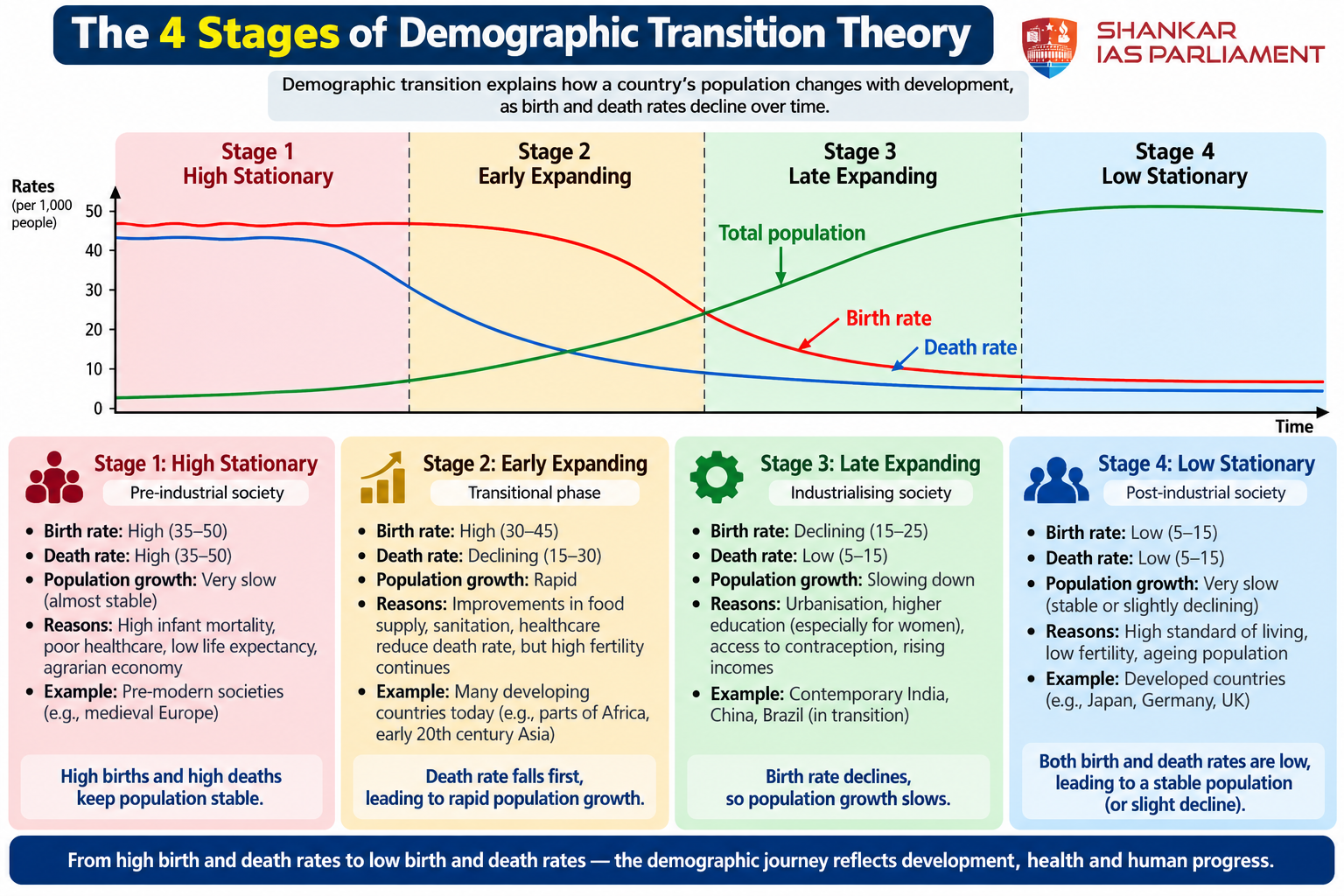
Describe demographic transition.
Contemporary India is currently spanning the late third and early fourth stages of the Demographic Transition Model.
National Total Fertility Rate (TFR) has dropped to 1.9, falling below the replacement level of 2.1.
Main Body
Key Challenges
Critically Examine
Conclusion:
Give a balanced conclusion and suggest some way forward measures.
20. Evaluate the impact of globalisation on Indian youths with reference to social, political, economic and cultural spheres. (250 words, 15 marks)
Direction: Intro-----Impacts-----Conclusion.
Introduction:
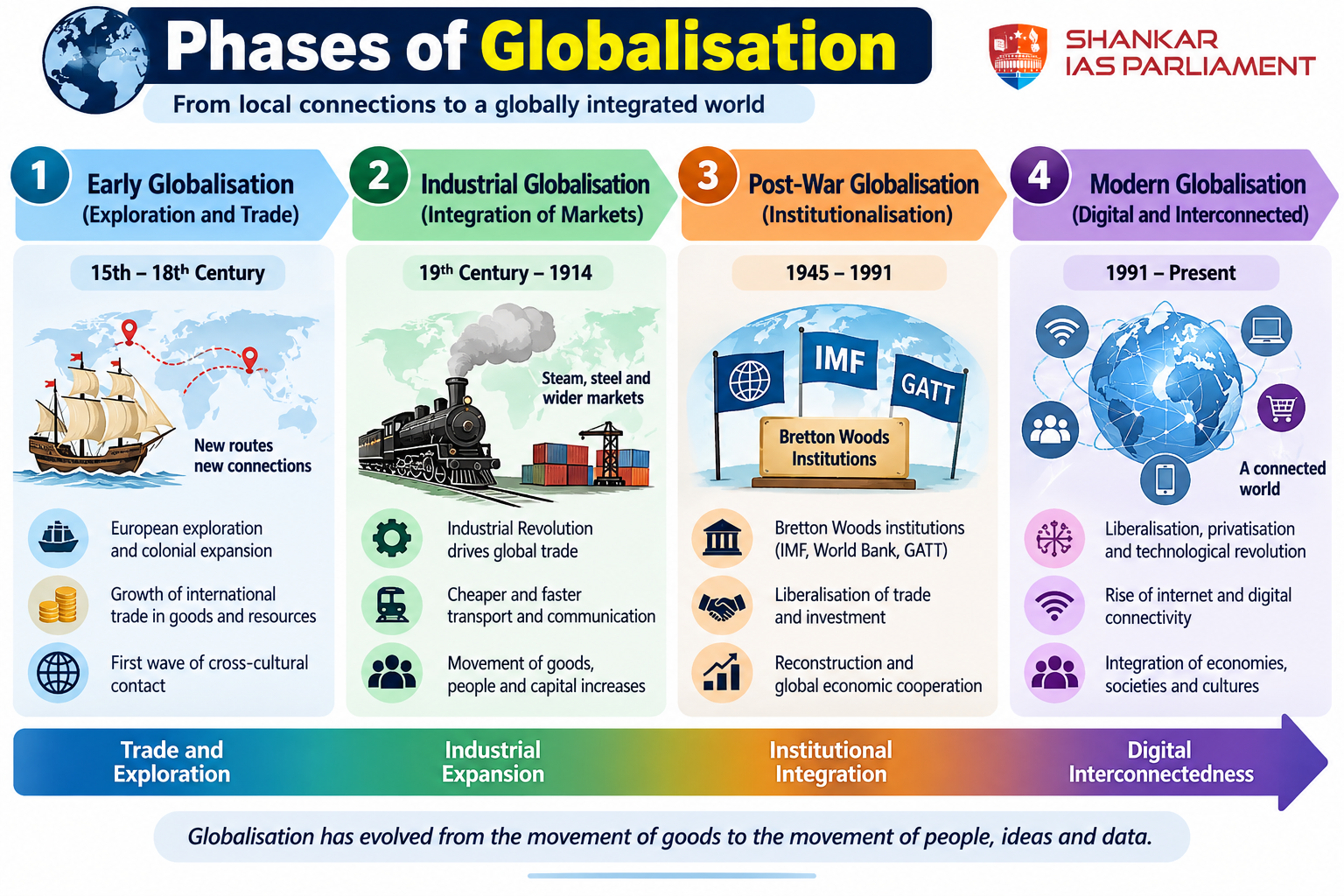
Briefly describe globalisation.
Main Body
Impacts
|
Spheres |
Positive impacts |
Challenges |
|
Social |
Awareness of gender equality, human rights and social justice Wider access to global education, knowledge and social networks. Access to diverse food & lifestyle patterns. |
Consumerism and status-driven lifestyles – westernisation. Social-media comparison, misinformation and online vulnerabilities
|
|
Political |
Awareness of democratic values, human rights, civil society activities. Digital platforms enable youth participation and mobilisation Exposure to international political debates |
Ideological polarisation Rapid spread of misinformation & disinformation Digital activism may not always translate into sustained institutional participation |
|
Economic |
Expansion of IT, startups, BPO, e-commerce and gig economy Access to global jobs, markets and skills. Greater entrepreneurial opportunities and exposure to global work practices |
Jobless/unequal growth and informalization Gig work - income insecurity and limited social protection Skill mismatch and digital divide |
|
Cultural |
Cross-cultural exchange and greater appreciation of global diversity Fusion of Indian and global cultural forms in music, cinema, fashion and food Gains global platforms through diaspora and digital media – Yoga, dance, etc. |
Concerns over cultural homogenization. Commercialisation/westernisation of traditions Possible weakening of some local languages, practices and traditional knowledge |
Conclusion:
Give a balanced conclusion.
Globalisation has transformed Indian youth from a largely domestic social group into an increasingly globally connected generation


