Prelims: Current events of National and International importance| Polity & Governance
Why in News?
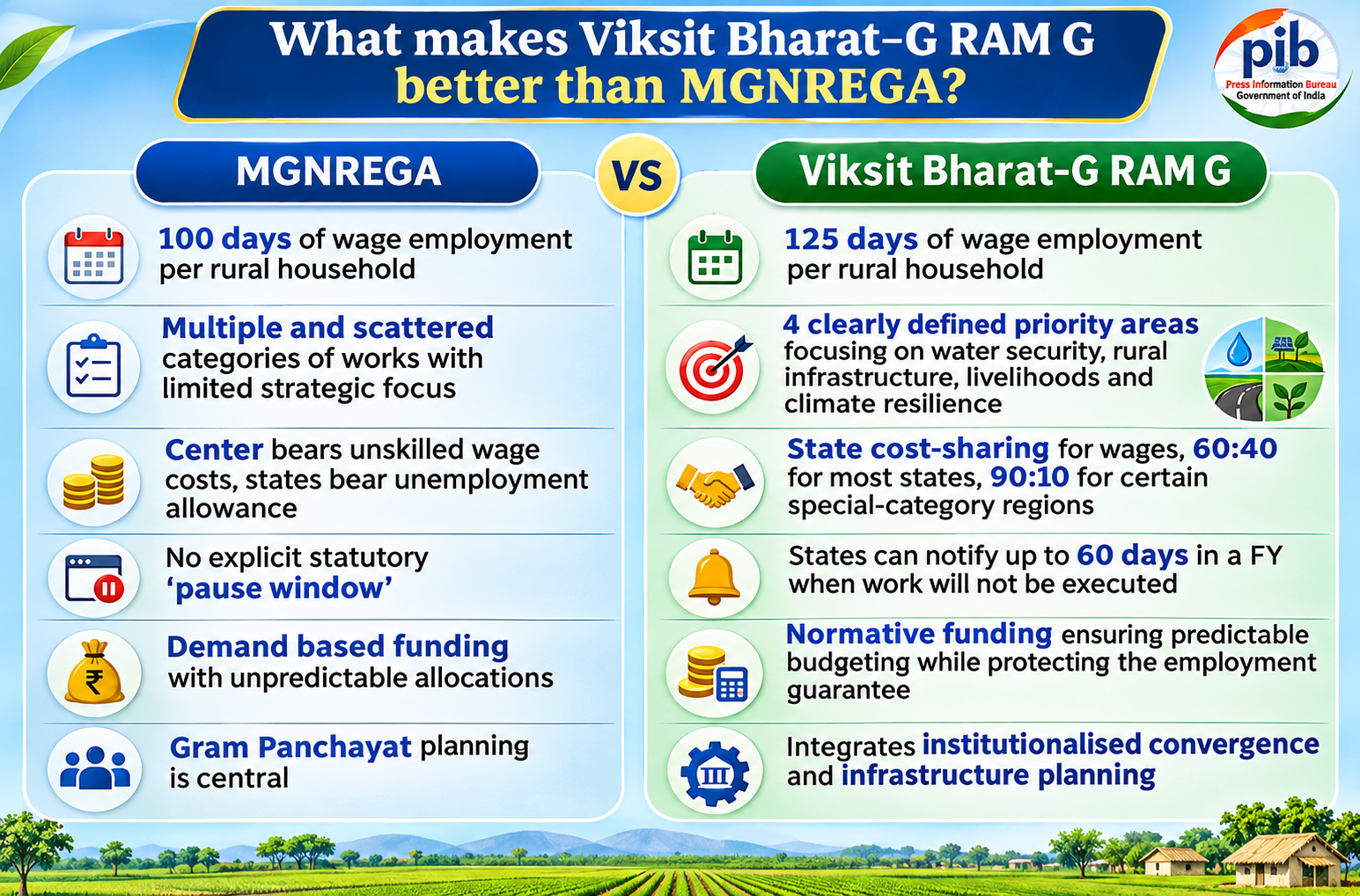
The Ministry of Rural Development notified the VB–G RAM G – Grievance Redressal Rules, 2026 on November 2, 2026, under the VB-G RAM G Act, 2025 (which replaced MGNREGA).
- Features of the 2026 Rules
- Time-Bound Resolution – Enquiries must be completed within 7 working days, and full resolution of grievances must happen within 15 days of receipt.
- Three-Tier Institutional Mechanism– States must set up redressal systems across three levels–
- Gram Panchayat Level– Initial complaint registration and handling via a designated Grievance Redressal Officer (GRO).
- Block Level– Examination and handling of escalated issues.
- District Level– Higher-level oversight supervised by the District Programme Coordinator.
- Multiple Submission Channels– Complaints can be submitted in person, via Speed Post, through telephone helplines, or on a designated digital public infrastructure platform.
- No Rejection Clause– A grievance cannot be refused registration due to format, language, manner of submission, or procedural deficiencies.
- Mandatory Digital Entry & Tracking– Physical complaints received at the local level must be logged onto the digital platform on the same day or the next working day.
- Complainants receive an acknowledgement containing a registration number and tracking details.
- Automatic Escalation– If a grievance remains unresolved after 15 days, it automatically escalates to the next higher administrative authority.
- Appeals– Further appeals follow the provisions outlined in Schedule I of the VB-G RAM G Act, 2025.
- Notable Omissions from MGNREGA Rules– The new framework dropped previous requirements for mandatory FIR registration in cases with prima facie evidence of financial irregularities, action-taken reports placed before panchayat meetings, and a fixed "designated day" each week for receiving complaints.
Reference
News on Air| VB–G RAM G – Grievance Redressal Rules, 2026



