Prelims: Current events of national and international importance | Science
Why in news?
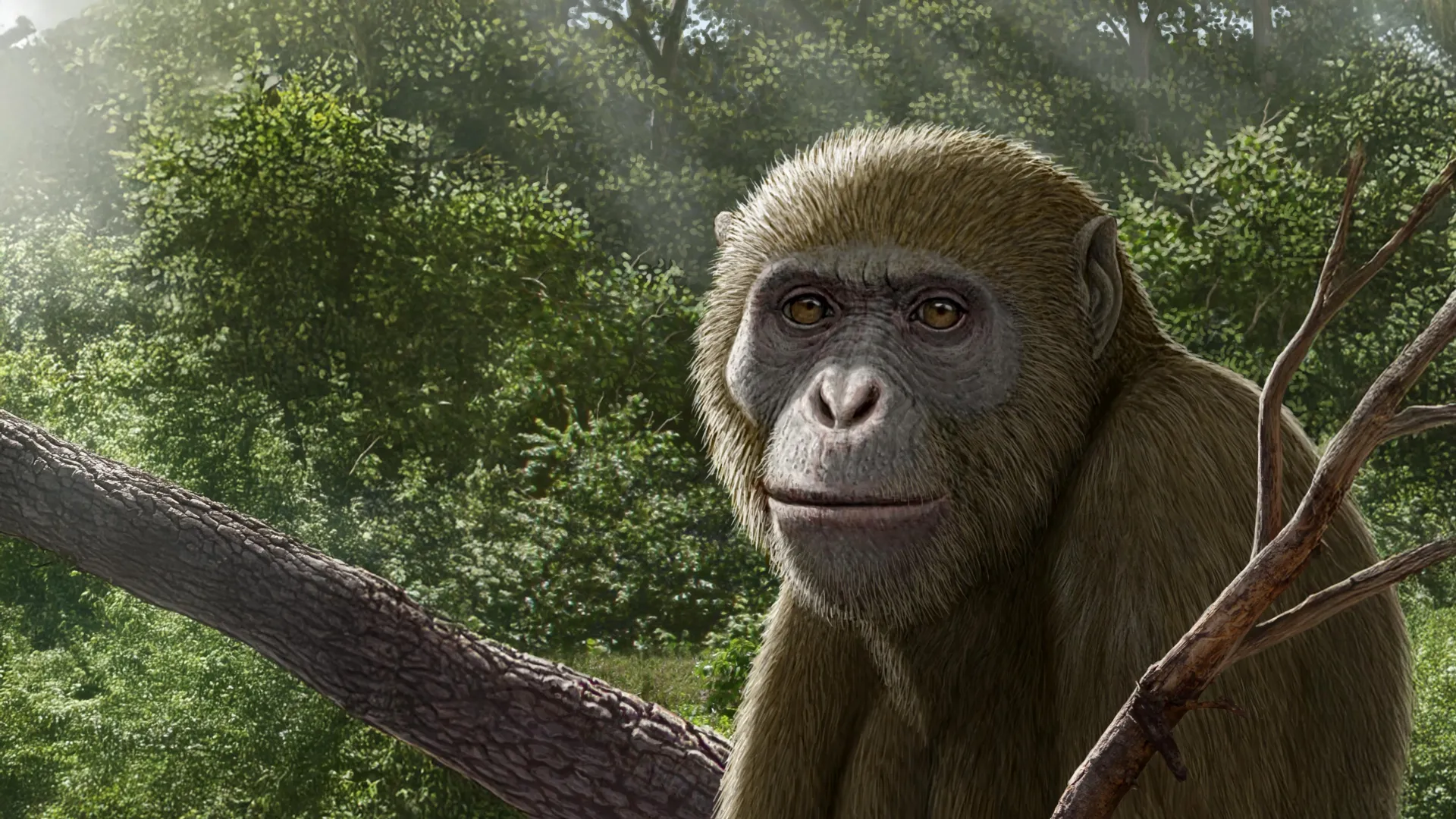
Recently, an ancient ape fossil has been discovered in Egypt that could rewrite the story of human origins.
Species name – Masripithecus moghraensis.
Age – It lived about 17 to 18 million years ago during the Early Miocene.
Discovered location – Fossils of the species were discovered at the Wadi Moghra archaeological site in Egypt, making it the first definitive fossil ape species ever discovered in North Africa.
Naming – Its genus name combines 'Masr', the Arabic name for Egypt, with píthēkos, the Greek word for ape, and the species name honours Wadi Moghra, where the fossils were found.
Key details of discovery
Fossils identified – Only fossil jaw bones were uncovered during excavations, but the jaws had an unusual combination of features, including a remarkably large canine and molars with rounded chewing surfaces and pronounced textures.
These features helped distinguish the animal from other apes of similar age.
Diet – The study interprets its chewing anatomy as evidence of a flexible, mainly fruit-based diet, with the ability to process harder foods such as nuts or seeds when needed.
Challenging existing theories – The discovery has significant implications for understanding ape origins.
Previously, scientists believed that the earliest apes and their close relatives were mainly concentrated in East Africa and regions farther south.
While fossils of ancient monkeys had been found in North Africa from the Early Miocene period, there was no clear evidence of apes living there at the same time.
New Possible Homeland – This discovery suggests North Africa and the Middle East were most likely the geographic home of the common ancestor of all modern apes, rather than East Africa alone.
Significance for human evolution – This adds to the understanding of the origins of Hominoidea, the evolutionary group that includes gibbons, orangutans, gorillas, chimpanzees, and humans, and the last common ancestor of all living apes and its descendants.
Future research – Scientists hope further exploration of North Africa and the Middle East for fossils could reveal more species and help find when the modern ape family tree first began to emerge.