Why in News?
India has the potential to become a global hub for rare-disease drug development and manufacturing by leveraging its pharma capabilities and large patient base.
What is the Status of Rare Diseases and Orphan Drugs?
- Rare Disease Drug – It, referred as an orphan drug, is a pharmaceutical agent specifically developed to diagnose, prevent, or treat a rare disease or condition.
- Definition – A rare disease is a condition affecting fewer than 65 to-100 per 100,000 people, As per World Health Organization (WHO).
- Global status –
- Around 8,000 rare diseases affect hundreds of millions globally.
- Orphan drugs face limited commercial incentives due to small patient populations and high R&D costs.
- The U.S. Orphan Drug Act, 1983 introduced incentives such as tax benefits, grants and market exclusivity.
- India –
- Around 1,004 rare genetic disorders have been reported in India.
- High treatment costs often exceed government support, leading to dependence on crowdfunding.
- India has strong capabilities in generics, biosimilars and advanced therapies, but rare-disease drug development remains limited.
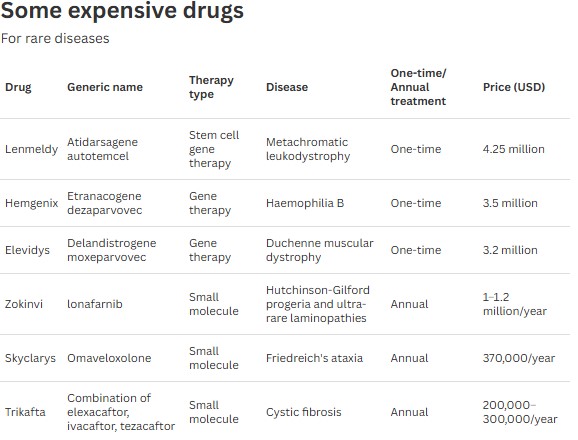
What is the Significance of Developing Rare-Disease Drugs?
- Improving healthcare access – Domestic production can reduce treatment costs and improve access to expensive medicines.
- Strengthening self-reliance – Indigenous drug development can reduce dependence on imported therapies and strengthen pharmaceutical capabilities.
- Promoting research and innovation – India’s large patient population, genetic diversity and patient registries provide opportunities for clinical trials and drug discovery.
- Enhancing global competitiveness – Cost-effective manufacturing can expand pharmaceutical exports and strengthen India’s position in specialised medicines.
- Ensuring healthcare equity – Affordable treatments can reduce the financial burden on patients and improve access to advanced healthcare.
- Generating investment and employment – Research centres, biotechnology facilities and specialised manufacturing can attract investment and create skilled jobs.
What are the Key Areas of Opportunity Developing These Drugs?
- Clinical research – Large patient pools and disease registries can support clinical trials and drug development.
- Domestic manufacturing – Generic, biosimilar and advanced-therapy capabilities can enable affordable small-batch production.
- Global collaboration – Partnerships can promote technology transfer, research and local manufacturing of existing orphan drugs.
What are the Challenges Associated?
- High R&D costs – Drug discovery and clinical trials require significant investment despite limited patient populations.
- Limited commercial viability – Small markets and uncertain demand reduce incentives for private investment.
- High treatment costs – Advanced therapies, particularly gene therapies, can cost crores of rupees.
- Clinical-trial difficulties – Identifying suitable patients, maintaining registries and determining trial endpoints remain challenging.
- Limited treatment availability – Most rare diseases lack specific approved therapies.
- Regulatory complexities – Unclear procedures and lengthy approval processes can delay access to medicines.
- Manufacturing constraints – Specialised infrastructure, quality control and small-scale production increase costs.
- Limited financial protection – Inadequate insurance coverage and dependence on crowdfunding increase the burden on patients.
What are the Initiatives taken in this Regard So far?
- National Policy for Rare Diseases, 2021 – Provides financial assistance of up to ₹50 lakh per eligible patient for specified treatments through designated Centres of Excellence.
- New Drugs and Clinical Trials Rules, 2019 – Rule 101 allows certain drugs approved in six specified countries, including the U.S. and the U.K., to be considered for Indian approval.
- These drugs doesn’t require repeated clinical trials, subject to applicable regulatory requirements.
- Centres of Excellence – These provide specialised diagnosis, treatment and care while supporting research and coordination of rare-disease services.
- Government Crowdfunding Platform – Enables eligible patients to mobilise additional financial support for expensive treatments.
- Global Orphan Drug Frameworks – The U.S. Orphan Drug Act and other countries similar frameworks provide incentives for orphan-drug research and development.
What Measures can be Taken?
- Streamline regulations – Establish transparent approval procedures while maintaining strict standards for safety, efficacy and quality.
- Provide financial incentives – Introduce tax benefits, research grants and production-linked incentives for orphan-drug development and manufacturing.
- Strengthen clinical research – Expand patient registries and promote collaboration between pharmaceutical companies, hospitals and research institutions.
- Promote public-private partnerships – Encourage multinational companies to establish drug-development centres and transfer technology to Indian manufacturers.
- Ensure affordable access – Introduce government procurement and advanced market commitments to create predictable demand and improve affordability.
- Strengthen domestic manufacturing – Support specialised infrastructure, small-batch production and high-quality manufacturing of orphan drugs.
- Promote fair pricing – Develop pricing and benefit-sharing arrangements that ensure Indian patients participating in research can access resulting treatments.
- Expand international collaboration – Encourage joint research, clinical trials and technology transfer to strengthen India’s role in global rare-disease treatment.
What lies ahead?
- India can build on its strength in generic medicines to develop a globally competitive rare-disease pharmaceutical sector.
- The ultimate objective is to ensure that pharmaceutical innovation translates into affordable and equitable treatment for rare-disease patients.
Reference
The Hindu| Rare-disease drugs



