India’s Journey Towards Viksit Bharat
India’s literacy journey has progressed significantly since Independence.
The PLFS 2025 places India’s overall literacy rate at 81.1%, while initiatives such as ULLAS, NIPUN Bharat and NEP 2020 seek to achieve universal literacy, foundational learning and lifelong education.
Understanding Literacy
- The Department of School Education and Literacy defines literacy as the ability to read, write and compute with comprehension, along with critical life skills such as digital and financial literacy.
- 95% literacy in a State/UT is considered equivalent to full literacy.
- UNESCO views literacy as a fundamental right and a foundation for equality, inclusion, employment and participation in society.
India’s Progress in Literacy
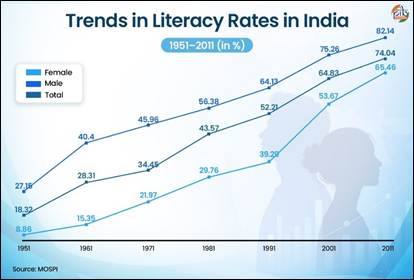
- India’s literacy rate increased from 18.32% in 1951 to 74.04% in 2011.
- Male literacy increased from 27.15% to 82.14%, while female literacy rose from 8.86% to 65.46%.
- Rural literacy increased from 12.10% to 67.8%, while urban literacy reached 84.1% in 2011.
- According to PLFS 2025, overall literacy reached 81.1%.
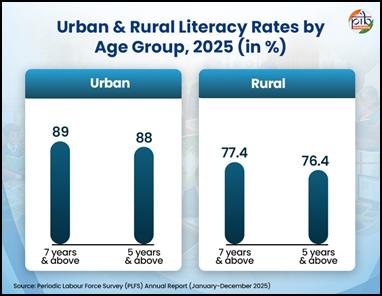
- Literacy among persons aged 7 years and above was 89% in urban areas and 77.4% in rural areas, showing a continuing rural-urban gap.
- Gender disparities also remain, particularly in rural areas, where literacy among males was 84.8% compared with 70.3% among females.
Improving School and Higher Education
School Education
According to UDISE+ 2025-26:
- More than 24.72 crore students were enrolled in schools.
- GER stood at 91.7% at the Preparatory stage, 89.6% at the Middle stage and 71.7% at the Secondary stage.
- Secondary-level dropout remained relatively higher at 7%.
- Transition from Middle to Secondary stage was 88.3%, highlighting the need to strengthen retention at higher school levels.
Higher Education
- Enrolment increased from 3.42 crore in 2014-15 to 4.50 crore in 2023-24.
- Higher education GER increased from 23.7% to 30%.
- The expansion of participation among women and disadvantaged groups supports the NEP 2020 target of 50% higher education GER by 2035.
Key Government Initiatives
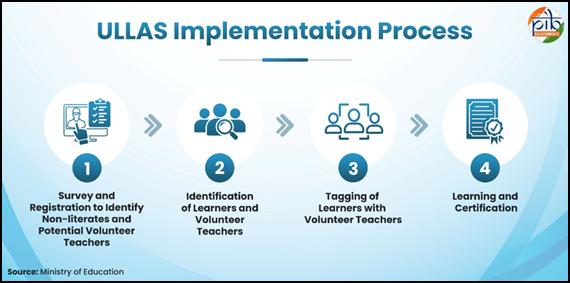
ULLAS – New India Literacy Programme
- Targets adult learners aged 15 years and above who missed formal schooling.
- Provides functional literacy, numeracy, digital and financial literacy and lifelong learning.
- Promotes Janbhagidari, volunteerism and “Jan Jan Saakshar”.
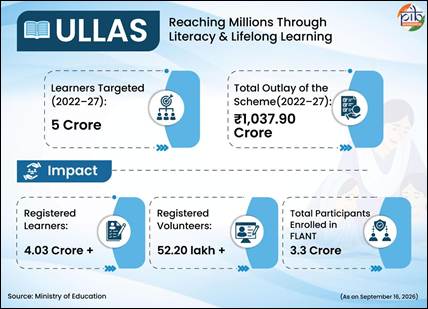
- Targets 5 crore learners during 2022-27, with an outlay of ₹1,037.90 crore.
- Over 4.03 crore learners and 52.20 lakh volunteers are registered.
- 10 States/UTs declared themselves fully literate between 2024 and 2026.
NIPUN Bharat
- Launched in 2021 under Samagra Shiksha.
- Focuses on foundational literacy and numeracy (FLN) for children aged 3–8 years.
- Seeks to ensure foundational skills by Grade 2.
Other Supporting Initiatives
- Samagra Shiksha – equitable and quality school education.
- PM SHRI – development of more than 14,500 exemplar schools.
- PM e-VIDYA – multi-mode digital and on-air education.
- PM POSHAN – nutritional support for 11.20 crore students, improving school participation.
Literacy and Viksit Bharat
- Literacy contributes to SDG 4 by promoting inclusive and equitable quality education and lifelong learning.
- It also strengthens women’s empowerment, employability, productivity, innovation and social inclusion. Digital, financial and vocational literacy can improve participation in the modern economy and support emerging green jobs and sustainable development.
Way Forward
- Bridge regional and gender gaps through targeted interventions.
- Strengthen foundational learning and teacher capacity.
- Improve retention, particularly at the secondary level.
- Expand digital, financial and functional literacy among adults.
- Strengthen community participation and lifelong learning.
- Ensure that literacy translates into skills, livelihoods, empowerment and meaningful participation.
Reference
PIB



