Mains – GSIII – Agriculture| Food Security
Why in News?
The International Day of Awareness of Food Loss and Waste, observed annually on September 29, highlights the need to reduce food loss and waste to strengthen food security, conserve natural resources and mitigate climate change.
What is the Status of Food Loss and Waste in India and the World?
- Global Status –
- According to the FAO, around 13.3% of food is lost globally after harvest and before reaching retail in 2023.
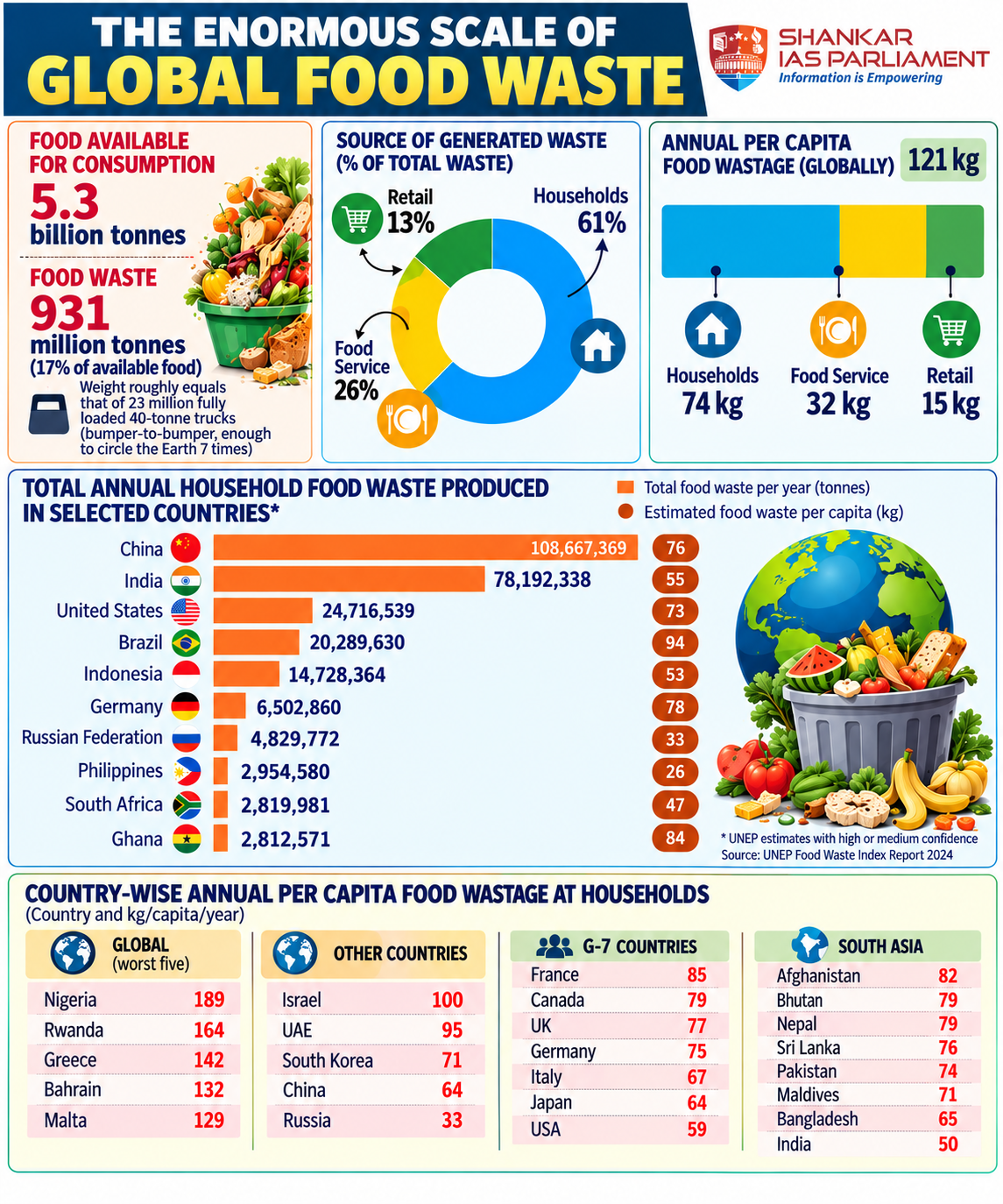
- According to the UNEP Food Waste Index Report 2024, approximately 1.05 billion tonnes of food, equivalent to 19% of food available to consumers, was wasted in 2022.
- Households accounted for 60% of global food waste, followed by food services (28%) and retail (12%).
- Food loss and waste together contribute around 8–10% of global greenhouse gas emissions, while also increasing pressure on land, water and biodiversity.
- Status in India –
- India produces sufficient food for its population of around 1.4 billion, but significant losses occur during harvesting, storage, transportation, processing and marketing.
- India is the only country to have conducted three nationally representative post-harvest loss surveys, during 2005–07, 2012–14 and 2020–22, respectively.
- A fourth round of the national survey is currently under way.
- However, data on food waste generated by households, retail outlets, hotels and restaurants remains limited.
What is the Significance of Reducing Food Loss and Waste?
- Strengthening Food and Nutritional Security – Reducing food losses increases food availability without requiring additional agricultural production.
- Conservation of Natural Resources – Preventing food loss conserves the land, water, energy, fertilisers and labour used in food production and reduces pressure on natural ecosystems.
- Climate Change Mitigation – Reducing food waste prevents methane emissions from landfills and supports India’s climate commitments through resource-efficient and low-carbon food systems.
- Improving Farmers’ Income – Better post-harvest management reduces economic losses, improves marketable surplus and enhances farmers’ income.
- Promoting Circular Economy – Converting unavoidable organic waste into compost, biogas and energy creates additional economic value.
- Achieving Sustainable Development Goals – Reducing food loss and waste contributes to SDG 12.3, to halve global food waste at retail and consumer levels.
What are the Key Areas of Food Loss and Waste Management?
- Farm and Post-Harvest Management – Promote scientific harvesting, drying, moisture control and proper handling.
- Improve affordable storage and preservation facilities for perishable produce.
- Storage, Transport and Processing – Strengthen cold chains, refrigerated transport and scientific warehousing.
- Expand food processing and digital traceability systems.
- Wholesale Markets – Improve segregation, collection and treatment of organic waste.
- Promote composting, biogas and other resource-recovery methods.
- Retail, Food Services and Households – Improve inventory management and food handling in retail, hotels and restaurants.
- Promote food redistribution, responsible consumption, proper storage and household composting.
What are the Challenges associated?
- Infrastructure gaps – Limited cold storage, transport, warehousing and processing facilities increase losses.
- Data gaps – Limited data on retail, food-service and household waste weakens planning.
- Financial constraints – High costs and limited credit restrict technology adoption by farmers and MSMEs.
- Weak coordination – Food-loss reduction is not fully integrated into agricultural, urban and climate policies.
- Poor waste management – Inadequate segregation and treatment send valuable organic waste to landfills.
- Technology and awareness gaps – Small producers and consumers often lack access to suitable technologies and knowledge.
What are the Initiatives taken in this Regard?
- National Post-Harvest Loss Surveys – The Ministry of Food Processing Industries has conducted three national surveys to identify post-harvest losses and loss hotspots.
- SDG 12.3 – The UN aims to halve food waste and reduce food losses along supply chains by 2030.
- FAO and UNEP monitor progress through the Food Loss Index and Food Waste Index.
- FAO–SIDBI Collaboration – FAO and SIDBI are promoting drying, moisture control, efficient cooling and storage technologies.
- SIDBI supports MSMEs through financing for these technologies.
- Urban Food Waste Management – FAO is supporting cities with a Package of Practices for measuring, preventing, and reducing, redistributing and recovering food waste.
- Waste-to-Energy – Bio-CNG projects such as the Surat plant demonstrate the potential to convert organic waste into clean energy.
What Measures can be taken?
- Strengthen data – Expand food-waste measurement to retail, food services and households.
- Modernise infrastructure – Expand cold chains, storage, transport, processing and climate-resilient technologies.
- Mobilise finance – Provide affordable credit and investment support to farmers, FPOs and MSMEs.
- Promote circular economy – Redistribute surplus food and convert unavoidable waste into compost, biogas and energy.
- Improve urban governance – Strengthen segregation, collection and scientific treatment of organic waste.
- Integrate policies – Include food-loss reduction in agricultural, food-processing, urban and climate policies.
- Create awareness – Promote responsible consumption, food donation, proper storage and waste segregation.
What lies ahead?
- Reducing food loss and waste can improve food security, resource efficiency and climate resilience.
- India should use its growing data, technology and institutional capacity to strengthen infrastructure, finance, waste management and policy coordination.
- This can help build a sustainable and circular agrifood system.
Reference
The Hindu| Tackling Food Waste



