Jute is one of India’s most important natural fibres and has emerged as a major contributor to rural livelihoods, sustainable industrial development and India’s transition towards environmentally friendly materials.
Known as the “Golden Fibre” because of its characteristic golden colour and silky appearance, jute is biodegradable, recyclable, versatile and relatively inexpensive.
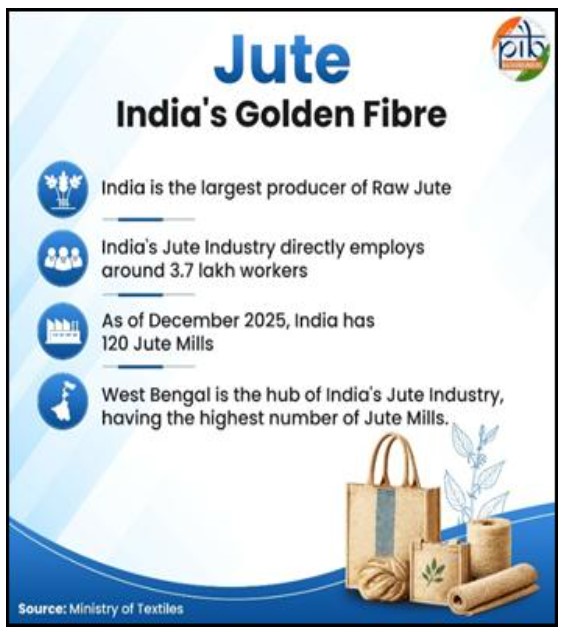
India is the world’s largest producer of raw jute and the leading producer of jute goods, making the sector strategically important for both the economy and environmental sustainability.
India’s position in the global jute industry
India has a dominant position in global jute production. During FY 2025–26, India produced 76 lakh bales of raw jute and 12.80 lakh metric tonnes of jute goods.
According to the Third Advance Estimate, combined jute and mesta production increased from 88.02 lakh bales in 2024–25 to 94.03 lakh bales in 2025–26.
India accounts for around 75% of estimated global jute-goods production. The industry is concentrated primarily in eastern India, especially West Bengal, which has 89 of India’s 120 composite jute mills.
The sector provides direct employment to approximately 3.70 lakh workers in organised mills and diversified jute units and supports nearly 40 lakh farm families involved in jute cultivation.
Jute is also important for domestic consumption. India consumed around 12.05 lakh MT of jute goods in FY 2025–26, accounting for approximately 94% of domestic production.
During the same year, India exported 1.71 lakh MT of jute goods worth ₹3,155.27 crore and 22,700 MT of raw jute worth ₹225.11 crore. This demonstrates that India possesses a largely self-sufficient jute ecosystem while also maintaining a significant export presence.
Historical evolution of jute in India
Jute cultivation in India has a long history, dating back to around the third century BC. However, it became an important commercial commodity during British rule, when its usefulness for industrial and military purposes encouraged the establishment of jute mills in Bengal.
The Partition of India in 1947 created a major disruption. Nearly 80% of the jute-growing areas of undivided Bengal went to East Pakistan, later Bangladesh, while most processing mills remained in India. This resulted in a shortage of raw material for Indian mills.
To address this problem, the government launched the “Grow More Jute” campaign in 1949, encouraging farmers to shift some land from paddy cultivation to jute. As a result, raw-jute production more than doubled from 6.7 lakh tonnes in 1951–52 to 14.56 lakh tonnes in 1961–62.
Another major intervention was the Jute Packaging Materials (Compulsory Use in Packing Commodities) Act, 1987, which created a stable market by requiring certain commodities to be packed in jute bags.
The policy continues to support demand, with the government mandating jute packaging for 100% of food grains and 20% of sugar.
Cultivation and farmer dependence
Jute cultivation is concentrated mainly in West Bengal, Bihar, Assam, Odisha and Jharkhand. It is generally sown between March and April and harvested within approximately 100–110 days. The crop grows best in hot and humid conditions with rainfall of around 700–1,500 mm during the growing period.
Since these conditions are particularly suitable for eastern and northeastern India, jute cultivation is largely concentrated in these regions and is predominantly rainfed. Most producers are small and marginal farmers, making government support particularly important for protecting their incomes.
Why jute is an important natural fibre?
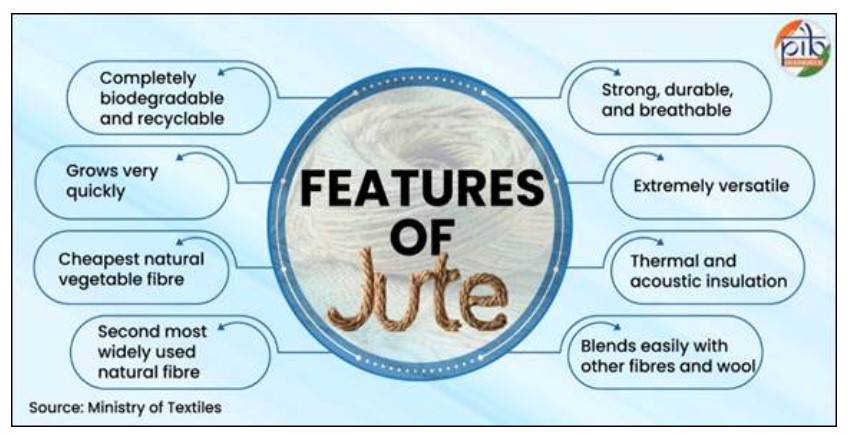
Biodegradable and recyclable
Strong and durable
Cost-effective and widely available
Breathable and capable of absorbing moisture
A good thermal and acoustic insulator
Low in static generation
Suitable for blending with natural and synthetic fibres
Its applications extend far beyond traditional sacks and packaging. Jute can be used in textiles, construction, agriculture, industrial products, packaging and technical textiles.
Its environmental advantages are particularly significant at a time when governments and industries are seeking alternatives to plastic and other non-biodegradable materials.
Jute as a food and health resource
Jute is not limited to fibre production. Its leaves are consumed as vegetables in parts of Africa, the Middle East and Southeast Asia and are recognised as a health food in Japan.
Jute leaves contain vitamins, carotenoids, calcium, potassium and dietary fibre, giving them nutritional and functional value. Technologies have also been developed to produce antioxidant herbal drinks and other healthcare products from jute leaves, indicating possibilities for diversification beyond conventional fibre-based industries.
Jute geotextiles: an emerging application
One of the most promising areas of jute diversification is Jute Geotextile (JGT), a technical textile used in infrastructure and environmental applications.
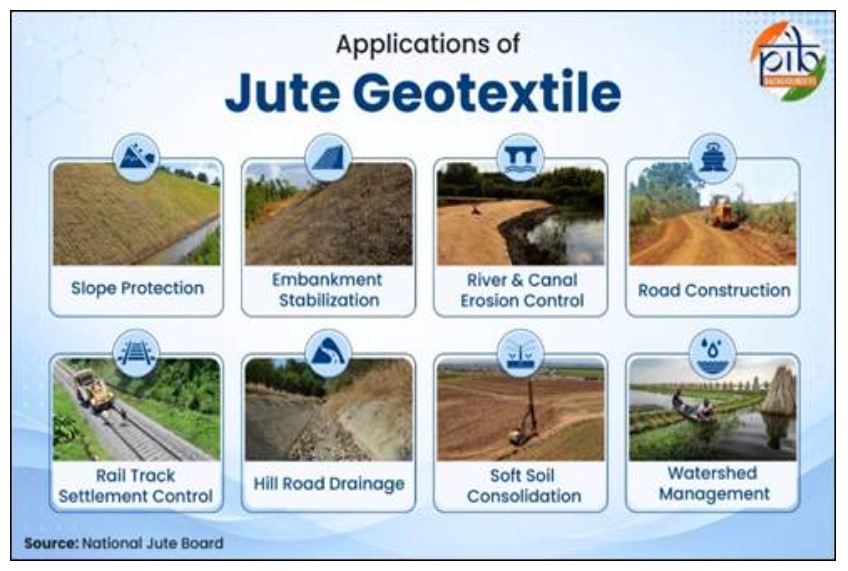
JGT can be used for:
Soil-erosion control
Slope and embankment protection
River-bank and canal protection
Road and railway construction
Soil stabilisation
Drainage systems
Rainwater-harvesting structures
Ecological restoration
Its key advantage is that it is biodegradable while providing useful engineering properties.
Its surface roughness and tensile strength help stabilise soil and reduce erosion.
It can also regulate soil temperature and reduce surface disturbance, thereby supporting seed germination and plant growth.
In road construction and railway formation, JGT can improve load distribution and control settlement, potentially reducing maintenance and lifecycle costs.
In drainage systems, it can regulate water movement while preventing soil migration.
The National Jute Board (NJB) has therefore been promoting JGT by providing technical assistance relating to design specifications, procurement, testing and installation.
Innovation in jute apparel
Jute is increasingly entering the fashion and textile sector. At the 2026 Commonwealth Games, Indian athletes and team members wore jute-viscose-blended apparel developed by the National Jute Board and designed by NIFT, New Delhi.
The initiative demonstrated that jute can be transformed into modern clothing while retaining its environmental credentials.
The development of biodegradable jute-viscose fabrics also provided international visibility to Indian jute manufacturers and showcased the potential of jute as a sustainable textile material.
Government support for farmers
The government has introduced several interventions to strengthen the jute value chain, beginning with support for farmers.
The Minimum Support Price (MSP) for raw jute has been fixed at ₹5,925 per quintal for FY 2026–27, providing a return of around 61.8% over the all-India weighted average cost of production.
This represents a significant increase from the MSP of ₹2,400 per quintal in FY 2014–15.
Government expenditure on MSP procurement has also increased substantially.
The amount paid to jute farmers rose from ₹441 crore during FY 2004–05 to FY 2013–14 to ₹1,342 crore during FY 2014–15 to FY 2025–26.
The Jute Corporation of India (JCI) is the nodal agency responsible for implementing the MSP policy.
When market prices fall below MSP, JCI purchases raw jute directly from farmers through its network of around 110 Departmental Purchase Centres across major jute-producing states.
National Jute Development Programme
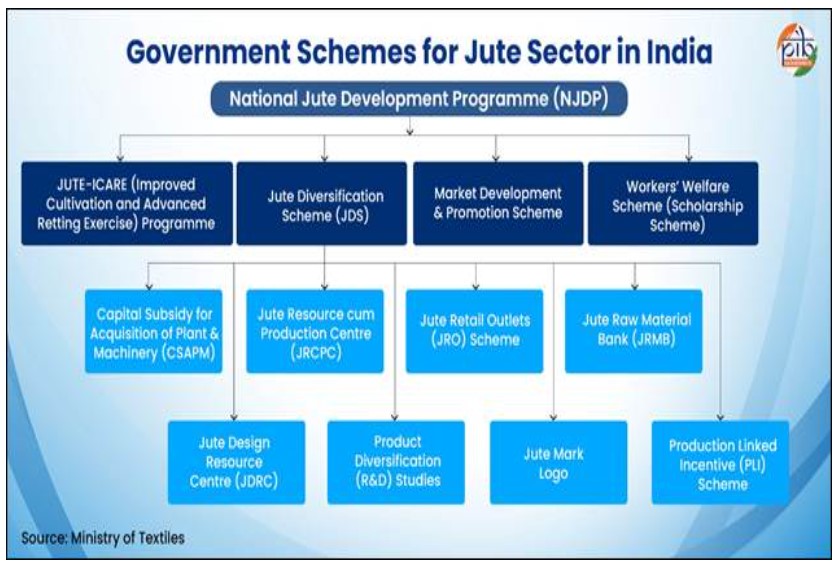
The government's broader strategy is implemented through the National Jute Development Programme (NJDP), the umbrella programme for development and promotion of the jute sector.
With an outlay of ₹485.58 crore for FY 2021–22 to FY 2025–26, the programme focuses on improving productivity, increasing farmer incomes and encouraging diversification.
Two major components are JUTE-ICARE and the Jute Diversification Scheme.
The JUTE-ICARE scheme, launched in 2015–16, promotes scientific cultivation, mechanisation and improved retting techniques.
Farmers receive support through certified seeds, demonstrations and mechanised interventions.
Retting ponds are also encouraged through convergence with agricultural and irrigation programmes.
The Jute Diversification Scheme promotes processing, value addition, marketing and sales, helping the industry move beyond traditional packaging.
Supporting MSMEs, artisans and entrepreneurs
Government intervention also targets the downstream part of the value chain.
The Jute Raw Material Bank provides raw jute to small units, artisans, women’s self-help groups and MSMEs at economical rates.
This improves access to quality raw material for producing diversified jute products.
Other measures include:
30% capital subsidy on machinery for eligible jute mills and MSMEs producing diversified products.
Jute Resource-cum-Production Centres for training and cluster-based production.
Support for Jute Retail Outlets, including 25% sales assistance up to ₹9 lakh per unit.
Production-linked incentives for exports of diversified jute products.
Market-development assistance for domestic and international sales.
These interventions encourage entrepreneurship, rural employment and the creation of higher-value jute products.
Branding and market development
The Jute Mark India logo provides a system of authenticity and quality assurance.
It verifies jute content in blended products and signals compliance with relevant quality standards.
This can strengthen consumer confidence and improve the international identity of Indian jute products.
Domestic demand is also promoted through exhibitions and fairs. More than 57 regional jute fairs were organised during FY 2025–26, including participation in major events such as the India International Trade Fair, Surajkund Mela and Bharat Tex.
Such initiatives have helped artisan groups and small enterprises gain direct access to buyers, secure bulk orders and enter export markets.
Digital transformation of the jute sector
Technology is increasingly being used to improve efficiency and transparency.
JUTE-SMART, introduced in 2016, digitised the procurement and supply of jute sacking bags used for food-grain packaging.
By August 2026, more than 303 lakh bales of B-Twill jute bags, representing approximately 1.515 billion bags, had been procured through the system, with a value exceeding ₹1 lakh crore.
In 2026, JUTE-SMART was further upgraded. Transporters, raw-jute traders and importers were brought onto the digital platform, while registration and regulatory returns were digitised to improve ease of compliance.
Another important technological initiative is the Jute Crop Information System, developed by ISRO's National Remote Sensing Centre in collaboration with JCI and NJB.
It uses remote sensing and field data to monitor cultivation.
Two tools support this system:
BHUVAN JUMP — a mobile application for field-level monitoring.
PATSAN — a web-based platform providing near-real-time surveillance and analytics.
These technologies can improve crop assessment, planning and policy decisions.
Welfare and inclusive development
The jute sector supports not only farmers and industrial workers but also artisans, women’s self-help groups and small entrepreneurs.
Government programmes therefore include welfare measures such as scholarships and incentives for the girl children of workers in jute mills and diversified jute-product MSMEs who successfully complete secondary and higher-secondary examinations.
This reflects an attempt to make the jute industry a vehicle for broader social development rather than simply a source of industrial output.
Conclusion
The central opportunity is to move jute beyond its traditional identity as a packaging material and develop it into a modern, technology-enabled and globally competitive green industry.
With continued investment in innovation, value addition, farmer welfare, market access and digitalisation, India’s “Golden Fibre” can play an increasingly important role in sustainable infrastructure, rural development, employment generation and the global shift away from synthetic and plastic-based materials.