Mains: GS II – International Relations
Why in News?
The 18th BRICS Summit in New Delhi, gives India a huge opportunity to bring coherence back to the expanded group and give it direction if it is to be an effective body in shaping global events.
What is BRICS?
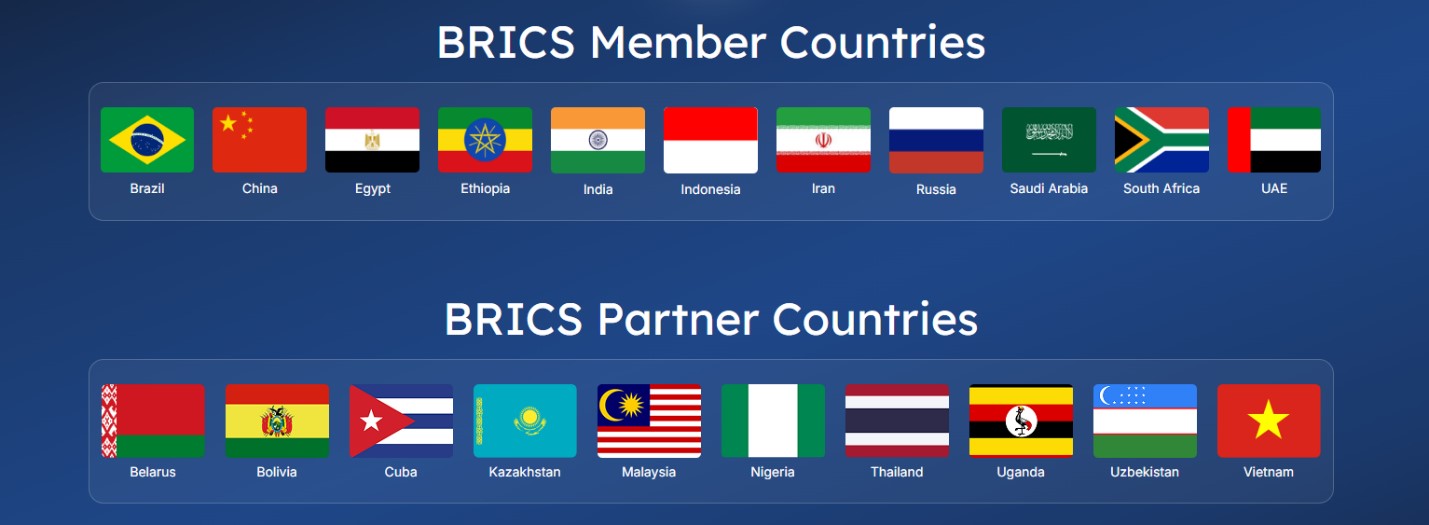
- BRICS – It is an organization that brings together eleven major emerging markets and developing countries of the world: Brazil, China, Egypt, Ethiopia, India, Indonesia, Iran, Russia, Saudi Arabia, South Africa and United Arab Emirates.
- It serves as a useful platform for consultation and cooperation on contemporary issues having global as well as regional significance, and issues of global political and economic governance.
- Evolution – BRIC was formalised at the first meeting of BRIC Foreign Ministers on the sidelines of the United Nations General Assembly (UNGA) in New York in 2006.
- The inaugural BRIC Summit was convened in Yekaterinburg, Russia, in 2009.
- Expansion – It was agreed to expand BRIC into BRICS with the inclusion of South Africa at the BRIC Foreign Ministers’ meeting in New York in 2010. Accordingly, South Africa attended the 3rd BRICS Summit in Sanya in 2011.
- Egypt, Ethiopia, Iran, Saudi Arabia and UAE became full member of BRICS from January 2024 and Indonesia in January 2025.
- Belarus, Bolivia, Kazakhstan, Cuba, Malaysia, Nigeria, Thailand, Uganda, Uzbekistan and Vietnam joined BRICS as Partner Countries in 2025.
- BRICS is a major global bloc of emerging economies that gives developing nations a collective voice to reshape international economic and political governance.
What is the significance of BRICS?
- Massive Global Share – BRICS accounts for roughly 40% of the world's GDP and nearly half of the global population.
- Outpacing Traditional Blocs – The group's economic output in purchasing power parity has surpassed the G7 nations.
- Resource Control – Member countries command major shares of global manufacturing, energy resources, and critical supply chains.
- South-South Cooperation – The bloc unites countries across Asia, Africa, Latin America, and the Middle East to advocate for shared interests.
- Reforming Global Institutions – BRICS pushes for fairer representation and voting power for developing nations in bodies like the United Nations Security Council, the IMF, and the World Bank.

- New Development Bank (NDB) – Founded to fund infrastructure and sustainable development projects independently of Western-led lenders.
- De-dollarization Efforts – Members promote alternative payment mechanisms like BRICS Pay and local currency trade to reduce reliance on the U.S. dollar.
- Diplomatic Balance – Rather than acting as an anti-Western military alliance, BRICS functions as a platform for economic and diplomatic cooperation to ensure a multi-centered global order.
What are the challenges and issues associated with BRICS?
- India-China Tensions – Border disputes and strategic competition between India and China limit deep security and political alignment.
- Conflicting Alliances – Members maintain contradictory foreign policies, such as India’s close ties with the United States versus Russia and China's anti-Western alignment.
- Leadership Rivalries – Major players like China, India, and Russia vie for leadership and influence over the direction of the Global South.
- Diverse Governance – The group includes authoritarian regimes and democracies, lacking shared values on human rights and governance.
- China's Hegemony – China accounts for over 60% of the bloc's total economic output, raising fears of economic dependency among smaller members.
- Low Intra-Bloc Trade – Trade among BRICS members remains low compared to their trade with Western economies.
- Currency Integration Hurdles – Plans to create a common currency or bypass the US dollar face massive hurdles due to disparate monetary policies and diverging national interests.
- Institutional Scale – The New Development Bank struggles to match the lending capacity and global scale of traditional institutions like the World Bank.
- Diluted Consensus – Rapid expansion to include new members with varied national interests makes consensus-based decision-making much harder.
- Lack of Secretariat – BRICS operates without a permanent formal secretariat, which slows down institutional follow-through and coordination
What could be done to strengthen BRICS?
- Alternative Payments – Operationalize a unified cross-border digital payment platform or independent messaging network to reduce heavy reliance on Western systems like SWIFT.
- Local Currencies – Expand trade settlements using national currencies among member states to protect against external economic shocks and sanctions.
- New Development Bank – Increase local-currency lending through the New Development Bank and establish dedicated credit rating structures tailored to emerging economies.
- Critical Minerals – Build reciprocal partnerships in renewable energy components, green tech, and critical minerals instead of exporting raw materials unprocessed.
- Food Security – Operationalize food-exchange and agricultural research platforms to stabilize food supplies and share climate-smart farming techniques.
- Trade Barriers – Rationalize tariffs and streamline regulatory standards to simplify business-to-business commerce across member nations.
- Responsible AI – Formulate human-centric artificial intelligence governance frameworks under shared platforms like an AI center or repository for science and research.
- Digital Public Infrastructure – Share successful digital identity, payment, and health models to bridge the technology gap across the wider Global South.
- Clear Expansion Rules – Consolidate clear modalities for integrating new member countries and formalizing partner-state relationships.
- People-to-People Ties – Institutionalize youth summits, academic networks, and cultural exchange programs to strengthen grassroots understanding.
What lies ahead?
- The Delhi summit should revive India's idea of “reformed multilateralism” and make BRICS a platform for Global South and middle-power countries seeking reform without choosing sides in the U.S.–China rivalry.
Reference
The Hindu| BRICS



