Mains: GS III – Environment
Why in News?
Ministry of Tribal Affairs (MoTA) has clarified that the FRA, 2006 does not explicitly mandate Gram Sabha consent for forest clearance, amid concerns over delays in major hydropower projects due to pending Gram Sabha clearances.
What is Forest Rights Act, 2006 (FRA 2006)?
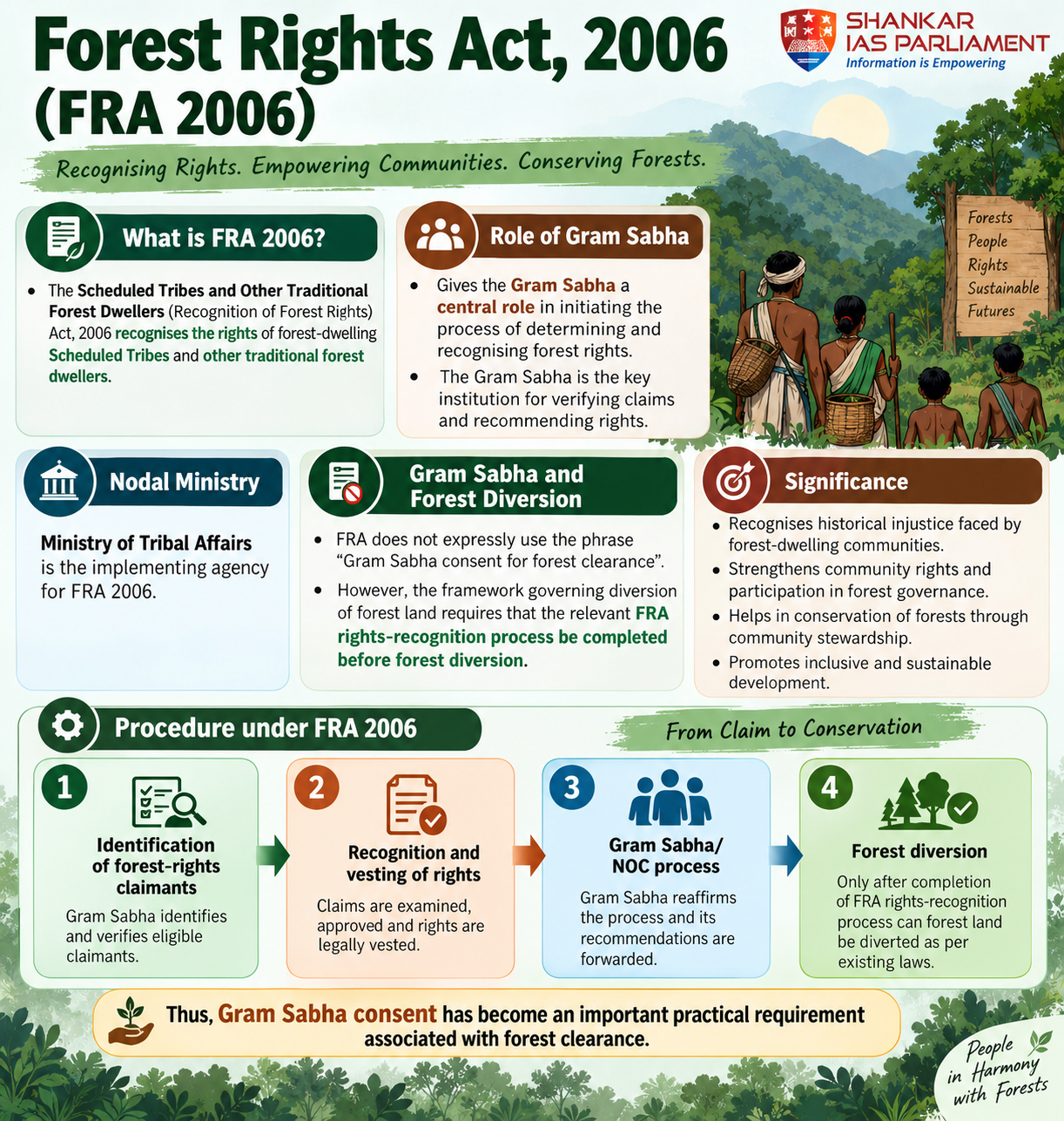
- FRA 2006 – Also called as Scheduled Tribes and Other Traditional Forest Dwellers (Recognition of Forest Rights) Act, 2006 recognises the rights of forest-dwelling Scheduled Tribes and other traditional forest dwellers.
- It gives the Gram Sabha a central role in initiating the process of determining and recognising forest rights.
- Nodal Ministry – Ministry of Tribal Affairs is the implementing agency.
- Gram Sabha and Forest Diversion – FRA does not expressly use the phrase “Gram Sabha consent for forest clearance”.
- The framework governing diversion of forest land requires that the relevant FRA rights-recognition process be completed before forest diversion.
- Procedure –
- Identification of forest-rights claimants
- Recognition and vesting of rights
- Gram Sabha/NOC process
- Forest diversion
- Thus, Gram Sabha consent has become an important practical requirement associated with forest clearance.
|
Why has the Issue Emerged?
|
- The Parliamentary Standing Committee on Public Undertakings report on the National Hydroelectric Power Corporation (NHPC), highlighted delays in hydropower projects.
- NHPC reported that obtaining forest clearance for under-construction projects takes an average of 106 months.
- The Committee identified the requirement of 100% Gram Sabha consent as a major bottleneck.
- In the Teesta-IV Hydroelectric Project, seven Gram Panchayats had given consent, while three were still pending, delaying the project.
- Committee suggested consent from 70% to 75% of the affected Gram Sabha’s would be sufficient to obtain forest clearance for “large hydropower projects of national importance”
- Concerns with a 70–75% Consent Threshold
- Minority communities may be overruled.
- Numerical consent may not reflect the rights affected.
- Gram Sabhas may face pressure to approve projects.
- Reduced consent could set a wider precedent.
- Community participation and informed decisions may weaken.
- MoTA's position is that the FRA does not itself prescribe a specific requirement of obtaining Gram Sabha consent for forest clearance.
- Therefore such matters do not fall directly within its administrative purview.
- Rising question – who is ultimately responsible for ensuring that forest-rights safeguards are respected when forest land is diverted for development projects?
|
What is the Significance of Gram Sabha Consent?
- Democratic participation – Gram Sabhas provide local communities with a mechanism to participate in decisions affecting their forests and livelihoods.
- Protection of tribal rights – Many forest-dependent communities derive livelihoods, food, fuel, cultural identity and customary rights from forests.
- Conflict reduction – Meaningful consultation can reduce conflicts between local communities, governments and infrastructure developers.
- Constitutional decentralisation – The role of Gram Sabhas is consistent with the broader objective of decentralised governance and community participation.
What could be done?
- Clarify the legal framework – The roles of MoTA, MoEFCC, State governments and Gram Sabhas should be clearly delineated.
- Ensure genuine consent – Consent/consultation should be free, informed and transparent, rather than treated merely as a procedural clearance.
- Time-bound decision-making – A statutory and transparent timeline can prevent indefinite delays while retaining safeguards.
- Strengthen Gram Sabhas – Provide communities with information regarding the project's environmental, social and livelihood impacts before taking a decision.
- Improve inter-ministerial coordination – MoTA and MoEFCC should establish a clear institutional mechanism to resolve disputes for implementation of FRA safeguards.
- Adopt project-specific safeguards – Instead of mechanically reducing the consent threshold, government should assess the extent of community rights affected.
What lies ahead?
- The controversy over Gram Sabha consent highlights the difficult balance between India's developmental needs and the statutory protection of forest-dependent communities.
- Faster forest clearance is important for infrastructure and energy security, but administrative efficiency should not come at the cost of weakening community rights.
- The way forward lies in clear legal responsibilities, genuine Gram Sabha participation, and stronger coordination between development and tribal-rights institutions.
Reference
The Hindu| FRA 2006 & Gram Sabha Consent of Forest Clearance



