Why in News?
The release of anaemia findings from the ICMR–National Institute of Nutrition (NIN) SAMPADA survey (2023–25) show lower overall prevalence across age groups than earlier surveys, while exposing stubbornly high rates among women and sharp regional disparities.
What is Anaemia?
- Anaemia - It is a condition marked by low haemoglobin or fewer healthy red blood cells carrying oxygen through the body reduces energy, concentration, work capacity, and maternal and child health outcomes.
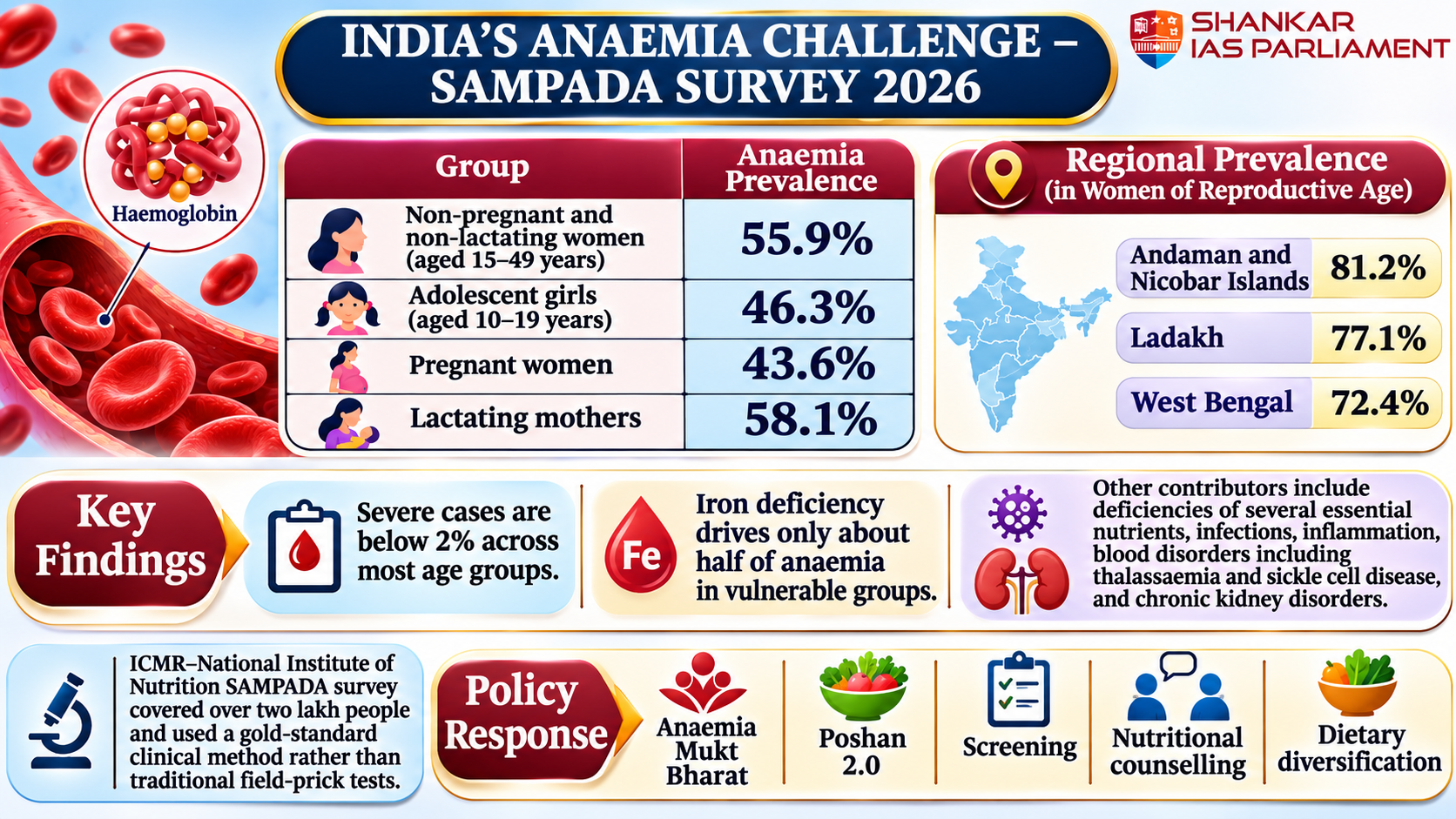
- While SAMPADA indicates lower prevalence across age groups and keeps severe anaemia below 2% in most groups, 55.9% of non-pregnant, non-lactating women aged 15–49 years and 58.1% of lactating women still have anaemia.
- Crucially, iron deficiency accounts for roughly half of anaemia cases in vulnerable groups, pointing to multiple nutritional and medical drivers.
What are the key highlights of the ICMR SAMPADA survey (2023–25)?
- Conducted across 183 districts in 35 States and Union Territories covering over 81,000 households and more than two lakh individuals.
- SAMPADA provides nationally representative estimates across life stages including older adults.
- Prevalence across key groups- Anaemia stands at
- 55.9% among non-pregnant, non-lactating women (15–49 years),
- 58.1% among lactating women,
- 43.6% among pregnant women,
- 46.3% among adolescent girls (10–19 years),
- 41.8% among children (12–59 months), and
- 31.3% among children (5–9 years), while
- Rates are lower among adolescent boys (22.8%) and adult men (22%).
- Severity Profile- About half of anaemic women, adolescent girls, and children have mild anaemia, while severe anaemia is below 2% in most groups.
- Beyond iron deficiency- Iron deficiency accounts for roughly half of anaemia cases among women, adolescent girls, and children, alongside non-iron contributors such as infections, inflammation, chronic diseases, and inherited blood disorders like thalassaemia and sickle cell disease.
- Wide regional gaps- Prevalence among women of reproductive age reaches 81.2% in Andaman and Nicobar Islands, 77.1% in Ladakh, and 72.4% in West Bengal.
Why Anaemia persists despite policy efforts?
- Dietary quality and Ultra-processed foods- Nutrition is shaped not just by food availability but by dietary diversity; diets across both low-income and affluent households increasingly lean toward ultra-processed foods high in fat, sugar, and salt.
- Non-Nutritional and clinical factors - Infections, chronic inflammation, worm infestations, menstrual blood loss, and haemoglobinopathies such as sickle cell disease or thalassaemia contribute significantly to low haemoglobin.
- Supplement adherence, myths, and regional variation - Side effects from iron tablets, misconceptions during pregnancy, uneven programme execution across states, and differences in diagnostic methods affect real-world outcomes.
Comparing approaches
|
Dimension
|
One-Size-Fits-All Approach
|
Targeted, Multi-Factor Strategy
|
|
Primary Focus
|
Broad distribution of iron-folic acid supplements across target groups
|
Combines screening, iron therapy where needed, dietary diversity, and management of infections/blood disorders
|
|
Diagnostic Precision
|
Relies largely on general haemoglobin thresholds and broad assumptions
|
Uses accurate blood testing, inflammation-adjusted markers, and clinical evaluation
|
|
Equity & Reach
|
Can miss high-burden pockets or non-iron causes in specific regions
|
It tailors interventions to high-prevalence states/UTs, life stages, and specific clinical causes
|
What are the key challenges in addressing anaemia?
- Persistent majority burden in women - Even with lower figures than past surveys, over half of women of reproductive age and lactating mothers remain anaemic, risking fatigue, reduced productivity, and maternal complications.
- Double burden of malnutrition - India faces overlapping challenges of undernutrition/micronutrient gaps and rising overweight/obesity alongside ultra-processed diets.
- Geographic and Health-system disparities- High-prevalence regions and weaker primary/secondary care links require stronger screening, counselling, and follow-up.
What is the way forward?
- Strengthen testing and tailored treatment especially for moderate and severe anaemia and inherited blood disorders under programmes like Anaemia Mukt Bharat and POSHAN 2.0.
- Encourage balanced meals rich in diverse foods while curbing ultra-processed food intake across urban and rural households.
- Pair nutritional support with infection control, clean water/sanitation, and focused outreach in high-burden states and Union Territories.
- Use rigorous biomarker and clinical surveillance to track progress across age groups and refine life-stage interventions.
Reference
Indian Express | India’s anaemia challenge persists



