|
One Liners 26-11-2026
|
|
Economy
|
|
Domestic Systemically Important Banks (D-SIBs) – 2026
RBI retained SBI, HDFC Bank and ICICI Bank in its 2026 list of Domestic Systemically Important Banks (D-SIBs), with unchanged bucket classifications.
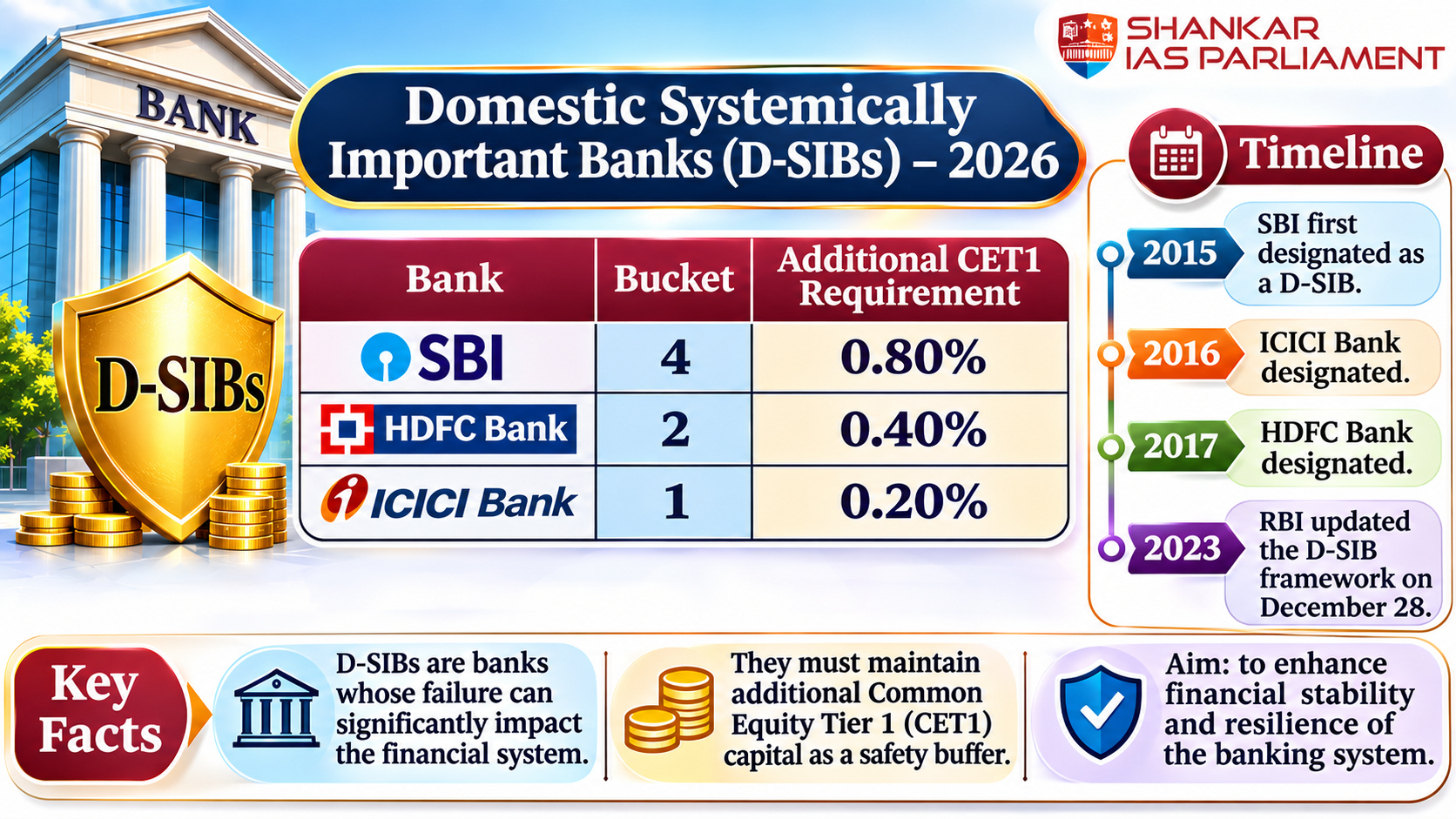
- Requirements are calculated as a percentage of Risk-Weighted Assets (RWAs).
- These requirements are over and above the Capital Conservation Buffer (CCB).
- Classification is based on data as of March 31, 2026.
D-SIBs
- D-SIBs are banks whose failure could disrupt the domestic financial system and economy due to their size, interconnectedness, complexity and lack of substitutability.
- RBI introduced the Framework for Dealing with D-SIBs on July 22, 2014.
- Banks are classified into buckets based on their Systemic Importance Scores (SISs).
- Higher buckets attract higher additional capital requirements.
- RBI publicly discloses the list annually.
|
|
Polity & Governance
|
|
Thirupparankundram Deepathoon Row – Supreme Court Review Petition
Tamil Nadu HR&CE Department filed a review petition against the Supreme Court’s November 20, 2026, interim order permitting one-time Karthigai Deepam lighting at the Deepathoon (stone pillar) on Thirupparankundram hill, Madurai.
- Supreme Court Order – Allowed restricted lamp-lighting on November 24, 2026, clarifying that it would not create a precedent or recognise any vested right.
- Grounds for Review
- Claimed an error apparent on the face of the record.
- Argued that the traditional lighting location is Deepa Mandapam near Uchi Pillaiyar Temple.
- Alleged violation of the Tamil Nadu HR&CE Act, 1959, concerning established temple customs and usages.
- Review Jurisdiction
- Article 137 – It empowers the Supreme Court to review its judgments/orders.
- Not an appeal in disguise; requires an apparent error or other recognised review ground.
- Generally heard by the same Bench, usually through circulation in chambers.
|
|
Space
|
|
HE 1153−0518 – Rare Stellar Fossil
Indian Institute of Astrophysics (IIA), Bengaluru, and Dakshin Kamrup College, Assam, discovered a rare ancient stellar fossil, HE 1153−0518, providing clues about the Universe's earliest generations of stars.
- Nature – Identified as a rare subclass of Carbon-Enhanced Metal-Poor (CEMP-no) stars.
- Methodology – High-resolution spectroscopy using the Subaru Telescope (Hawaii), along with astrometric and photometric data.
- Institution – IIA functions under the Department of Science and Technology (DST).
- Key Characteristics
- Contains only about 1/1,000th of the Sun's iron abundance.
- Rich in carbon and sodium but deficient in heavy elements produced through neutron-capture nucleosynthesis.
- Low carbon isotope ratio (¹²C/¹³C), indicating significant internal mixing.
- Excess infrared emission suggests possible circumstellar dust.
- Significance – It acts as a stellar fossil, preserving chemical signatures of the earliest stars and helping understand nucleosynthesis and Galactic chemical evolution.
|
|
Welopō’ai – Unusual Triple-Star System
Astronomers from the Trottier Institute for Research on Exoplanets, Université de Montréal, discovered an unusual triple-star system named Welopō’ai, located approximately 28 light-years from Earth.

- Composition – One dim red dwarf and two white dwarfs.
- Name Meaning – Welopō’ai refers to a path of family traits in Hawaiian.
- Discovery – Second white dwarf identified during observations initially aimed at finding exoplanets around the red dwarf.
- Origin – The system is believed to have originally contained two Sun-like stars and one red dwarf; the two Sun-like stars evolved into white dwarfs.
- White Dwarf – Dense, compact stellar remnant formed when a low- or intermediate-mass star exhausts its nuclear fuel and sheds its outer layers.
- Typically has a size comparable to Earth but a mass comparable to the Sun.
- Red Dwarf – Small, cool, low-mass star that consumes hydrogen slowly and therefore has an extremely long lifespan.
- Significance – It provides insights into stellar evolution, white dwarf formation and the survival of complex multiple-star systems.
|
|
Most Distant Quasar Discovered – Dún Aonghasa
Astronomers discovered the most distant quasar, J1504+6252 (Dún Aonghasa), with a redshift of 8.13, making it the first confirmed quasar with redshift above 8.
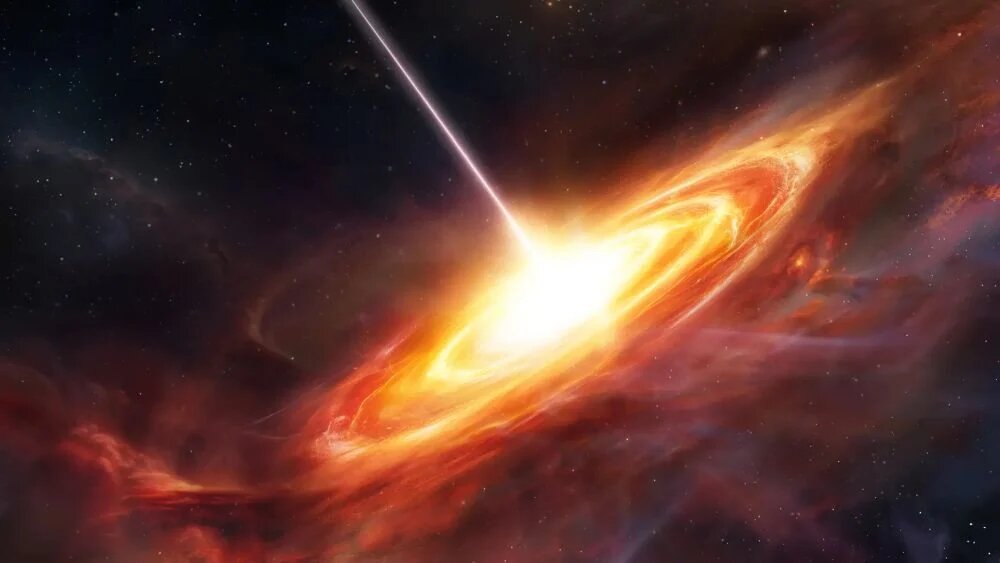
- Discovery – Identified through the European Space Agency’s Euclid Wide Survey.
- Confirmation – Observations by Keck Observatory, Hubble Space Telescope, Large Binocular Telescope and James Webb Space Telescope (JWST).
- Location in cosmic history – Existed approximately 630 million years after the Big Bang.
- Black hole mass – Several 100 million times the mass of the Sun.
- It existed around 40 million years earlier than the previous record-holding quasar.
Quasars
- Extremely luminous galactic cores powered by supermassive black holes.
- Their brightness results from the heating of gas and dust as matter spirals towards the black hole through accretion.
- They are among the most luminous persistent sources in the universe.
|
|
Security
|
|
Bagheera AT1 – Vehicle-Mounted Anti-Tank Guided Missile (ATGM)
Adani Defence & Aerospace demonstrated the Bagheera AT1 at Pokhran Field Firing Ranges, Rajasthan, under a No Cost No Commitment (NCNC) evaluation.

- Developer – Adani Defence & Aerospace; developed and integrated over 18 months for Indian operational requirements.
- Platform – Missile, automated launcher, day/night sights mounted on a 4×4 high-mobility armoured vehicle.
- Key Features
- Range – Up to 8 km against armoured targets.
- Guidance – Laser beam-riding guidance; high resistance to electronic jamming.
- Tandem firing – Two missiles fired sequentially along a single beam to counter Active Protection Systems (APS).
- Capacity – 4 ready-to-fire missiles + 8 reloads (12 total).
- Targeting – Day-vision and thermal-imaging sights with automated target tracking.
- Mobility – Shoot-and-move capability; demonstrated aerial-target engagement.
- Significance – It strengthens India's domestic private-sector defence development and anti-armour capability.
- Status – It demonstrated for Armed Forces evaluation; demonstration does not imply induction or procurement.
|
|
ASHANK (Yard 3036) – Anti-Submarine Warfare Shallow Water Craft
Indian Navy received Ashank, an indigenously built Anti-Submarine Warfare Shallow Water Craft (ASW-SWC), at Visakhapatnam.
- Builder – Garden Reach Shipbuilders and Engineers (GRSE), Kolkata.
- Standards – Designed and constructed according to Indian Register of Shipping (IRS) classification rules.
- Key Features
- Designed for anti-submarine warfare (ASW) and coastal surveillance.
- Equipped with lightweight torpedoes, indigenous rocket launchers and advanced sonar systems.
- Supports mine-laying operations.
- Among the largest Indian naval warships powered by waterjets.
- Indigenous content – Over 80%.
- Significance – It strengthens coastal anti-submarine warfare, underwater surveillance and indigenous naval shipbuilding under Aatmanirbhar Bharat.
|
|
Science
|
|
Pooja Pal – Low-Cost Dust-Free Thresher

- Innovator – Pooja Pal (17), Agehra village, Barabanki district, Uttar Pradesh.
- Innovation – Low-cost (approximately Rs.3,000) dust-free threshing device (Bhusa-Dhool separation machine) to reduce airborne chaff and dust during threshing.
- Working mechanism – Uses a water-based dust-trapping mechanism, fan and mesh to capture dust particles and reduce air pollution at the source.
- Recognition – Selected under INSPIRE-MANAK (2023) among 60 national winners; displayed at the National Science Exhibition (2024).
- International exposure – Participated in Japan's Sakura Science High School Programme (June 2025).
- Patent support – Ministry of Science and Technology is reportedly supporting patent-related efforts.
|
|
India's 1st Human Metabolic Chamber Facility – CMC Vellore
India's first dedicated Human Metabolic Chamber Facility was inaugurated at Christian Medical College (CMC), Vellore.
- Established by – Joint collaboration between Tata Institute of Fundamental Research (TIFR) and CMC Vellore.
- Technology – A room-sized calorimeter that measures oxygen consumption and carbon dioxide production to determine energy expenditure and utilisation of fats and carbohydrates during sleep, meals and physical activity.
- Research Focus – Nutrition, diabetes, obesity, metabolism and metabolic disorders.
- Funding – Department of Atomic Energy (DAE) and CSR support from Hindustan Unilever Limited.
- Significance – It enables India-specific metabolic research and strengthens evidence-based preventive healthcare.
- Related Initiatives
- Ayushman Arogya Mandirs – Over 1.87 lakh centres providing primary healthcare and NCD screening.
- Yoga – Over 7.8 crore cumulative yoga sessions conducted.
- Aaj Se Thoda Kam – Campaign promoting reduced oil consumption.
- ARUMDA-TIFR – Advanced Research Unit on Metabolism, Development & Aging.
|
|
Miscellaneous
|
|
International Day for the Elimination of Violence against Women
- Annually observed on – 25th November.
- Aim – To raise awareness of gender-based violence against women and girls.
- 2026 Theme – “Ensure Justice, Protect Survivors, End Impunity” under the UNiTE campaign.
- 16 Days of Activism – November 25 – December 10 (International Human Rights Day).
- Campaign Call – “Speak Out. Believe Survivors. Demand Justice.” – promotes survivor support, accountability and combating stigma.
- Origin – Commemorates the Mirabal sisters (Dominican Republic), assassinated on November 25, 1960, under Rafael Trujillo’s regime.
- History
- Women’s rights activists began observing November 25 in 1981.
- Officially designated by the UN General Assembly through Resolution 54/134 (1999).
- The UN Declaration on the Elimination of Violence against Women was adopted in 1993 through Resolution 48/104.

|



