Prelims: Current events of national and international importance | Environment
Why in News?
A team of Indian botanists has discovered a rare new species of fern within the misty Kolli hills of the Eastern Ghats, TamilNadu.
- It was identified by researchers from Government Victoria College and Sri Vyasa NSS College in Kerala during a series of scientific expeditions in Tamil Nadu.
- Nomenclature - The specific epithet, madhusoodananii, was chosen to honour Professor Dr P. V. Madhusoodanan, the former Head of the Department of Botany at the University of Calicut.
- The discovery is particularly urgent as the species has been immediately classified as ‘Critically Endangered’ due to its extremely small habitat and the threat of human encroachment.
- Habitat - The discovery was made during a taxonomic revision of ferns in southern India.
- While exploring the outskirts of the Puliansolai shola forest, the researchers noticed a fern population that didn’t quite match any known records.
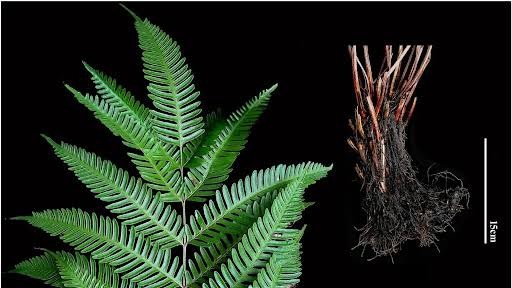
- It looks similar to other ferns in the Pteris family, Pteris madhusoodananii is characterised by stiff, leathery leaves with a lustrous, deep green colour.
- Unlike its closest relatives, it features a very prominent lobe at the base of its lower segments.
- It also has a unique pinna-pinnule architecture, in which its smaller leaflets are arranged along the stem.
- At a microscopic level, its spores possess a narrow, wavy-edged belt called a cingulum, a feature distinct from the smooth, wider belts found on similar species.
- Distribution - It is currently known to exist in only two small sites covering just eight square kilometres.
- These areas are not officially protected and are currently threatened by road construction, logging, and the conversion of forest into farmland.
- Scientists are calling for immediate conservation efforts to save this newly discovered piece of India’s natural heritage.
Reference
Research Matters | Critically endangered fern



