Mains: GS-III – Economy | Food Security
Why in News?
India’s food security debate now centres on the draft National Food Security (Amendment) Bill, 2026, which links Antyodaya Anna Yojana entitlements to household size.
What about the NFSA Act & draft 2026 bill?
- NFSA, 2013 – The National Food Security Act (NFSA), 2013 legally entitles about two-thirds of India's population (75% in rural areas and 50% in urban areas) to
- Receive highly subsidised food grains like rice at Rs. 3, wheat at Rs. 2, and coarse grains at Rs. 1 per kg.
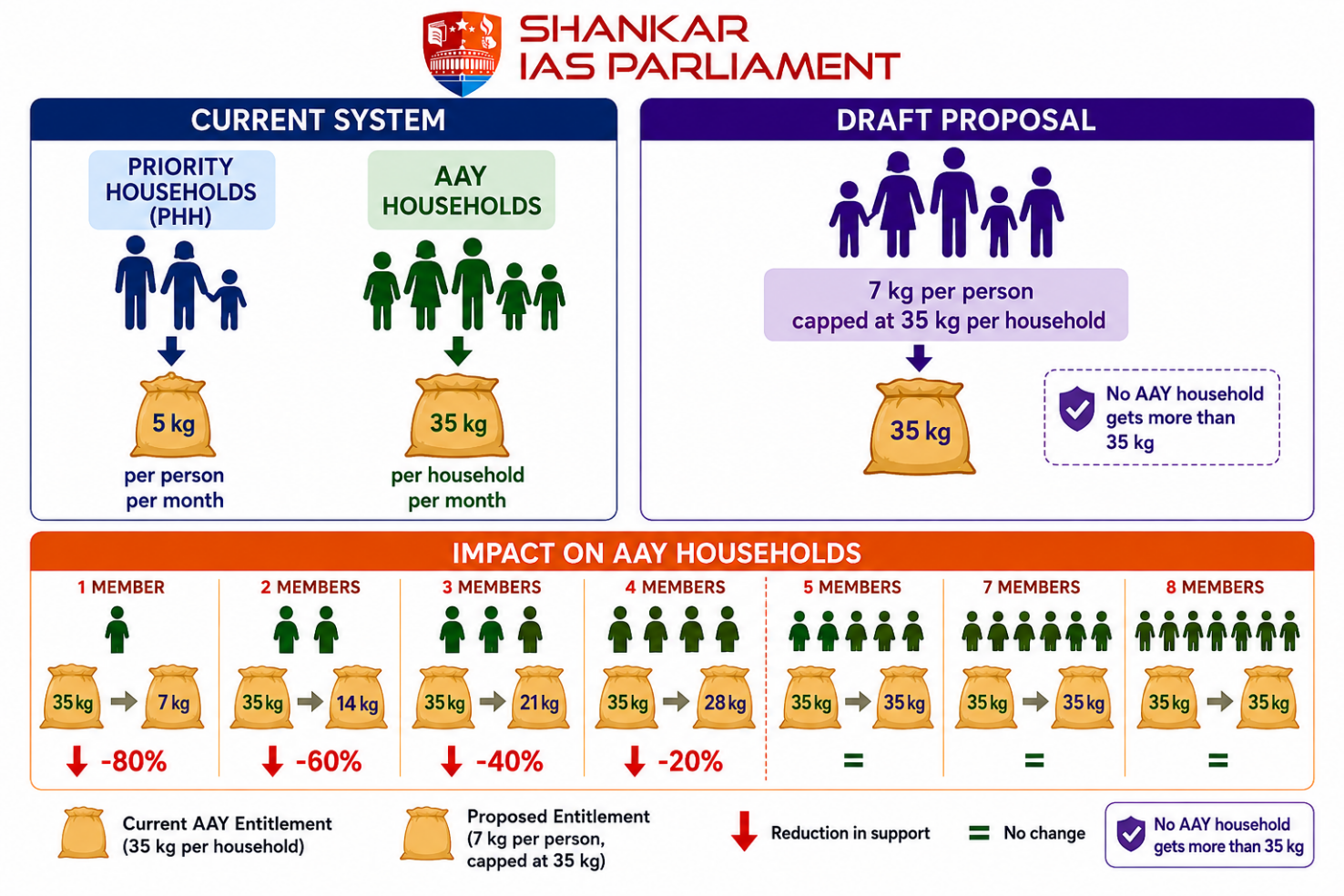
- Draft NFSA bill, 2026 – It proposes shifting Antyodaya Anna Yojana (AAY) rations from a flat 35 kg per household to 7 kg per person monthly, while keeping an absolute ceiling of 35 kg per household.
- Priority Households (PHH) remain at 5 kg per person.
- Objective – To remove intra-category inequities, provide a more rational foodgrain allocation and better align entitlements with nutritional requirements.
- This would reduce support for households with one to four members by 20% to 80%, leave those with five or more unchanged, and provide no AAY household with additional foodgrain.
- Beyond family size – Vulnerability depends not only on family size but also on age, disability, widowhood, and dependency.
Why is the reset necessary?
- Outdated coverage – NFSA has an 81.35-crore beneficiary ceiling that remains based on Census 2011; about 80 crore people receive free foodgrains.
- With the estimated population of 146.4 crore in 2025, effective NFSA coverage has fallen to 55.6%.
- Nutrition Concern – The latest household consumption survey suggests that the share of households unable to afford a healthy diet fell from about 52% (2011-12) to about 25% (2023-24).
- It is still affecting 25% of rural and 21% of urban households that still cannot afford an adequate, healthy diet.
- Health Concerns – Protecting the grain entitlement must go beyond a cereal-only understanding of food security.
- Double Burden of Malnutrition in India
- NFHS-6 (2023-24) – Stunting fell from 35.5% to 29.3%, Wasting & Underweight barely changed, from 19.3% to 19.0% and 32.1% to 31.8%, respectively.
- Only about 15% of children (6-23 months) receive a minimally adequate diet.
- Rising non-communicable disease risk – ICMR-INDIAB study: 101 million Indians had diabetes and 136 million had prediabetes in 2021.
- India now faces maternal undernutrition, low birth weight and a growing risk of non-communicable diseases (NCDs) linked to diet and other behavioural factors.
- Dietary imbalance – The PDS system largely remains cereal heavy food basket, which contains rice, wheat, etc.
- Diets already high in carbohydrates and low in protein-rich foods may reinforce dietary imbalance.
- Foodgrain entitlement does not directly cause diabetes, but cereal-heavy diets without dietary diversification may worsen health outcomes.
What are the key recommendations/suggestions?
- Updating Coverage – Food security coverage should be recalculated after Census 2027.
- Meanwhile, updated population estimates and deprivation criteria could support a transparent review, with clear inclusion and appeal mechanisms.
- Nutrition Balance – By replacing some carbohydrate calories with protein-rich foods, improving overall dietary quality.
- Policy Direction – The solution is not to reduce essential cereal entitlements, but to finance dietary diversification alongside — adding pulses, healthier oils, and other nutrient-rich foods.
- Diversify PDS Basket – The PDS cannot supply the entire healthy plate; it can best provide affordable, shelf-stable foods.
- ICMR-NIN’s 2024 guidelines – Cereals & millets provide at most 45% of energy, with greater contributions from pulses, beans, milk, nuts, vegetables, fruits and other protein sources.
- States should be supported to offer pulses, local rice, wheat and millet choices and, where feasible, healthy edible oils.
PDS Achievement – By the end of 2025, 5.50 lakh of 5.51 lakh fair price shops used electronic point-of-sale devices, while One Nation One Ration Card covered nearly all NFSA beneficiaries.
- Strengthen MSP – Local production and consumption should guide supply chains and effective Minimum Support Price (MSP) procurement for pulse, millet and oilseed growers.
- Link major initiatives – Sustained public investment should link food, nutrition and health systems through complementary programmes –
- PDS,
- Anganwadi services for young children and pregnant or lactating women,
- Pradhan Mantri Poshan Shakti Nirman (PM POSHAN) for school children.
- Separate Budget – Dietary diversification must be separately budgeted, not financed by reducing cereal entitlements.
- Pilot-based expansion – Before nationwide rollout, assess actual consumption, dietary diversity, anaemia and glycaemic risk, household spending, wastage, exclusion and supply feasibility.
- Use of Technology – Technological interventions support portability and monitoring but must include reliable
- Offline alternatives,
- Assisted/doorstep access for elderly & disabled and
- A clear guarantee that no denial due to authentication failure.
- Linking food with health – Fair price shops could support last-mile nutrition information and referral.
- Simple multilingual receipts, displays, voice and mobile messages could promote dietary diversity, appropriate cereal portions, pulses, healthier oils, and less salt and added sugar.
- Health outreach – Feasible, trained health workers could undertake periodic outreach through India’s primary-health infrastructure, linking willing adults to government diabetes, hypertension and other NCD services.
By June 2026, India had over 1.86 lakh Ayushman Arogya Mandirs, while government data recorded 41.3 crore diabetes screenings.
- Amendment anchored with 3 safeguards
- Protect existing entitlement – No AAY household should receive less than 35 kg/month.
- Periodic review – Adequacy of the 35 kg ceiling should be reviewed periodically for larger households & those with high dependency/nutritional needs, using consumption, nutritional and fiscal evidence.
- Separate finance – Dietary diversification must be separately financed and progressively implemented without reducing existing cereal entitlements.
What lies ahead?
- India’s next food security reform must protect people from hunger while also addressing the dietary drivers of diabetes and other NCDs.
- Its success should be judged not only by the tons of grain moved, but by whether vulnerable families can eat enough, eat healthier and obtain their entitlements with dignity.
Reference
The Hindu | A timely reset for the Food Security Act



