Mains: GS II – Polity & Governance
Recently, the Micro, Small and Medium Enterprises Development (Amendment) Bill, 2026, was passed by the Parliament in August 2026.
MSMED Bill – It is a legislative update to the Micro, Small and Medium Enterprises Development Act (MSMED Act) was notified in 2006.
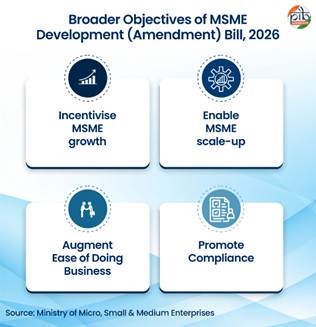
Objectives – To reduce payment-related constraints, make dispute resolution more time-bound and simplify compliance.
To facilitate the growth, development and competitiveness of MSMEs while promoting Ease of Doing Business.
Economic Survey 2025 26: MSME Contribution
Share of Gross Domestic Product (GDP) – 31.1%
Contribution to manufacturing output – 35.4%
Contribution to exports – 48.58%
MSME Scale and Transformation as of August 2026
Registration – A total of 9.16 crore MSMEs are registered on the Udyam platform.
Employment – These MSMEs collectively employ over 40 crore individuals.
Key drivers of change – It include technological advancements and the adoption of information technology-enabled systems.
Coverage – Rural, semi-urban, and urban areas, play an active role in formal supply chains.
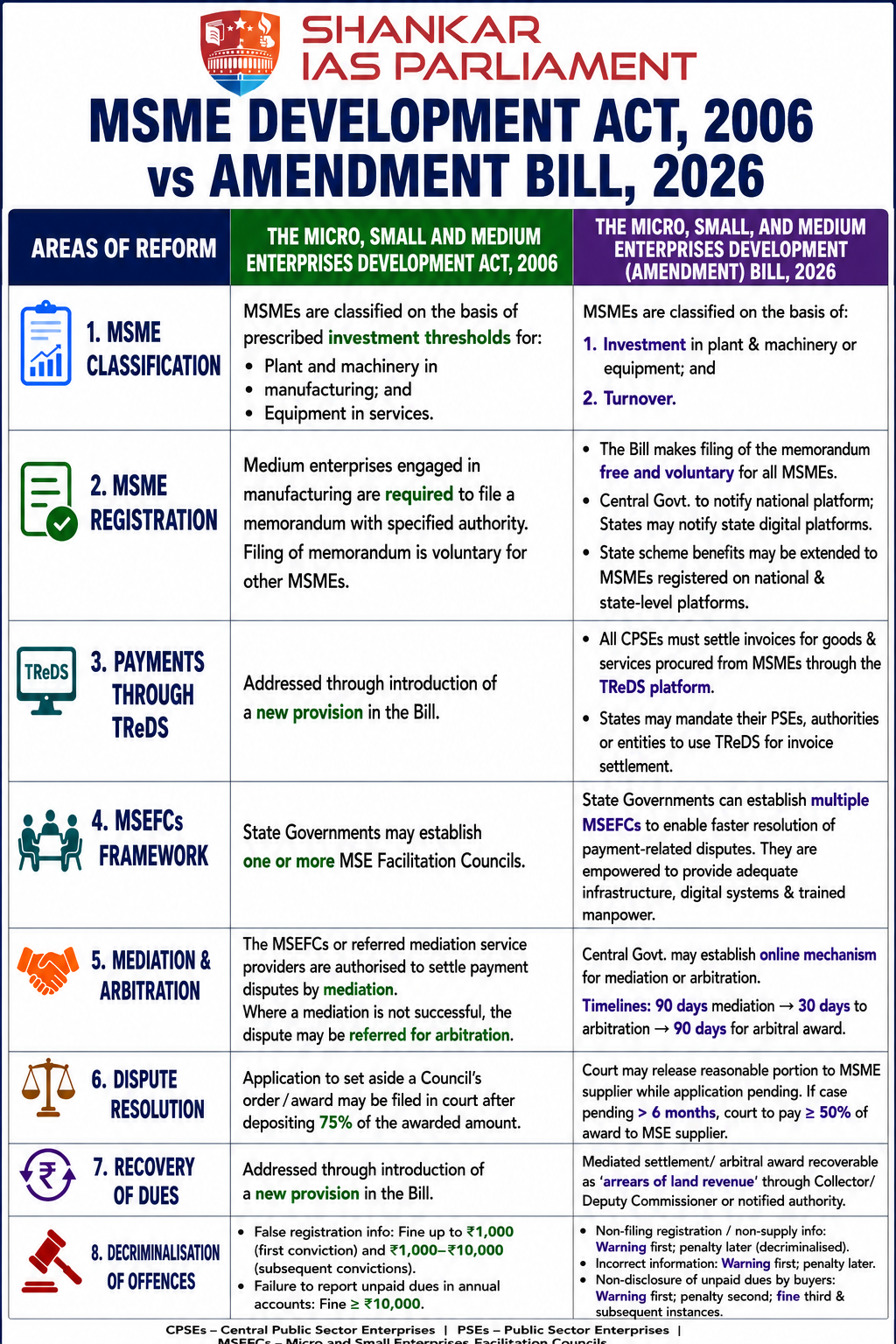
MSMEs classification – On the basis of:
Investment in plant and machinery or equipment; and
Turnover.
MSME Registration – The Bill makes filing of the memorandum free and voluntary for all MSMEs.
The Centre will notify a national MSME platform, with States free to launch their own; MSMEs registered on these platforms will also gain access to State scheme benefits.
Payments through Trade Receivables Discounting System (TReDS)
Mandatory Use of TReDS – All CPSEs must settle MSME invoices via the TReDS platform to resolve payment delays.
State-Level Adoption – States may require their PSEs, authorities, or entities to also use TReDS for invoice settlement.
Micro and Small Enterprises Facilitation Councils (MSEFCs) Framework
States may set up multiple MSEFCs and provide infrastructure, digital systems, and trained manpower to ensure faster resolution of MSME payment disputes.
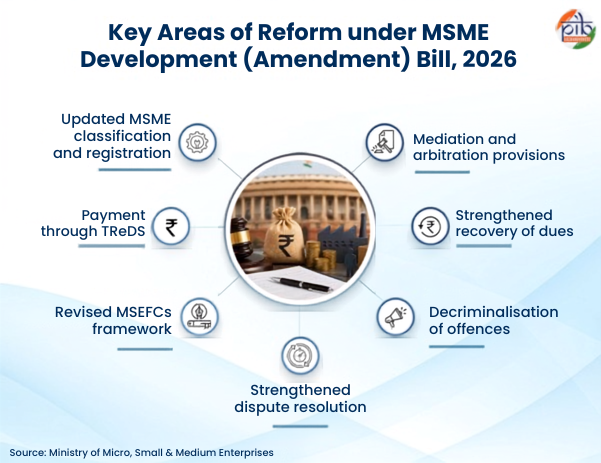
Mediation and Arbitration – Central Government may establish an online mechanism for mediation or arbitration, with specific timelines such as:
Mediation Timeline – MSEFC/mediator must complete mediation within 90 days of first appearance.
Arbitration Referral – If mediation ends, MSEFC must refer case to arbitration within 30 days.
Arbitral Award – Arbitration body must deliver award within 90 days after pleadings conclude.
Dispute Resolution
Pending Applications – Courts may release part of the deposit to MSME suppliers while applications are under consideration.
Delay Beyond 6 Months – At least 50% of the awarded amount must be paid if set‑aside applications remain pending beyond six months.
Recovery of Dues –Mediated settlements or arbitral awards under Section 18 can be recovered as arrears of land revenue.
Jurisdictional Authority – Recovery is carried out by the District Collector/Deputy Commissioner or other notified authority with jurisdiction over the buyer’s assets.
Decriminalisation of Offences
Incorrect Information – The first instance will result in a warning. Any further instances will result in a penalty.
Non-disclosure of Dues – The first instance will result in a warning, the second in a penalty, and any further instances in a fine.
Expanding Formal Recognition
Udyam Portal Recognition – Provides free, paperless, self‑declaration registration giving MSMEs official recognition.
Informal Enterprise Inclusion – Extends recognition to micro enterprises outside GST/Income Tax systems, verified via authorised partners.
Improving Access to Financing – TReDS is an electronic platform that enables MSMEs to finance or discount trade receivables.
It operates in accordance with guidelines issued by the Reserve Bank of India.
Enabling Online Dispute Resolution (ODR) – The ODR Portal was launched in June 2025.
It offers MSEs a low-cost, end-to-end digital mechanism for resolving delayed payment disputes, including small-value claims.
Strengthening the MSEFC Network – MSEFCs are set up to adjudicate disputes arising from payment delays faced by Micro and Small Enterprises.
Weak recovery mechanisms – Delays in executing MSEFC rulings hinder timely payment collection.
Resource deficits – New councils lack guaranteed funding, technology, and adequate staffing.
Credit access gaps – MSMEs face challenges obtaining institutional loans due to high collateral requirements.
Expansion anxiety – MSMEs are concerned about losing incentives once they exceed eligibility thresholds.
Compliance burden – GST, labor, and environmental regulations continue to impose significant demands.
Competitiveness challenge – The lack of a technology upgrade strategy leaves MSMEs exposed to import competition.
This bill seeks to strengthen the foundations of an MSME’s journey from a small enterprise to a growing business.
It provides for a stronger regulatory framework to help MSMEs operate and expand in an evolving business environment.
PIB | MSME Development (Amendment) Bill, 2026



