Mains: GSIII – Environment
Why in News?
The Kigali Amendment completed 10 years on October 15, 2026, aiming to phase down HFCs and prevent up to 0.5°C of global warming by 2100, while highlighting India’s need for sustainable cooling.
What is the Montreal Protocol and Kigali Amendment?
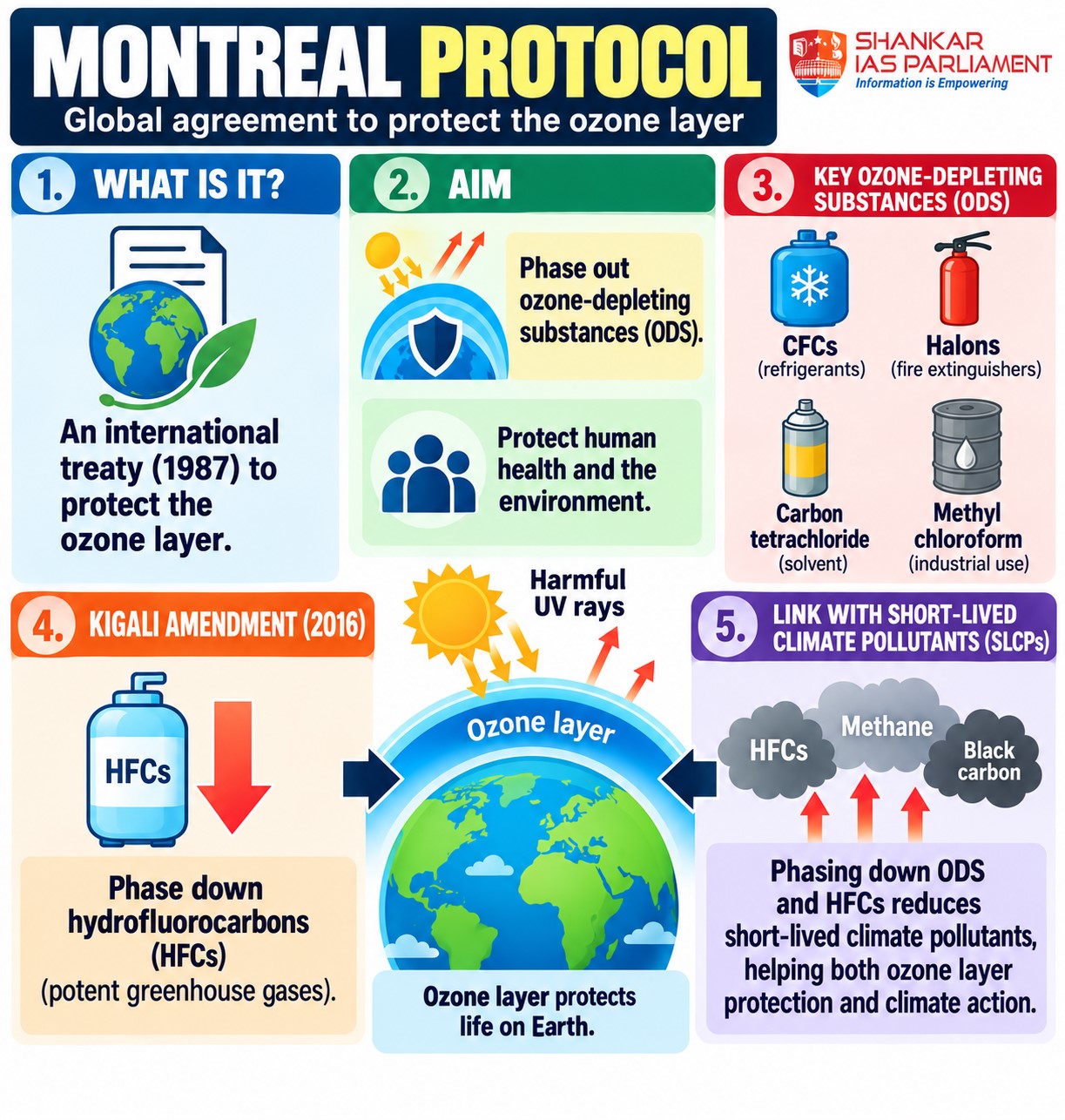
- Background – The Montreal Protocol (1987) aims to phase out chlorofluorocarbons (CFCs) and other ozone-depleting substances.
- HFCs were adopted as substitutes because they do not damage the ozone layer, but many have a much higher global warming potential than carbon dioxide.
- Kigali Amendment – It was adopted in Rwanda on October 15, 2016, and entered into force in January 2019.
- Objective – It establishes binding schedules to phase down HFC production and consumption, with longer compliance timelines for developing countries.
- By early October 2026, 175 parties had joined the amendment.
- It complements the Paris Agreement’s objective of limiting warming to well below 2°C while pursuing efforts to limit it to 1.5°C.
Why is Sustainable Cooling Important for India?
- Rising electricity demand – Cooling accounts for slightly more than 10% of India’s annual electricity demand, while air-conditioners can consume up to one-third of electricity on hot summer nights.
- Dual climate impact – Refrigerant leakage directly contributes to global warming, while electricity consumption generates emissions when power comes from fossil fuels.
- Economic benefits – Energy-efficient appliances reduce household electricity bills and limit the need for additional power-generation capacity.
- Industrial competitiveness – Adopting efficient technologies and suitable refrigerants can help Indian manufacturers meet evolving domestic and international standards.
|
India’s Commitments under the Kigali Amendment
|
|
Year
|
Commitment
|
|
2028
|
Freeze HFC production and consumption at the agreed baseline
|
|
2032
|
Reduce HFC production and consumption by 10% below the baseline
|
|
2047
|
Achieve an 85% reduction below the baseline
|
What is the Role of the Multilateral Fund?
The Multilateral Fund was established in 1990 and began operations in 1991 under the Montreal Protocol.
- Financial and technological support – Developed countries contribute funds to meet the agreed additional compliance costs of developing countries.
- Climate benefits – The Fund estimates that its work helped developing countries avoid emissions of approximately 50 billion tonnes of carbon dioxide between 1995 and 2021.
- Significance for India – Access to finance can help Indian manufacturers transition to climate-friendly refrigerants while meeting growing cooling demand.
Why Has the Montreal Protocol Been Successful?
- Binding targets – Clear phase-out and phase-down schedules provide certainty for governments and manufacturers.
- Progressive strengthening – Controls have been tightened and extended to additional chemicals as alternatives have become available.
- Scientific and technological assessment – Expert panels evaluate available technologies, enabling governments to strengthen commitments in line with industrial capabilities.
- Differentiated timelines – Developing countries receive longer compliance periods and financial assistance.
- Adaptive framework – The approach described as “start and strengthen” allows the agreement to evolve without renegotiating its basic framework.
|
Montreal protocol – Short Lived Pollutants
|
- Short-lived climate pollutants (SLCPs) cause strong warming but remain in the atmosphere for less time than CO₂. These are
- Methane – Emitted by oil and gas operations, agriculture and waste.
- Black Carbon – Produced by incomplete combustion of fuels.
- Hydrofluorocarbons (HFCs) – Used as refrigerants in air-conditioners and refrigerators.
- Tropospheric Ozone – Ground-level ozone formed by chemical reactions between air pollutants in sunlight.
- The Montreal Protocol model could support binding international agreements to reduce emissions, particularly methane leaks from oil and gas operations.
- In India, mitigation measures must also address agricultural emissions and black carbon while protecting farmers’ livelihoods and promoting cleaner fuels.
|
What are the Major Challenges in Implementing the Kigali Amendment?
- Rising cooling demand – Rapid growth in air-conditioning use could increase electricity consumption and associated emissions.
- Transition costs and technological gaps – Manufacturers need financial assistance, suitable alternatives and technical expertise to modify production facilities.
- Refrigerant leakage – Existing equipment continues to release HFCs during servicing, maintenance and disposal, requiring stronger recovery systems.
- Incomplete global participation – Wider participation, adequate financing and effective implementation are necessary to maximise climate benefits.
What Measures Should India Adopt for Sustainable Cooling?
- Improve appliance efficiency – Strengthen energy-efficiency standards and promote high-efficiency air-conditioners before the treaty deadlines, reducing electricity bills and future power demand.
- Promote climate-friendly refrigerants – Encourage alternatives with lower global warming potential and support manufacturers in redesigning equipment and production processes.
- Strengthen refrigerant management – Recover and reuse refrigerants during servicing and safely destroy them when reuse is impractical, including during equipment disposal.
- Improve market regulation – Enforce efficiency standards for imported equipment to prevent the entry of inexpensive but energy-intensive appliances.
- Expand consumer awareness – Encourage consumers to consider lifetime electricity costs rather than only the initial purchase price.
What lies ahead?
- The Kigali Amendment demonstrates how binding international commitments, financial assistance can address global environmental challenges.
- For India, the priority is to combine energy-efficient cooling, climate-friendly refrigerants and effective refrigerant recovery to meet rising cooling demand.
Reference
The Indian Express| The Kigali Amendment at 10



