Mains: GSIII – Environment
Why in News?
Studies have found persistent PFAS chemicals in Indian water sources. India lacks specific drinking-water limits for PFAS, and conventional treatment methods cannot effectively remove them.
What are PFAS (Forever Chemicals)?
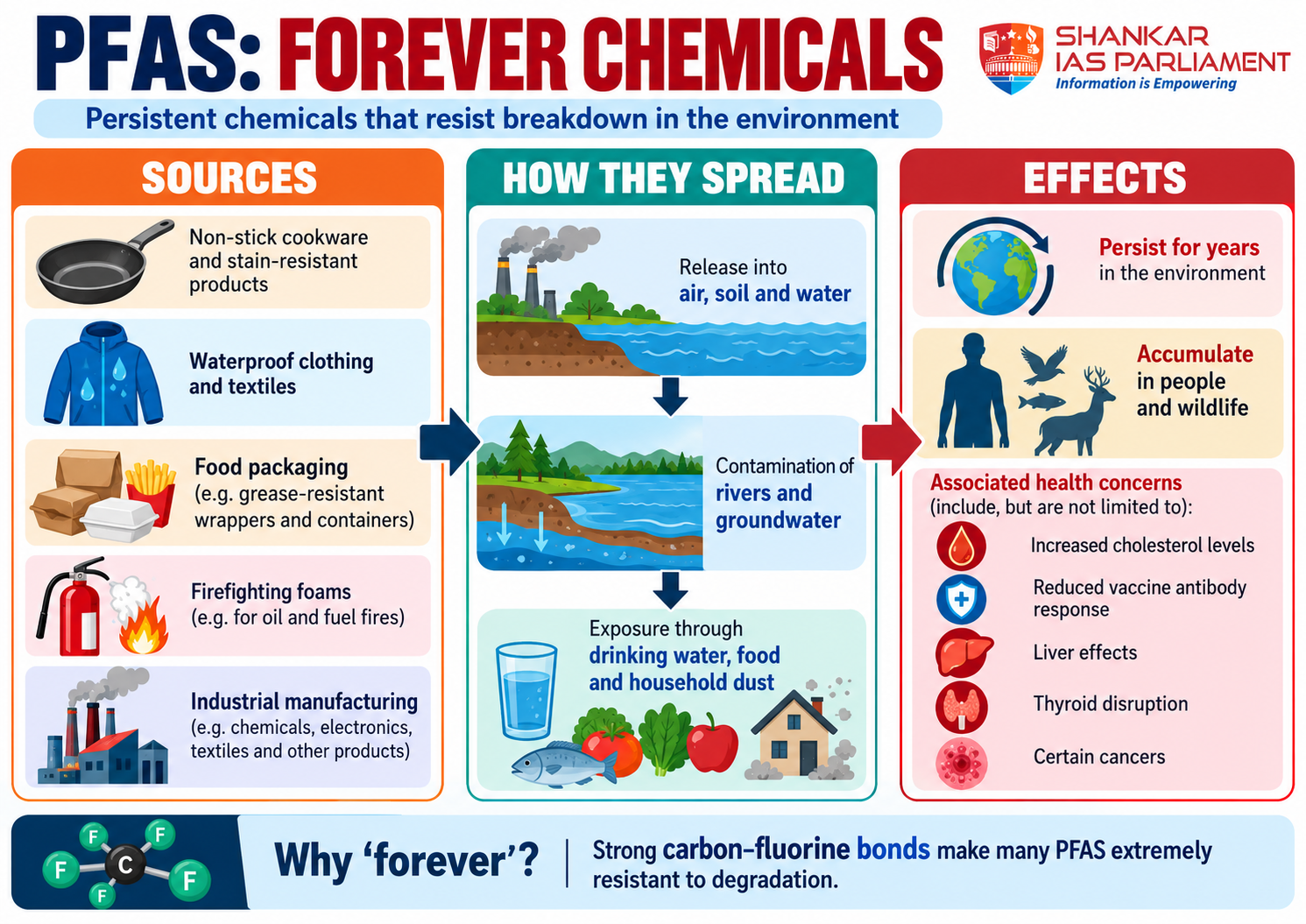
- Definition – PFAS are synthetic chemicals containing multiple carbon–fluorine bonds, widely used in coatings, textiles and industrial products.
- Persistence – Their strong chemical bonds make them resistant to degradation, allowing them to persist in the environment for long periods.
- Environmental contamination – PFAS have been detected in groundwater, surface water, sewage and seawater across different parts of India.
- The International Agency for Research on Cancer (IARC) classified perfluorooctanoic acid (PFOA) as carcinogenic to humans.
|
Extent of PFAS Contamination in India
|
- Chennai – A 2024 IIT-Madras study detected PFAS in groundwater, surface water and samples from different stages of a water treatment plant.
- Groundwater near garbage dumps had the highest levels,
- Treated-water concentrations of the eight target PFAS were 5%–103% higher than raw-water concentrations.
- Visakhapatnam – A 2026 study detected 38 PFAS compounds among 77 types tested in seawater and sewage.
- Modelling estimated that sewage contributed about 41% of median PFAS concentrations along the coast.
- Data gaps – Differences in sampling and testing methods, limited monitoring and unidentified chemical precursors make it difficult to assess.
|
What are the Major Challenges in Tackling PFAS Contamination?
- Ineffective conventional treatment – Conventional biological wastewater treatment cannot effectively remove PFAS, while adsorption-based technologies require further development.
- Limited detection – Testing for a fixed list of chemicals may miss other PFAS, unidentified precursors and transformation products.
- High-resolution mass spectrometry can improve detection.
- Unclear pollution sources – Municipal sewage and industrial discharges can mix, making it difficult to identify and hold specific polluters accountable.
- Insufficient exposure data – India lacks adequate baseline data to reliably estimate human exposure and associated health risks.
- Regulatory gaps – India has no PFAS-specific drinking-water limit under IS 10500 –2012 and no specific regulation banning PFAS manufacturing.
What Measures are needed to Address PFAS Pollution?
- Establish standards – Introduce precautionary interim limits for well-studied PFAS and establish enforceable drinking-water standards.
- Strengthen monitoring – Develop harmonised testing methods and conduct nationwide baseline monitoring of water, industrial discharges and consumer products.
- Adopt advanced treatment – Develop affordable adsorption materials and other effective technologies for removing PFAS from drinking water and wastewater.
- Apply the precautionary principle – Regulate hazardous PFAS groups, including precursors and transformation products, rather than fixed list of named chemicals.
- Ensure accountability – Identify pollution sources through systematic sampling and establish clear mechanisms for enforcement and penalties.
- Strengthen research – Expand toxicological studies, laboratory capabilities and cooperation with international scientific programmes.
Conclusion
- PFAS contamination presents an emerging environmental and public-health challenge and are difficult to remove using conventional treatment methods.
- India needs harmonised monitoring, advanced treatment technologies and stronger polluter accountability to prevent long-term contamination.
Reference
The Hindu| India’s water plants are failing to catch elusive ‘forever chemicals’



