Mains: GSIII – Infrastructure
Why in News?
In the recent events of India’s maritime energy dependence and west coast infrastructure concentration expose it to geopolitical disruptions, the Chennai–Vladivostok Eastern Maritime Corridor (EMC) can diversify energy routes.
What Is the Status of India’s Energy Security?
India is the world’s 3rd-largest energy consumer and imports around one-third of its total energy supply.
- High Import Dependence – India’s crude oil import dependence is nearly 85–90%, while LNG and LPG import dependence stands at around 50% and 60%, respectively.
- West Coast Concentration – Around 65–70% of oil imports, 75–80% of LNG imports and 55–60% of LPG imports are handled on the western coast.
- Nearly 60–65% of refining capacity and 70–75% of LNG regasification capacity are also concentrated there.
- Maritime Vulnerabilities – Dependence on the Strait of Hormuz and the Bab-el-Mandeb Strait exposes energy supplies to regional conflicts, maritime attacks and shipping disruptions.
- Security Risks – Concentration of major refineries, including Jamnagar and Vadinar, further increases the vulnerability of India’s energy infrastructure.
What Is the Eastern Maritime Corridor (EMC), and How Is It Connected to Russia?
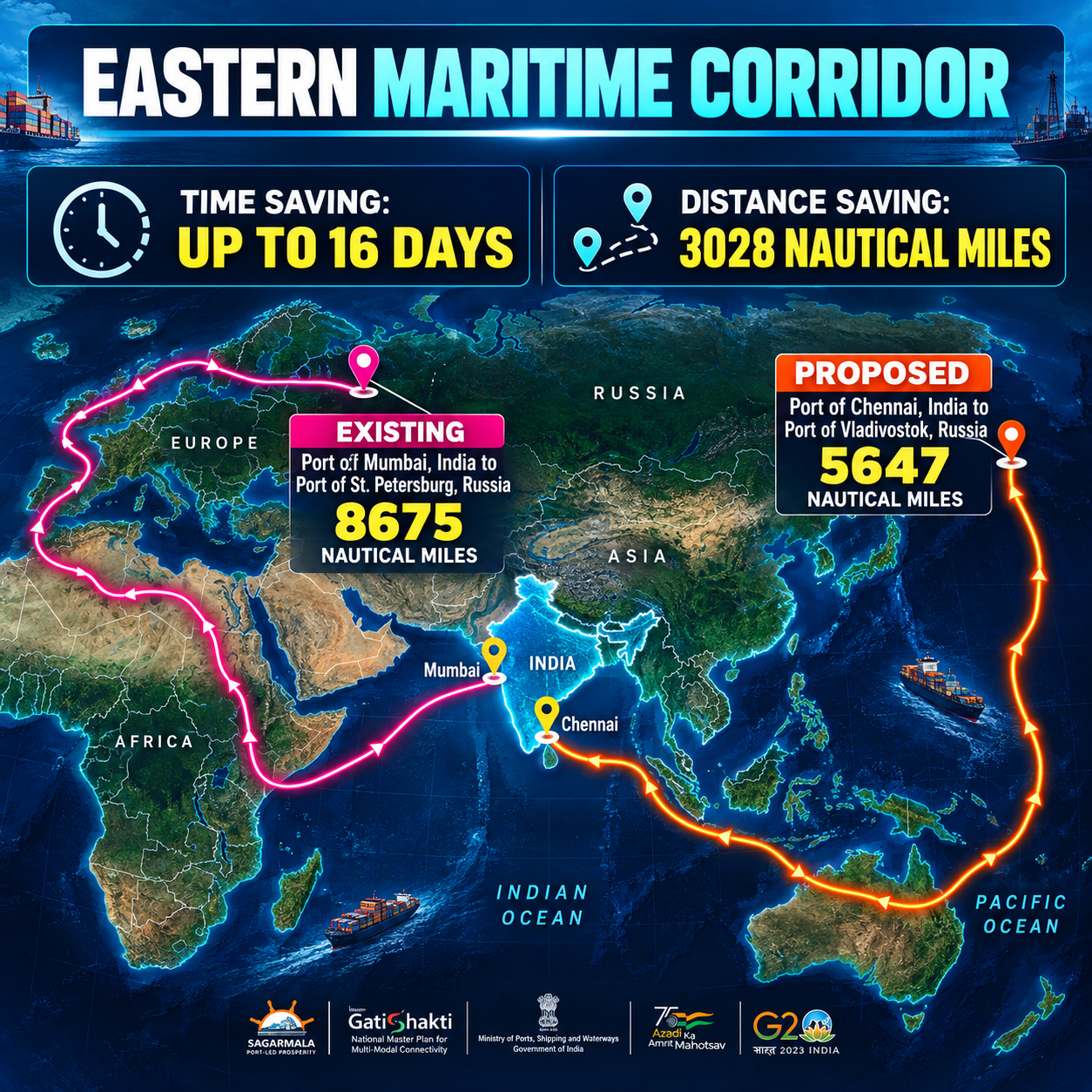
Eastern Maritime Corridor (EMC) is a maritime route connecting Chennai with Vladivostok in Russia’s Far East, launched in 2019 by the Indian and Russian leaders.
- Strategic Connectivity – Connects India to the western side of Russia’s Trans-Arctic Transport Corridor (TATC) through the INSTC and to its eastern side through the EMC.
- Integrated Transport Network – The TATC integrates Russian maritime routes, railways, roads and inland waterways, linking St Petersburg, Arctic ports and Vladivostok.
- Transit Efficiency – The 10,470-km EMC takes approximately 24 days at 10 knots, compared with 36 days for the 16,070-km Mumbai–St Petersburg route via the Suez Canal.
- Lower Freight Costs – Freight costs are expected to be over 50% lower than the Suez route due to shorter distances and no canal transit charges.
How Can the EMC Strengthen India’s Energy Security and Economic Interests?
- Diversification of Supply Routes – Reduces dependence on western ports and vulnerable maritime chokepoints for energy transportation.
- Energy Partnership – Can strengthen India–Russia energy trade, with Russia supplying around 30–40% of India’s oil imports since 2023.
- Strategic Resources – Improves access to Russian Far Eastern and Arctic reserves of oil, natural gas, coal, base metals and rare earth elements.
- Critical Mineral Security – Supports access to minerals essential for electronics, renewable energy, fertilisers and strategic industries.
- Trade and Connectivity – Enhances connectivity with Asian economies, including China, Japan and South Korea, supporting the India–Russia target of $100 billion bilateral trade by 2030.
What Are the Major Challenges Facing the EMC?
- Lack of Regular Shipping Services – Despite being declared operational in November 2024, the corridor lacks direct, scheduled shipping services between major Indian and Russian Far Eastern ports.
- Logistical Bottlenecks – Reliance on third-party ports such as Ningbo and Shanghai increases transit time, costs and uncertainty; specialised transshipment infrastructure is also inadequate.
- Trade Imbalance – Bilateral trade reached $68.7 billion in FY 2024–25, but Indian exports were only $4.9 billion against Russian exports of $63.8 billion.
- Commercial Viability – Shipping companies need sufficient cargo volumes, while exporters require predictable schedules to use the corridor.
- Financial Constraints – Banking sanctions and payment difficulties hinder bilateral trade.
What Measures Are Needed to Improve the EMC’s Effectiveness?
- Establish Regular Shipping – Introduce reliable weekly or fortnightly direct services between Chennai and Vladivostok.
- Provide Initial Incentives – Offer temporary subsidies, lower port charges and guaranteed berthing to attract shipping operators.
- Ensure Cargo Availability – Secure minimum cargo commitments and joint shipping agreements to reduce commercial risks.
- Promote Indian Exports – Expand exports of pharmaceuticals, engineering goods, chemicals and agricultural products to Russia’s Far East.
- Strengthen Trade Facilitation – Improve port infrastructure, customs coordination and payment mechanisms to reduce trade barriers.
What lies ahead?
- The Eastern Maritime Corridor offers India an opportunity to diversify energy supply routes, improve access to Russian resources and strengthen bilateral trade.
- However, its success depends on reliable shipping schedules, balanced trade flows and efficient logistics.
- India must transform the EMC from a strategic connectivity initiative into a commercially viable and dependable maritime corridor.
Reference
The Indian Express| India’s west coast is vulnerable: How Russian oil can reach Bay of Bengal ports



