Mains: GS I – Art & Culture
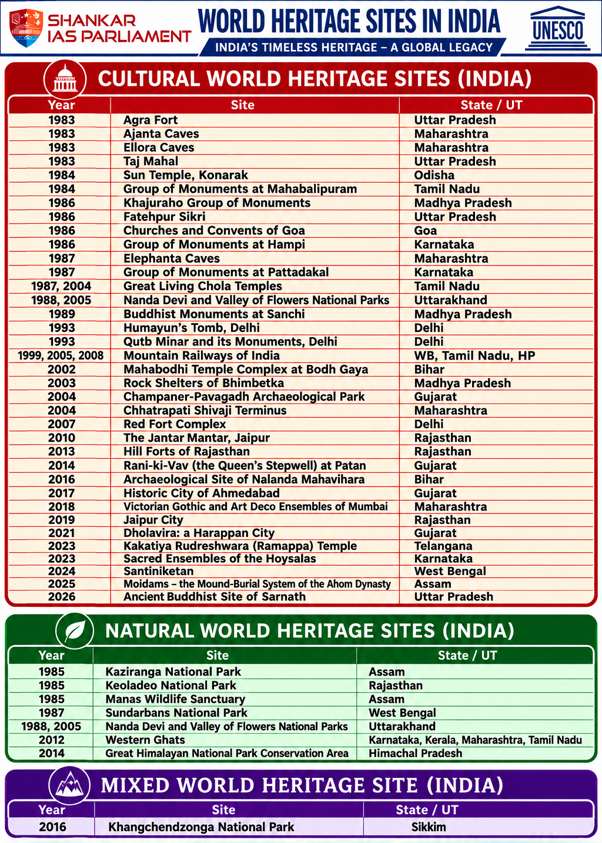
Recently, the Ancient Buddhist Site of Sarnath has been added to the UNESCO World Heritage List, bringing India’s total to 45 World Heritage properties.
Sarnath – Located in Varanasi, Uttar Pradesh, it is one of the four key sites of Buddhist pilgrimage.
Buddhist Tradition – Sarnath, also known as Rishipatana, Ishipatana, or Mrigadava, is the sacred site where Gautama Buddha delivered his first sermon in the 6th century BCE, signifying the commencement of Buddhist teachings.
Buddha's first sermon and his meeting with his first five disciples.
This sermon, known as Dharmachakra Pravartana or the "Turning of the Wheel of the Law".
It marked the beginning of the Buddhist Sangha and the establishment of the principles of the Noble Eightfold Path.
Continuous Development – Sarnath developed over approximately sixteen centuries, with monuments dating from the pre-Mauryan period (4th–3rd BCE) to the 12th century CE, before its decline and destruction.
Rediscovery – The site remained largely unknown until the 18th century, when it was rediscovered.
Coverage – UNESCO World Heritage inscription covers two connected components:
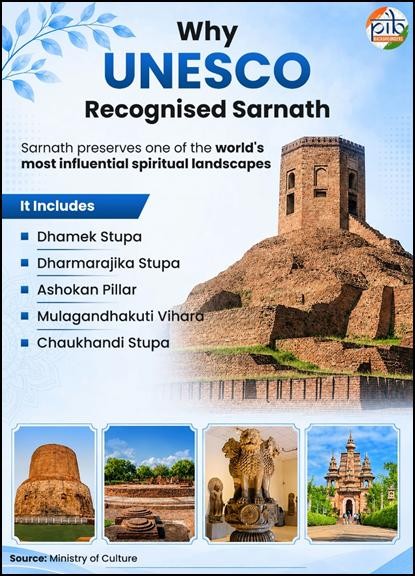
Chaukhandi Stupa and
Archaeological Remains of Sarnath.
The archaeological complex includes the Dhamek Stupa, Dharmarajika Stupa, Mulagandhakuti Vihara, the Ashokan Pillar and several other ancient remains.
A Global Legacy of Peace – Sarnath continues to serve as a major global center for Buddhist pilgrimage, extending its significance beyond archaeology.
International Visitors – It remains a global pilgrimage destination for Buddhists from Japan, Thailand, Sri Lanka, Myanmar, Vietnam, South Korea, Cambodia, Mongolia and many other countries.
Cultural Diplomacy – It reinforces India's identity as the birthplace of Buddhism and serves as a bridge for cultural ties and international engagement with Buddhist nations.
UNESCO Coverage – With its inscription, Sarnath joins Lumbini (Nepal) and Bodh Gaya (Bihar) on the UNESCO World Heritage List.
It brings 3 of the 4 main Buddhist pilgrimage sites associated with Buddha’s life under this recognition.
They join other important Buddhist World Heritage sites, including Sanchi, Nalanda and Ajanta in India, Anuradhapura in Sri Lanka, Paharpur in Bangladesh, and Taxila and Takht-i-Bahi in present day Pakistan.
|
UNESCO |
|
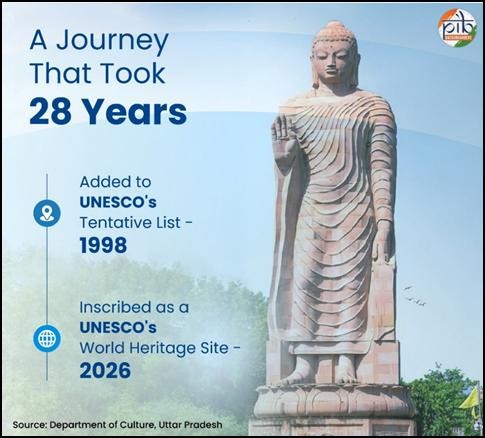
Tentative Listing – It is included in India’s Tentative List in 1998, has now achieved UNESCO World Heritage recognition after a long and careful process.
Proposal – Inscription proposal submitted to the World Heritage Committee in Jan 2025.
Evaluation – Followed by 18‑month process with UNESCO advisory meetings and ICOMOS mission for assessment.
Decision – Culminated in inscription at the 48th Session of the World Heritage Committee, Busan (South Korea).
Nomination – Sarnath proposed under UNESCO criteria (iii) & (vi).
Criterion (iii) – It highlights Sarnath’s enduring spiritual significance as a major Buddhist pilgrimage site with centuries-old monuments.
Criterion (vi) – It recognizes Sarnath’s direct association with Buddha’s first sermon, his disciples, teachings, and the Triratna concept.
The purpose of the Convention is to support UNESCO’s goal of preserving heritage of Outstanding Universal Value for future generations.
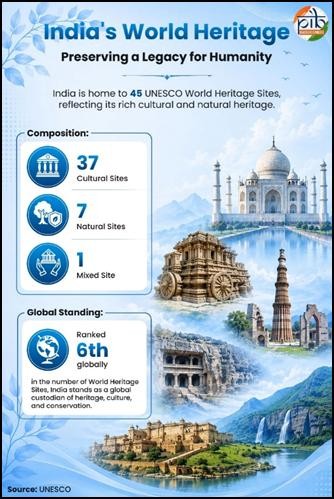
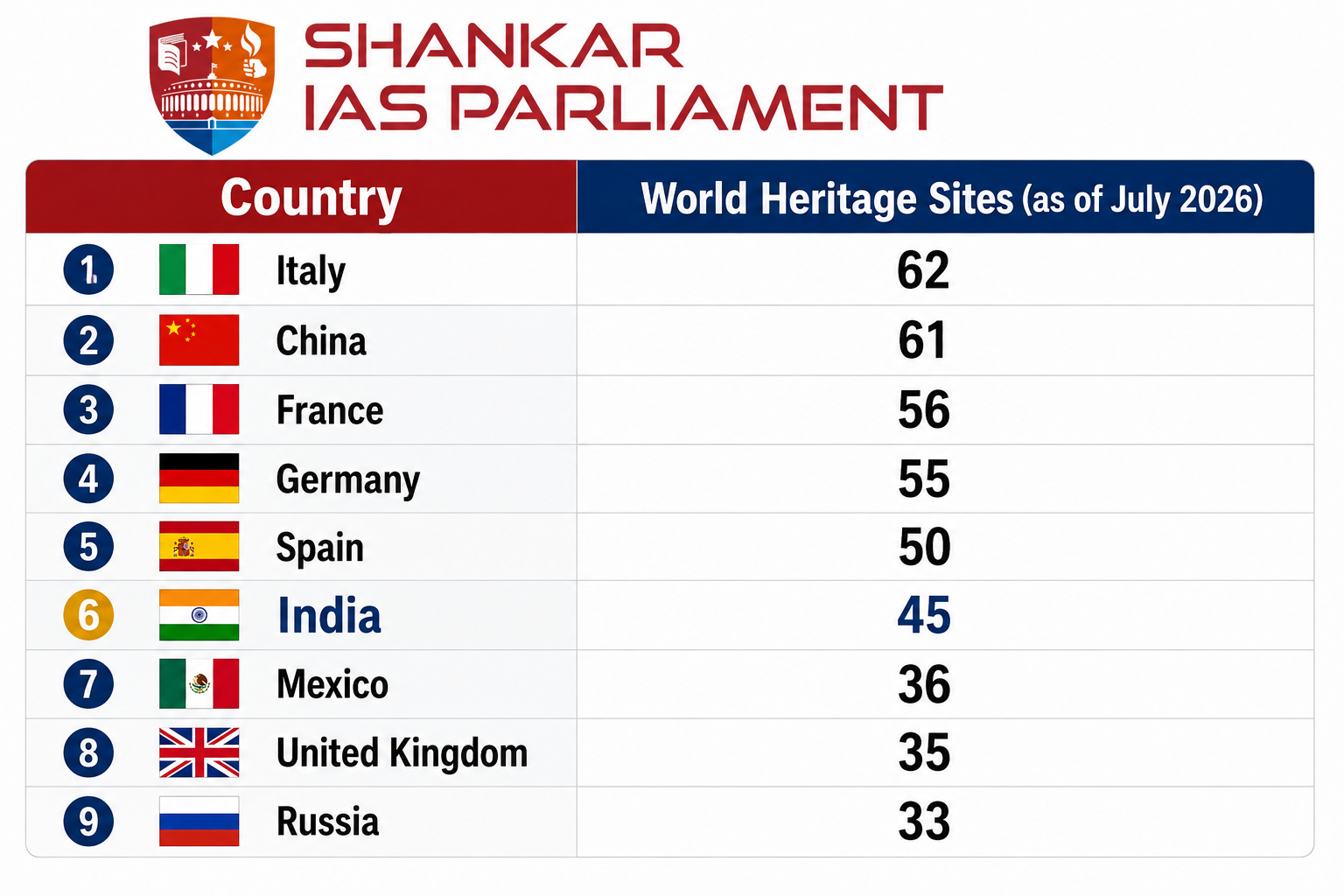
Current Status – India possesses 45 UNESCO World Heritage properties, comprising 37 cultural, 7 natural, and 1 mixed site. The country ranks sixth globally and second in the Asia-Pacific region.
First Inscriptions (1983) – The earliest entries included Agra Fort, Taj Mahal, Ellora Caves, and Ajanta Caves.
Recent Additions – The inclusion of Maratha Military Landscapes (2024, Paris) and Sarnath (2025, Busan) increased the total number of sites to 45.
Future Potential – India’s Tentative List currently includes 69 properties, representing the pipeline for future World Heritage nominations.
Repatriation Drive – India has recovered 669 antiquities (656 since 2014) through coordinated efforts of the Ministry of Culture, ASI, Indian Missions, and enforcement agencies; recently, 657 art objects were handed over by US authorities.
Key Artefacts – Returns include iconic pieces like the Chola‑period Shiva Nataraja, Saint Sundarar with Paravai, and Somaskanda.
Adopt a Heritage
Launched in – Sept 2017, revamped in Sept 2023.
Collaboration Framework – It involves private firms, PSUs, NGOs, trusts, societies.
Focus – To develop & maintain visitor‑friendly amenities at Protected Monuments of National Importance.
Supported by – CSR & contributions, aimed at enhancing visitor experience.
Gyan Bharatam Mission
Launched in – 2025, to preserve, digitise, and disseminate India’s manuscript heritage, focusing on ancient knowledge systems.
Technology Integration – Uses modern digital tools & conservation networks to safeguard fragile manuscripts and ensure global accessibility.
National Manuscript Survey (2026) – To identify, document, and build a comprehensive national database of manuscripts.
National Mission on Monuments and Antiquities
Implementation by – Archaeological Survey of India (ASI).
Objective – To build a national database of built heritage and antiquities.
Role – To document and inventory monuments to guide planning, prioritisation, and monitoring of conservation work.
India's cultural heritage is a living legacy that continues to inspire, educate, and connect people across generations.
The inscription of Sarnath reflects the country's sustained commitment to conserving places of exceptional value while strengthening their role in education, cultural exchange, and sustainable development.
As India moves forward, protecting its heritage will remain central to preserving its civilisational legacy and sharing it with the world.
PIB | Turning the Wheel of Heritage



