0.1073
7667766266
x

India’s Non-Fossil Fuel Power Capacity

iasparliament Logo
August 26, 2026

Mains: GS III – Energy

Why in News?

Recently India’s Non Fossil Fuel Power Capacity has crossed 300 GW.

What is the Non-Fossil fuel capacity of India?

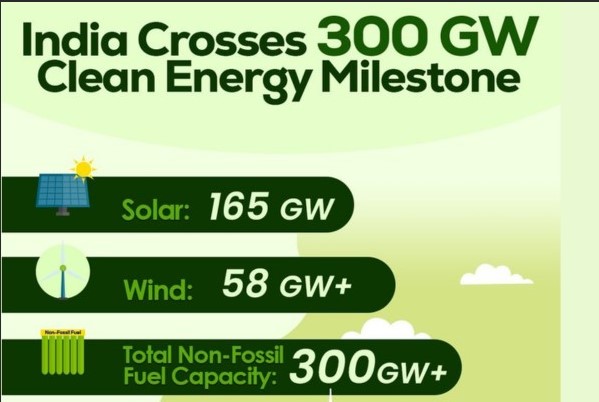
  • Present status – India’s Non-Fossil Fuel Power Capacity Crosses 300 GW.
  • It is 60 percent of its non-fossil fuel power generation capacity target of 500 GW.
  • Non-fossil fuel capacity includes solar power, wind power, hydro power, bio-power and Nuclear Power.
  • The share of non-fossil fuel-based electricity capacity in the country’s total installed electricity generation capacity has reached over 54 %.

NON fossil Power capacity of INDIA. UPSC

  • In the total Non-Fossil Fuel Capacity of the country, solar energy has remained a key growth engine.
  • It is with around 165 gigawatts of installed capacity at present.
  • According to the Ministry of New and Renewable Energy, a record 55.29 gigawatts of non-fossil fuel-based electricity generation capacity was added in the country during 2025-26.
  • Sector-wise Contribution
  • Installed solar capacity has risen to 164.59 GW.
  • Installed wind capacity has reached 58.14 GW
  • Presently, hydropower accounts for 57.24 GW of capacity, while bio-power contributes 11.75 GW.
  • Nuclear power accounts for another 8.78 GW.

What is Nationally Determined Contribution (NDCs)?

  • NDC – Under the 2015 Paris Agreement, every country is obligated to decide upon, and implement, a set of climate actions that help the global fight against climate change.
  • These are referred to as nationally-determined contributions, or NDCs.
  • On March 25 this year, India revealed its revised NDCs for 2035.
  • India said it would ensure that at least 60% of its electricity installed capacity in 2035 was based on non-fossil fuel sources, up from the 50% target it had set for 2030.
  • It has promised to attain at least a 47% reduction in emissions intensity, or emissions per unit of GDP, on 2005 levels, which is two percentage points more than its current target of 45% for 2030.
  • It has also promised to create a carbon sink that is at least 3.5 to 4 billion tonnes of CO2-equivalent larger than what existed in 2005.

Greenhouse gas Emission Intensity (GEI)

  • GHGs are gases that trap heat in the atmosphere and contribute to the “greenhouse effect” that raises surface temperature on Earth.
  • The five most abundant GHGs in the atmosphere are water vapors, carbon dioxide, methane, nitrous oxide, and ozone.
  • Other GHGs include synthetic fluorinated gases such as chlorofluorocarbons (CFCs) and hydrochlorofluorocarbons (HCFCs).
  • GEI is the amount of greenhouse gases (GHG) emitted per unit of product output, such as the quantum of gases released while producing cement.
  • Energy storage – It refers to systems that can store excess renewable electricity during periods of high generation and discharge it when demand rises but power generation remains low.
  • At its core, energy storage systems convert electricity from renewable sources such as solar and wind, when it is available, into forms that can be stored.
  • Later, it converts these back into electricity when need arises.
  • In India, a key challenge is emerging for its power system — electricity supply that is abundant in some hours but insufficient in others.

What are the range of energy storage technologies?

  • Pumped hydro storage (PHS) – It uses surplus electricity to pump water from a lower reservoir to a higher one.
  • When electricity demand peaks, it releases the stored water downhill through turbines to generate power.
  • Battery energy storage systems (BESS) – This technology stores electricity chemically and discharges it when needed.
  • Lithium-ion batteries, particularly lithium iron phosphate (LFP) batteries, are currently the dominant technology for grid-scale storage because of their falling costs, high efficiency and long operational life.
  • Concentrating solar-thermal storage systems – This technology uses mirrors that capture and focus sunlight onto a receiver.
  • As the receiver gets heated, materials such as molten salt are circulated inside the receiver to store the heat.
  • The stored heat can later be used to produce steam.
  • This steam is converted into mechanical energy in a turbine, which powers a generator to produce electricity.
  • Compressed-air energy storage systems - It uses excess electricity to compress air and store it in underground caverns or tanks.
  • When power demand rises, the compressed air is released to drive turbines and generate electricity.
  • Flywheel energy storage systems – It stores electricity as rotational energy by spinning a rotor at extremely high speeds.
  • Because they can inject power into the grid almost instantly, they are particularly useful for maintaining grid stability and managing short-term fluctuations.
  • Gravity energy storage systems – It uses electricity to lift heavy weights to higher elevations.
  • When electricity is needed, the weights are lowered, converting gravitational energy back into electricity through generators.

Reference

The Indian Express| India’s solar PV manufacturing capacity

Login or Register to Post Comments
There are no reviews yet. Be the first one to review.

ARCHIVES

sidetext