Why in News?
The recent issues surrounding the increase in sugar prices needs to be understood from the real facts.
What is the status of India’s sugar industry?
- Sugarcane production – India’s sugar industry is a major agricultural, industrial, and rural livelihood ecosystem.
- India is the world’s second-largest sugarcane producer.
- India’s sugarcane production has reached 500 MMT in 2025-26 as per the Third Advance Estimate of Production released by the Ministry of Agriculture & Farmers Welfare.
- This marks approximately 43.5 percent growth over the last 10 years, compared with 348.44 MMT of production in 2015-16.
- Employment – The sugarcane sector supports nearly 5 crore farmers and around 5 lakh workers in sugar factories and its allied industries.
- Area Under Cultivation – The area under sugarcane cultivation has also increased from 49.27 lakh hectares in 2015-16 to 58.87 lakh hectares in 2025-26.
- Top Producing States – Uttar Pradesh and Maharashtra are the top sugarcane-producing states in India.
- India exported 8 lakh MT of sugar in 2025-26, compared with 0.47 lakh MT in 2016-17.
- Pricing Support – Fair and Remunerative Price (FRP) of sugarcane for the sugar season 2026-27 (October - September) has been set at ₹365/quintal by the government.
- This provides a basic recovery rate of 10.25%.
- This price is ₹135 more than the FRP for the sugar season 2016-17, which was fixed at ₹230/quintal with a basic recovery rate of 9.5%.
- Export Destinations – Major export destinations of Indian sugar include Sri Lanka, West Asia, and East Africa.
- Adequate sugar buffer stocks are available, and sugar production in 2025–26 is expected to remain sufficient.
What is the role of the indian sugar industry in advancing ethanol blending?
- Reduce fossil fuel dependence – The blending of ethanol with petrol is aimed at reducing dependence on fossil fuels and enhancing energy security.
- Sustainable fuel – This move is in sync with the government's push for sustainable fuel alternatives.
- Support farmers – This initiative also supports farmers by providing them with a stable income and reducing greenhouse gas emissions.
- However, this does not mean that ethanol blending would lead to a shortage in sugar for domestic consumption.
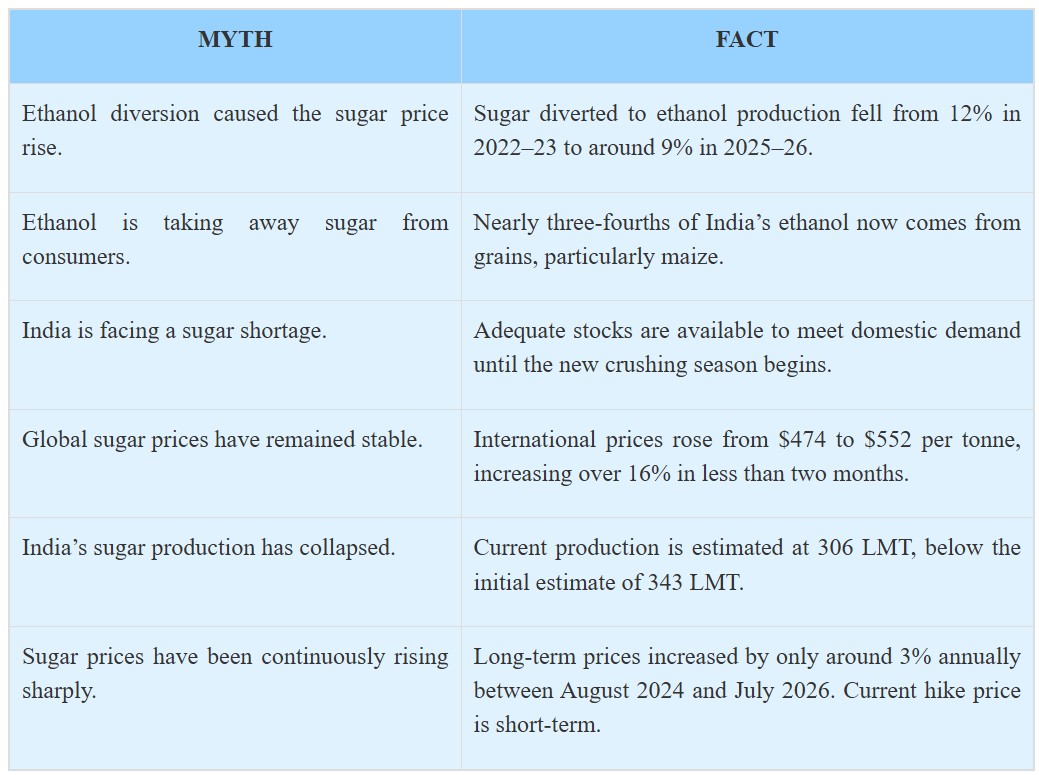
- Sugar for ethanol – The share of sugar diverted for ethanol production has declined from around 12% in 2022-23 to around 9% in 2025-26.
- Moreover, nearly three-fourths of the ethanol produced in the country now comes from grains, particularly maize.
- In fact, the ethanol programme has helped sugarcane farmers and strengthened sugar mills:
- On an average, India produces around 300-340 lakh MT of sugar annually.
- India’s domestic sugar consumption is around 280-290 lakh MT annually.
- In years of surplus production, excess stocks block the funds of sugar mills and delay payments to sugarcane farmers.
- Diversion of excess sugar towards ethanol has helped address this structural problem and improved the financial health of sugar mills.
- As of August 20, 2026, 97% of sugarcane dues for the 2025-26 sugar season have already been paid to farmers.
- The improved financial position of sugar mills has reduced their dependence on government support.
- Simultaneously, retail sugar prices for consumers have also remained broadly stable, increasing by only around 3% annually between August 2024 and July 2026.
What are the reasons for sudden increase in sugarcane prices?
- Price increase – Sugar prices have increased in recent weeks, from ₹48.18 per kg on July 20, 2026, to ₹55.70 per kg on August 20, 2026.
- This reflects an increase of around 15.6% within one month.
- It's worth distinguishing this recent movement from the longer-term trend, however: as noted earlier, sugar prices rose by only about 3% annually between August 2024 and July 2026.
- This suggests the current uptick largely reflects short-term supply and market factors, rather than a shift in the underlying price trend.
- Reasons – The present increase in sugar prices is due to a combination of factors, including:
- Lower-than-expected domestic production,
- Increased demand ahead of the festive season,
- Weather-related damage to the sugarcane crop,
- Tightening global sugar supplies and rising prices, and
- Speculation and hoarding by some sections of the industry.
- Sugar production during the current season is expected to be around 306 LMT, compared to the initial estimate of around 343 LMT.
- Factors affecting production – Production has been affected by two factors:
- Red Rot and Top Borer disease, and waterlogging caused by excess rainfall.
- However, despite the lower-than-estimated production, adequate sugar stocks are available in the country to meet domestic demand. The new crushing season will begin in October.
- The tightening of sugar supplies is a global phenomenon and is not limited just to India.
- The global sugar deficit for 2026-27 is estimated at around 33 lakh MT.
- As a result, international sugar prices have risen sharply from $474/tonnes on June 30, 2026 to $552/tonnes on August 20, 2026.
- This marks an increase of over 16% in less than two months.
What is are the myths and realities of current increase in sugarcane price?
What are the government efforts to curb hoarding of sugar and increase supply?
- Stock limits – A stock limit of 400 tonnes has been imposed on sugar dealers across the country from August 1, 2026, to November 30, 2026.
- From September 1, 2026, onwards, bulk consumers will not be permitted to hold sugar stocks exceeding 15 days of consumption.
- Joint teams of central and state government officials are conducting physical verification of sugar stocks at mills to check for hoarding and artificial scarcity.
- Duty free import – As a precautionary measure, the government has decided to permit duty-free import of 10 lakh MT of raw sugar to augment domestic availability.
- Crushing advisory – States and sugar mills have been advised to begin crushing from October 15, 2026.
- This is expected to raise October sugar production from the usual 3-4 lakh MT to more than 10 lakh MT.
- This would improve availability during the festive season.
What lies ahead?
- India’s sugar sector has evolved into a diversified industry that supports farmers, mills, energy production, and global trade.
- Recent price pressures reflect lower production, seasonal demand, global supply conditions, and market practices.
- However, these pressures remain temporary against the sector’s broader growth and diversification.
- The government’s priority remains balancing consumer interests, timely farmer payments, and industry stability.
Reference
PIB| India’s SugarIndustry



