Mains: GS III – Defence
Recent Wars in Ukraine and Iran highlight air‑power limits, sharpening India’s debate on theatre‑isation and whether the IAF’s centralised flexibility can meet a China conflict.
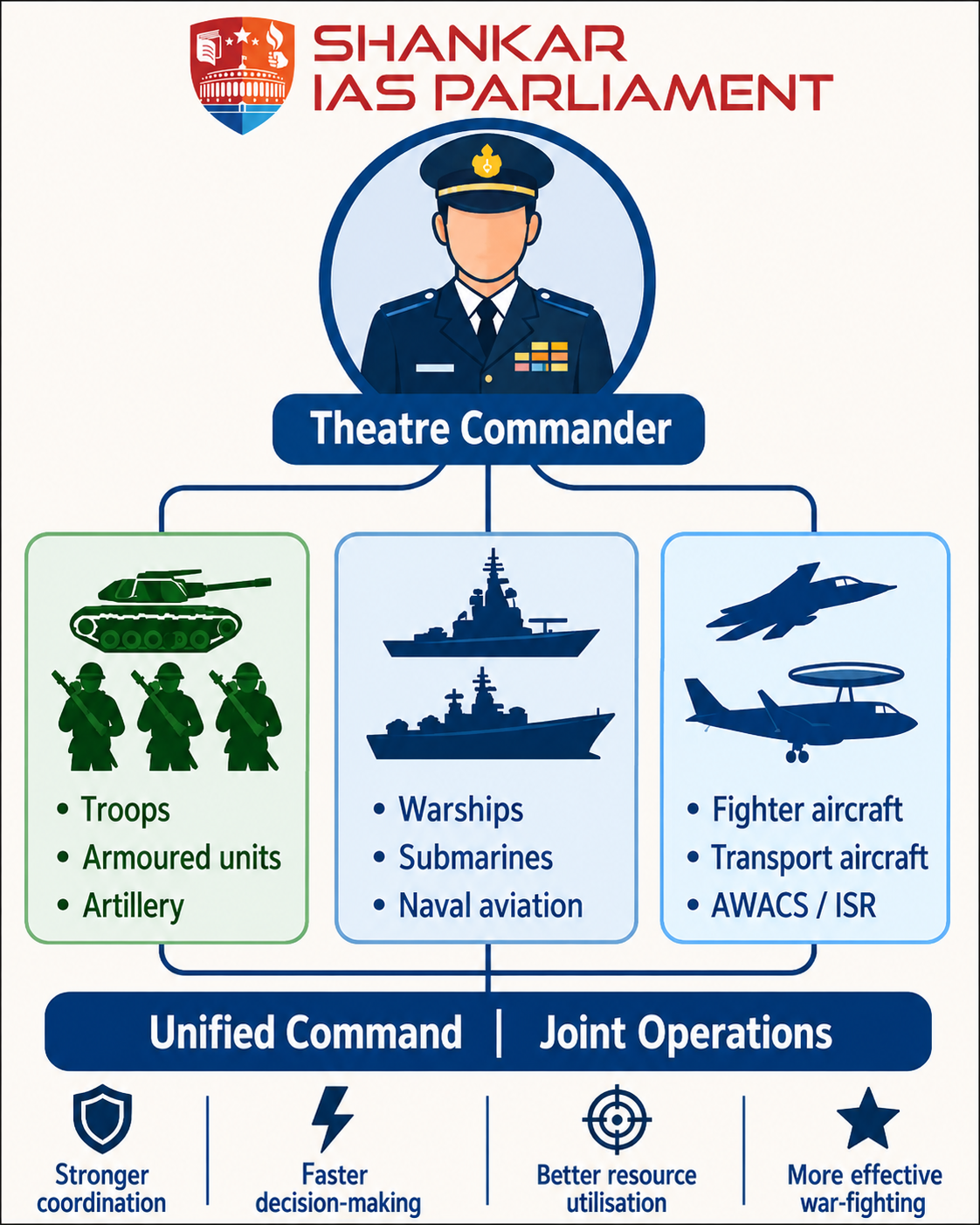
Theatre-isation – It refers to the reorganisation of the Army, Navy, and Air Force into integrated theatre commands, with each command responsible for a specific geographical area or strategic mission.
A theatre commander is granted operational control over resources from all three military services.
Objectives – To ensure joint planning, expedite decision-making, enhance resource allocation efficiency, and achieve integrated war-fighting capabilities.
Contrast with IAF – The IAF prioritises centralised control and flexibility, enabling quick redeployment of aircraft and assets across fronts as needs evolve.
Ukraine: Air Denial Operations – Ukraine's integrated air-defence network prevented Russian forces from achieving full control of Ukrainian airspace.
Key lesson – Air superiority by itself is insufficient to defeat a robust, well-networked air-defence system.
Iran: Air Dominance – Although the opposing coalition established extensive control over Iranian airspace, this control did not necessarily result in a decisive political outcome.
Key lesson – This case demonstrates that while air power is effective in destroying visible targets, it cannot eliminate all concealed assets or guarantee strategic victory.
Drone Warfare and Cost Asymmetry – Low-cost drones are capable of imposing disproportionately high financial burdens on defenders who rely on expensive interceptor systems.
India’s Operation Sindoor (2025) exposed cost‑asymmetry challenges, which in a China conflict could be far greater due to Beijing’s massive drone production and military resources.
Need for Integrated Warfare – While modern air power is indispensable, achieving air superiority alone is insufficient for victory in warfare.
Integrated air defence, drone technology, electronic warfare, intelligence capabilities, ground forces, and joint operations are also critical.
What challenges does the IAF face in countering China and other major threats?
Numerical Limitation – The IAF has fewer combat aircraft compared to China’s larger air‑power ecosystem, creating a resource imbalance.
Geographic Challenge – Himalayan terrain restricts airbases, logistics, and redeployment, meaning a multi‑front crisis could overstretch aircraft and air‑defence systems.
Ongoing Gaps in Integration – India continues to face challenges in joint planning, training, and integrated force generation among its military services.
Historical Context – The Kargil War (1999) and the Ladakh crisis (2020) revealed persistent weaknesses in inter-service coordination.
Command and Decision-Making Issues – Consultative coordination impedes timely decision-making during rapidly evolving conflicts, thereby diminishing the effectiveness of military responses.
Institutional and Career Barriers – Structural gaps, such as disparities in service ranks, organizational hierarchies, and career progression pathways, inhibit the development of deeper jointness.
Two or Multi‑Front Challenge – India faces the strategic imperative of deploying limited high‑value assets such as Rafale aircraft and S‑400 missile systems across multiple simultaneous fronts.
Coordination Risk – In the absence of an integrated command structure, allocation decisions may become slow or fragmented, thereby reducing the effectiveness of the overall response.
Integrated Training & Postings – Expand joint training, exercises, planning, and permanent cross‑service postings.
Career Progression – Make jointness a core element of career advancement, not an additional responsibility.
Seamless Network – Integrate fighters, S‑400s, SAMs, radars, AWACS, and counter‑drone systems into a unified air defence grid.
Layered Protection – Build multi‑tier defence against aircraft, cruise missiles, ballistic missiles, and drones.
Affordable Defence – Reduce reliance on expensive interceptors for low-cost drone threats.
Innovative Investment – Focus on electronic warfare, directed energy systems, low-cost interceptors, and indigenous counter UAS technologies.
Improve Joint Force Generation – Enable rapid assignment of air, land, and maritime assets to theatres through realistic multi‑front war‑gaming and mobilisation exercises.
Resolve Theatre Command Structure – Government must finalise theatre command by reconciling IAF’s flexibility with operational integration.
Focus on Joint War‑fighting – Theatre‑isation should aim at faster, effective joint operations, not mere organisational restructuring.
India should reconcile the Indian Air Force’s asset-shifting flexibility with the imperative for integrated joint operations.
Future conflicts are expected to integrate air power, drones, missiles, cyber capabilities, electronic warfare, space, air defence, and ground forces.
The establishment of theatre commands should be accompanied by doctrinal, technological, and institutional reforms rather than limited to boundary adjustments.



