Prelims: Current events of national and international relations | Science and technology
Why in News?
ISRO is planning to launch GISAT-1A in September 2026.
- The mission is significant as it follows the failure of the earlier GISAT-1/EOS-03 mission in 2021 and comes after recent PSLV failures.
GISAT-1A
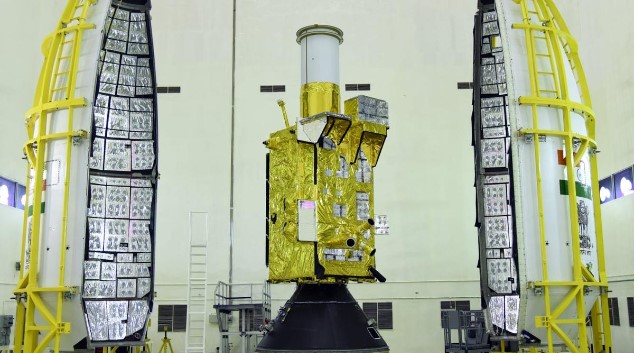
- Developed by – Indian Space Research Organisation (ISRO)
- Features
- GISAT – Geo-Imaging Satellite designed for wide-area and near-continuous observation of the Indian subcontinent.
- It is intended to observe the Indian landmass for large parts of the day.
- Applications include –
- Flood monitoring
- Cyclone tracking
- Agriculture
- Forestry
- Monitoring rapid changes on the Earth's surface.
- The replacement mission is designated F17.
GISAT-1 Mission Failure
- GISAT-1/EOS-03 was launched in August, 2021 using GSLV Mk-II.
- It was supposed to first enter a Geosynchronous Transfer Orbit (GTO) and then move to a geostationary orbit.
- The mission failed when the cryogenic upper stage did not start.
- The failure was linked to a valve leak, which reduced pressure in the liquid hydrogen tank.
- The cryogenic stage uses liquid hydrogen as fuel and liquid oxygen as oxidiser.
Orbit Concepts
- Geosynchronous Transfer Orbit (GTO) –
- Highly elliptical orbit (170 km - 36,000 km).
- Used as an intermediate orbit before reaching geostationary orbit.
- Geostationary Orbit –
- A satellite in this orbit appears fixed relative to a point on Earth.
- It is particularly useful for continuous observation and communication.
Different types of launch vehicles
|
Feature
|
PSLV
|
GSLV Mk-II
|
LVM-3
|
|
Stages
|
4
|
3
|
3
|
|
Cryogenic stage
|
No
|
Yes
|
Yes
|
|
Cryogenic engine
|
_
|
CE7.5
|
CE20
|
|
GTO capacity
|
_
|
Up to 2.5 tonnes
|
Up to 4 tonnes
|
- PSLV and GSLV Mk-II share some design elements, including the S139 first-stage solid motor lineage.
- They also share aspects of avionics, guidance, tracking and separation systems.
Recent ISRO Launch Issues
- PSLV-C61 carrying EOS-09 failed in May 2025.
- PSLV-C62 carrying N1 satellite failed in January 2026.
- Both failures involved anomalies during the third stage.
- ISRO subsequently paused launches while failure causes were investigated.
- GSLV-F15/NVS-02 was intended to strengthen India's NavIC constellation.
NavIC provides Positioning, Navigation and Timing (PNT) services over the Indian subcontinent.
- Following the NVS-02 problem, the constellation had only 3 satellites, whereas at least 4 are required for PNT services.
- NVS-03 is expected to be launched subsequently.
Human Spaceflight Connection
- LVM-3 is planned to be upgraded into a human-rated LVM-3.
- It is intended to launch Indian astronauts under the Gaganyaan programme.
Reference
The Hindu| GISAT-1A (EOS-05) mission



