Mains: GS Paper III | Disaster and Disaster Management
Why in News?
The 261st Report examines India's evolving disaster vulnerability matrix caused by accelerating climate change, rapid urbanization, and emerging technological applications in hazard management.
What is Disaster Management (DM)?
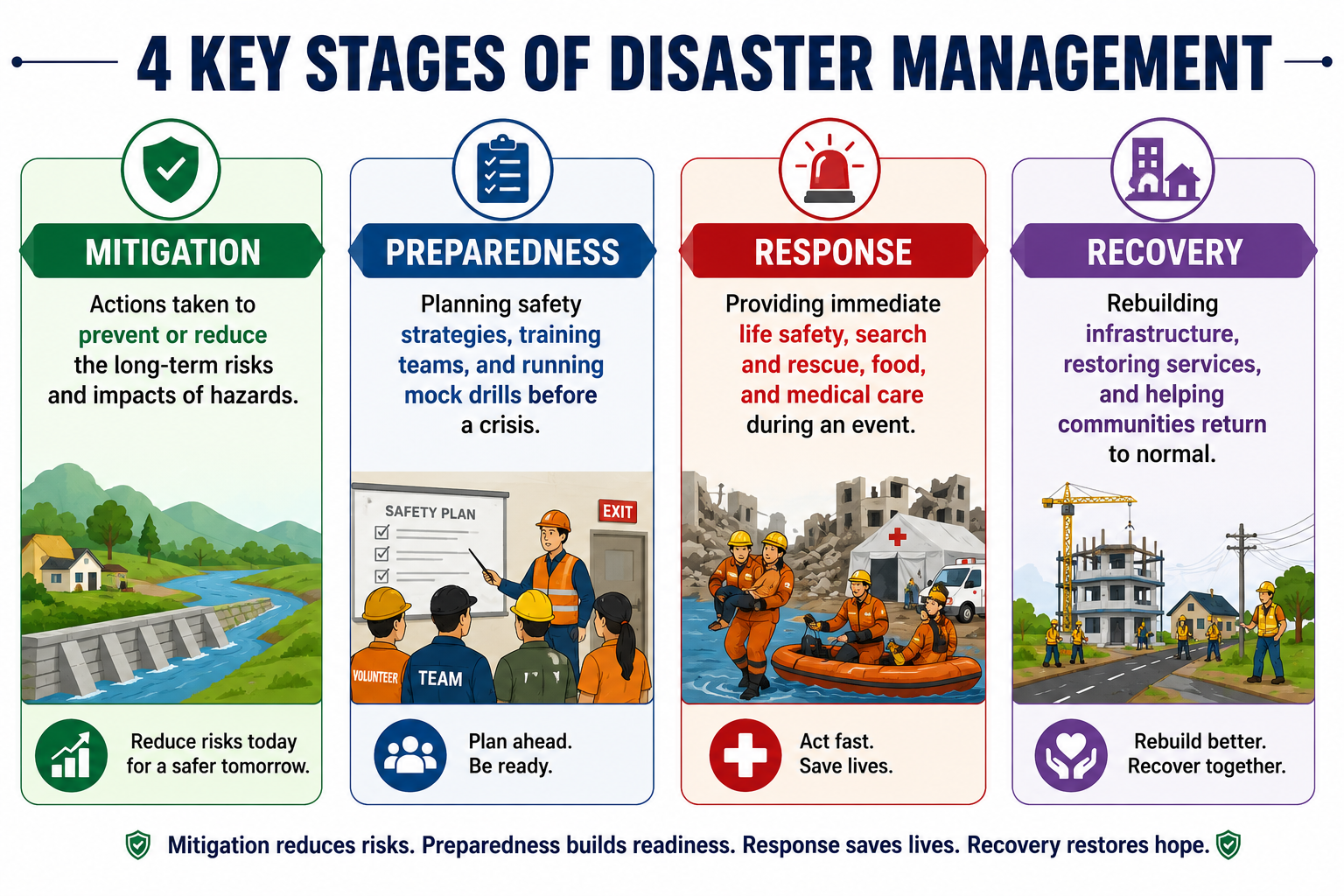
- Disaster Management (DM) is the process of planning, organizing, and coordinating measures to prevent, prepare for, respond to, and recover from natural or human-made disasters.
- It is governed nationally by the National Disaster Management Authority (NDMA) under the Disaster Management Act of 2005.
- Disaster Management (Amendment) Act, 2025 updated the foundational 2005 law.
- Key Administrative Tiers in India
- National Level - Headed by the Prime Minister via the National Disaster Management Authority (NDMA) for overarching policies.
- State Level - Headed by the Chief Minister through the Tamil Nadu State Disaster Management Authority (TNSDMA) for regional execution.
- District Level - Managed locally by District Collectors and urban municipal commissioners (such as in Chennai) to handle grassroots relief and early warnings.
What are the key systemic gaps identified by the committee?
|
Focus Area
|
Identified Deficit / Vulnerability
|
|
National Policy Framework
|
The National Policy on Disaster Management (2009) and National Disaster Management Plan (2016/2019) predate the DM Amendment Act (2025) and lack provisions for AI-driven forecasting and climate risk.
|
|
Urban Risk Governance
|
Despite provisions under the 2025 Amendment Act, only Karnataka has established a specialized Urban Disaster Management Authority (UDMA).
|
|
Fire Safety Legislation
|
Only 10 States/UTs have adopted the Model Bill on Maintenance of Fire and Emergency Services (circulated in 2019).
|
|
Infrastructure Planning
|
Landslide susceptibility mapping and seismic microzonation are rarely incorporated into mandatory town-planning regulations or pre-project clearances.
|
|
Disaster Financing
|
Disaster funding remains heavily skewed towards post-disaster relief rather than proactive, long-term risk mitigation.
|
What are the key recommendations of the 261st report?
Policy Realignment
- Review of 2009 National Policy - Immediate review of the National Policy on Disaster Management (2009) to integrate AI-assisted forecasting, urban risk concentration models, and climate change projections.
- Updating the NDMP – Quickly revise the National Disaster Management Plan (NDMP) to align operational guidelines with the DM Amendment Act, 2025 and the National Disaster Mitigation Fund (NDMF).
Upgrades in Urban Disaster Management
- Mandatory UDMAs - Direct all States/UTs to establish dedicated Urban Disaster Management Authorities (UDMAs) in state capitals and municipal corporations.
- Fire Safety Model Bill - Urge non-complying States to adopt the Model Bill on Fire and Emergency Services within a time-bound window.
- Mandatory DRIA - Enforce a statutory Disaster Risk Impact Assessment (DRIA) as a prerequisite for all major infrastructure, industrial, and urban development projects.
Early Warning Systems
- Hyper-Local Warning Systems - Shift from district-level advisories to ward-level, hyper-local early warning mechanisms using high-resolution geospatial data.
- Unified Multi-Hazard Platform- Integrate real-time data from IMD, Central Water Commission (CWC), INCOIS, and National Remote Sensing Centre (NRSC) into a single interoperable platform.
- Updated IDRN Data- Mandate quarterly updates by all states to the India Disaster Resource Network (IDRN) to track inventory availability during crises.
SDRF Expansion
- Recognizing New Disasters- Recommend to the 16th Finance Commission that Heatwaves and Lightning be formally added to the nationally notified list of natural disasters eligible for funding under the State Disaster Response Fund (SDRF).
- Mitigation Outcome Tracking- Establish a rigorous monitoring framework to measure outcomes from the National Disaster Mitigation Fund (NDMF).
Specialized Himalayan Preparedness
- Dedicated Himalayan NDRF Units - Establish 2 dedicated Regional Response Centres for the Western and Eastern Himalayas to handle landslides, glacial lake outburst floods (GLOFs), and flash floods.
- Site-Arrival Metrics- Measure disaster response efficiency based on actual site-arrival times rather than headquarters deployment timing.
- Grassroots Expansion- Scale up the Aapda Mitra scheme with specialized gear and systematically integrate Village Disaster Management Plans (VDMPs) into District Disaster Management Plans.
What is the way forward?
- Modernize the 2009 National Policy on Disaster Management and mandate Urban Disaster Management Authorities (UDMAs) with compulsory Disaster Risk Impact Assessments.
- Transition to hyper-local, ward-level early warning systems while integrating AI forecasting and maintaining real-time resource tracking via the India Disaster Resource Network.
- Expand the State Disaster Response Fund (SDRF) to cover heatwaves and lightning while scaling up community first-responder programs like Aapda Mitra across vulnerable districts.
Reference
PIB | 261st REPORT



