Mains: GS II | III – Social Justice | Economy
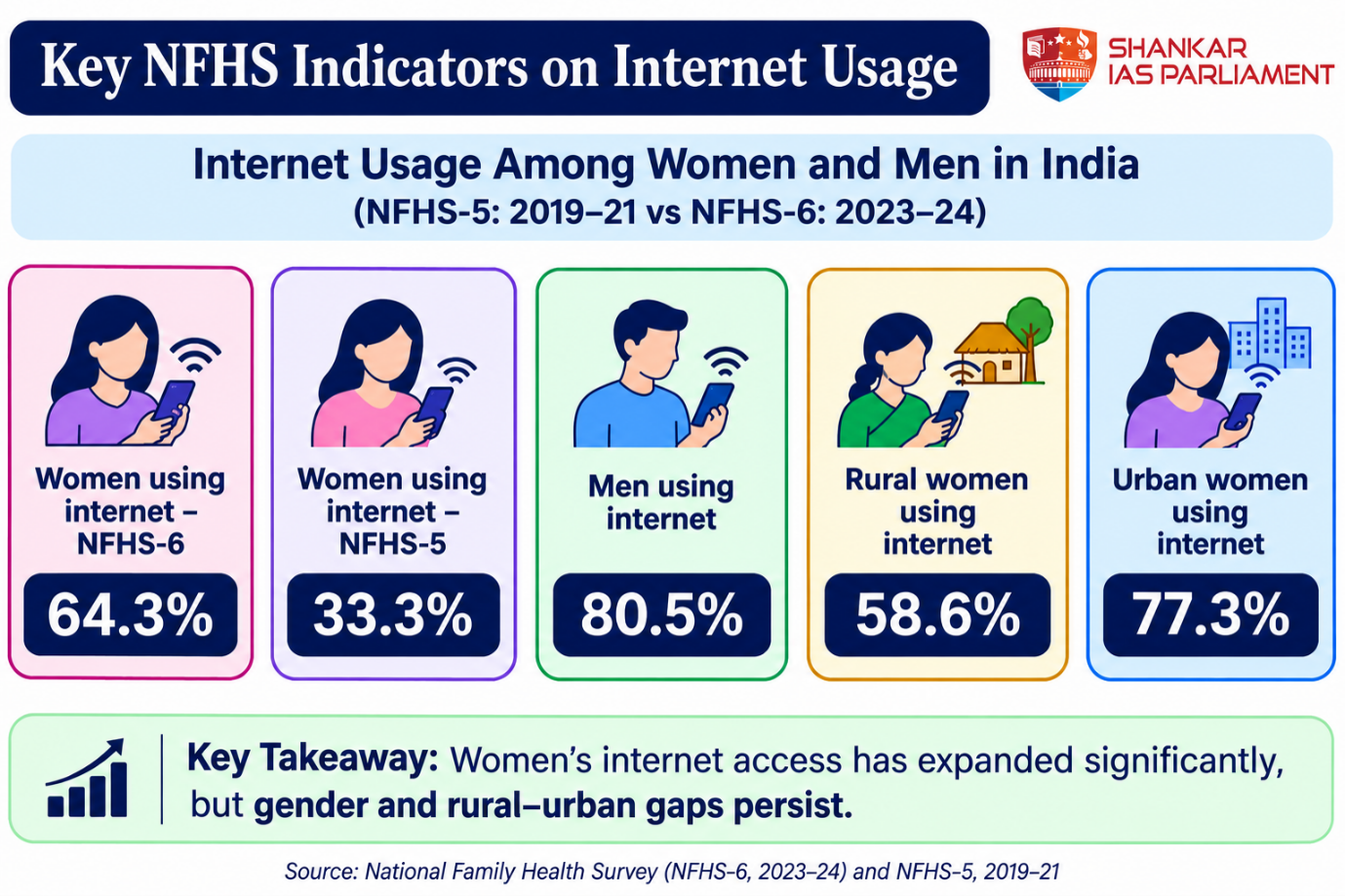
National Family Health Survey ‑ 6 (2023–24) reports that women’s internet use has doubled; however, this growth has not resulted in increased digital empowerment.
Gendered digital equity – It refers to ensuring that women possess not only access to digital technology, but also ownership, relevant skills, safety, privacy, financial autonomy, and decision-making power necessary for independent use.
Consequently, gendered digital equity is central to Sustainable Development Goal 5, which focuses on gender equality and the empowerment of women and girls.

Pradhan Mantri Gramin Digital Saksharta Abhiyan (PMGDISHA) – It delivers basic digital literacy training to rural households, prioritizing female enrolment and certification.
Digital India, 2015 – Digital government services were expanded to enhance accessibility and efficiency.
Connectivity in rural areas was improved through the implementation of broadband networks.
PMGDISHA, 2017 – The program provides basic digital literacy training to citizens residing in rural areas.
It specifically targets marginalized groups, with a focus on women.
According to the 2022 Lok Sabha response, women accounted for 52% of registered beneficiaries.
NMEICT and Online Education – Initiatives such as SWAYAM and the National Digital Library provide free digital learning platforms, increasing access to education and technology skills for girls and women.
Pradhan Mantri Jan Dhan Yojana – It has facilitated the opening of bank accounts for millions of women, establishing a foundation for direct benefit transfers and digital payments.
Bank Sakhis and Banking Correspondents – Women are deployed as banking correspondents at the grassroots level to promote digital financial literacy and facilitate transactions in rural areas.
Stand-Up India and MUDRA – These schemes provide collateral-free and subsidized digital microloans to women entrepreneurs, supporting the launch of digital or technology-enabled ventures.
Market Access and Entrepreneurship – Womaniya on GeM is an initiative on the Government e-Marketplace portal that reserves procurement quotas and provides onboarding support for women-owned micro and small enterprises.
Mahila E-Haat – This digital marketing platform enables women entrepreneurs and self-help groups (SHGs) to showcase and sell their products directly online.
Safety and Security – Dedicated cybercrime helplines, such as the 1930 hotline, and local women’s help desks in police stations offer specialized channels for reporting online harassment and ensuring digital safety.
Persistent Gender Gap – Digital access rates are 64.3% for women and 80.5% for men.
Rural–Urban Disparities – Among women, digital access is 58.6% in rural areas compared to 77.3% in urban areas.
Affordability and digital skills
High costs, low literacy levels, and limited digital skills continue to serve as significant barriers to digital access.
Patriarchal social norms – In many families, particularly in rural areas, women's use of mobile phones and technology is frequently monitored or restricted.
Safety and cybersecurity concerns – Concerns regarding safety and cybersecurity discourage women from participating independently in digital environments.
Device-sharing – The practice of sharing family devices restricts privacy and autonomy, particularly when women seek access to sensitive health-related services.
Financial dependence – Even when women generate income, financial decision-making is frequently controlled by other family members, especially men.
Intersectional barriers – Factors including class, caste, religion, ethnicity, disability, and geographic location further exacerbate the digital divide.
Access – Implement targeted subsidies or vouchers to facilitate mobile device ownership among women.
Expand access to credit and microfinance options to support the purchase of mobile devices.
Integrate mobile device ownership initiatives within existing welfare schemes.
Capability – Develop and implement gender-sensitive digital literacy programs.
Ensure the inclusion of women, girls, parents, and community leaders in digital literacy initiatives.
Incorporate cybersecurity and digital safety education into school curricula and community programs.
Ownership & Privacy – Promote individual ownership of mobile devices among women.
Ensure the availability of accessible technologies for women with disabilities.
Financial Inclusion – Develop digital financial services tailored to the needs of women.
Adopt inclusive application design and integrate assistive technologies.
Combine digital financial services with community-based and peer support mechanisms.
India should transition from providing mere digital access to fostering digital agency.
The progression should encompass connecting, equipping, protecting, enabling ownership, facilitating decision-making, and ultimately empowering individuals.
The true indicator of digital inclusion is not merely the number of women who are online, but rather how many women are able to use technology independently to exercise their choices, rights, and economic agency.
Indian Express | India’s Gendered Digital Equity



