Mains: GS II – Government Policies & Interventions
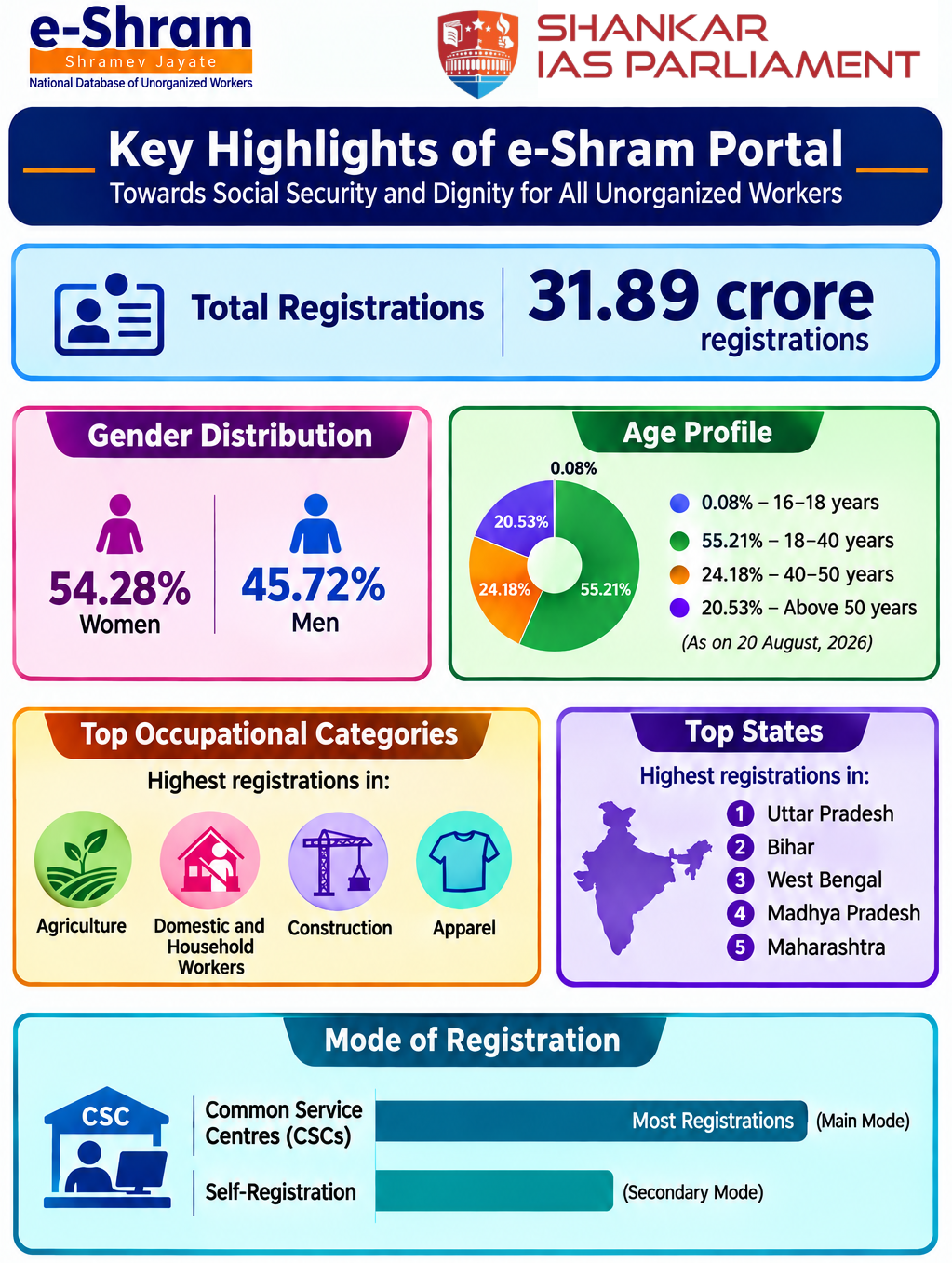
The e-Shram Portal completes 5 years, marking a significant milestone in strengthening social security for India's unorganised workforce.
e-Shram Portal – It is India's first national centralized database of unorganized workers, launched by the Ministry of Labour and Employment in August 2021.
"Unorganised worker" includes a home-based worker, self-employed worker, or a wage worker in the unorganised sector. It also includes a worker in the organised sector who is not a member of ESIC/ EPFO/ Government Employee.
Developed by – National Informatics Centre (NIC), created the country's first-ever Aadhaar-seeded National Database of Unorganised Workers.
Target Audience – It covers construction workers, migrant workers, gig and platform workers, street vendors, domestic workers, and agricultural labourers.
Key objectives
National Database of Unorganised Workers (NDUW) – It creates an Aadhaar-seeded database for workers outside formal or organized employment.
Universal Account Number (UAN) – Every registered worker receives a unique 12-digit UAN card that remains valid across India.
One-Stop Solution – The portal connects workers to social security schemes, welfare benefits, job opportunities, skilling, and pensions.
Portability – It helps migrant workers carry social security benefits across different states.
Crisis Response – The government can use the database to provide direct assistance during national emergencies like pandemics.
e‑Shram Portal Transformation
Unified Platform – Transitioned to One‑Stop Solution (Oct 2024), integrating welfare, employment, skilling & pension services with scheme visibility and convergence across portals.
Social Security Strengthening – Improves delivery, portability, and access to welfare for unorganised workers, aligned with Union Budget 2024‑25 vision.
One-Stop Solution – It brings together 15 Social Security and Welfare Schemes on a single platform. These include
Pradhan Mantri Shram Yogi Maan-Dhan Yojana (PM-SYM),
Pradhan Mantri Suraksha Bima Yojana (PMSBY),
Pradhan Mantri Jeevan Jyoti Bima Yojana (PMJJBY),
National Social Assistance Programme (NSAP),
One Nation One Ration Card (ONORC),
Pradhan Mantri Awaas Yojana–Gramin (PMAY-G) and others.
Insurance Access
Easy Enrolment – Registrants can directly enrol in PMSBY and PMJJBY through the e Shram portal.
Accidental Cover (PMSBY) – Provides Rs.2 lakh for accidental death/permanent disability and Rs.1 lakh for partial disability.
Life Cover (PMJJBY) – Offers Rs.2 lakh insurance for death due to any cause.
Portal Linkages
Employment & Skilling – Connects workers to National Career Service (NCS) for jobs and Skill India Digital Hub for skilling/apprenticeship.
Scheme Discovery – Provides access to myScheme for identifying eligible government welfare programmes.
Pension Access
Direct Enrolment – Eligible workers can register for Pradhan Mantri Shram Yogi Maan Dhan (PM SYM) through the e Shram portal.
Benefit – Assured Rs.3,000/month pension after age 60, subject to eligibility criteria.
Multilingual Functionality – In 2025, the e-Shram portal, powered by BHASHINI, introduced 22 language multilingual support to enhance inclusivity and accessibility for workers nationwide
Family Details – Collects information on the families of migrant workers to facilitate more effective welfare planning.
Construction Workers – Shares data with States and Union Territories to support registration under Building and Other Construction Workers (BOCW) Boards.
Gig and Platform Workers – Facilitates identification and registration within the national database for unorganised workers.
Scale and Utility – Approximately 1.15 million platform workers are registered, and the database informs the development of targeted social security measures.
Low Awareness and Digital Divide – Many unorganised workers, particularly women and those in rural areas, have limited awareness.
Digital illiteracy further restricts their ability to self-register.
Language and Interface Barriers – Although the platform supports 22 languages, navigation and usability remain challenging for some workers.
Aadhaar Dependence – Address mismatches and outdated Aadhaar-linked mobile numbers may exclude eligible workers, especially migrants.
No Real-Time Benefits – The system primarily serves as a worker database.
Registration does not automatically provide benefits such as insurance, which require separate enrolment.
Static or Unverified Data – Employment, occupation, and migration details may not be updated regularly, increasing the risk of outdated records.
Weak Institutional Follow-Up – Limited coordination among labour departments, local bodies, and field-level staff, along with insufficient training, reduces outreach.
Migrant Worker Challenges – Frequent migration makes it difficult to maintain updated information on location, occupation, and employment status, which affects effective targeting of schemes.
Bridge Digital Divide – Expand assisted registration through Common Service Centres (CSCs), Panchayats, and Self-Help Groups (SHGs). Implement targeted awareness campaigns for women, rural populations, and migrant workers.
Improve Accessibility – Simplify the user interface, enhance support for regional languages, and incorporate features for voice input and low-literacy users.
Minimise Aadhaar Exclusion – Implement flexible authentication and correction mechanisms for Aadhaar, mobile, and address mismatches, with particular attention to migrant populations.
Dynamic Database – Enable regular updates and verification of occupation, location, employment status, and migration status.
Link Registration with Benefits – Integrate the e-Shram platform with welfare schemes to enable automatic eligibility determination and seamless benefit delivery.
Ensure Portability – Establish a portable social security identity for migrant workers that is recognised across all States.
Strengthen Coordination – Enhance coordination among central, state, and local bodies. Provide regular training for officials and volunteers.
Ensure Data Security – Enhance privacy protections, informed consent processes, cybersecurity measures, deduplication, and verification protocols to ensure reliable worker records.
The e‑Shram Portal has established a robust foundation for an inclusive, technology‑enabled social security ecosystem for India’s unorganised workforce.
To advance this progress, the portal should transition from a static database to a dynamic social security platform.
This evolution would facilitate portable, automatic, and timely access to welfare benefits, thereby transforming worker identification into substantive social security empowerment.



