Mains: GS II – Polity & Governance
The CPGRAMS has recently undergone major reforms, making it one of the world’s largest digital grievance redressal platforms.
CPGRAMS – The primary digital grievance redressal system implemented by the government.
Single Portal – A unified platform designed for the submission and tracking of grievances.
Integration – The system is connected with all ministries and departments of the Government of India and state governments.
It operates as a 24x7 online platform that enables citizens to lodge grievances related to service delivery.
Role-based access – It ensures that each Ministry and State has defined levels of access to the system.
Transformation – Transition from fragmented and manual processes to a technology-driven platform.
Emphasis on efficiency, transparency, and citizen satisfaction.
Rising Grievances – Annual grievances increased from 301,000 in 2014 to 2.7 million in 2024.
This nearly ninefold increase reflects growing public trust in the system.
Expanded Network – The number of Grievance Redressal Officers expanded from 10,232 in 2014 to over 111,000 projected in 2025.
This expansion has resulted in broader institutional coverage.
Improved Service Delivery – Average grievance disposal time reduced from 157 days in 2014 to an estimated 15 days in 2025.
This represents a significant reduction in delays and enables faster resolution of grievances.
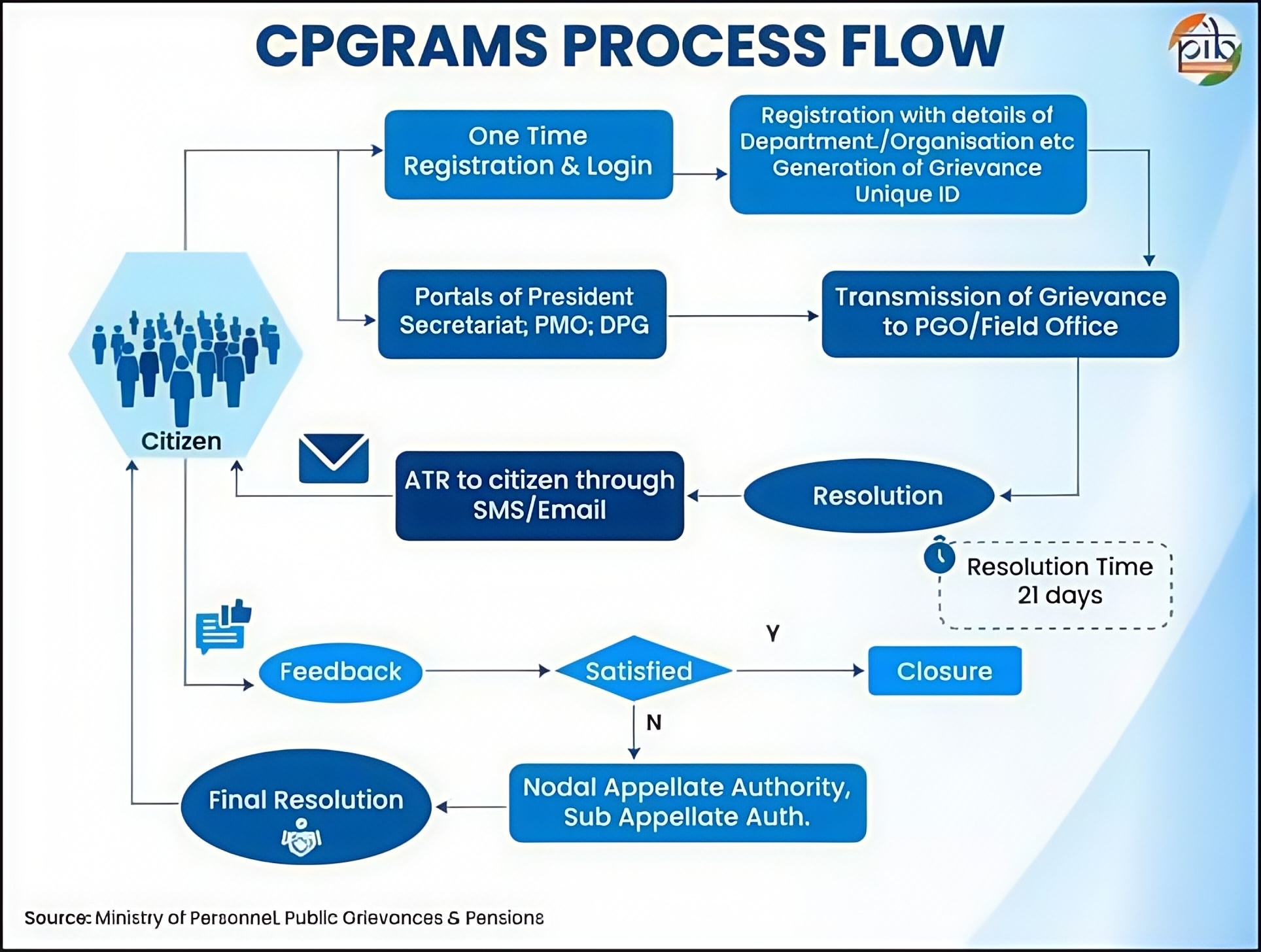
Registration – One‑time registration via pgportal.gov.in.
Digital Access – Grievances can be filed via CPGRAMS mobile app (integrated with UMANG) and through 5 lakh+ CSCs run by 2.5 lakh Village Level Entrepreneurs.
Offline Integration – Complaints received by post are digitised and uploaded into the system.
Auto‑Routing & Categorisation – The system identifies and assigns the appropriate last-mile Grievance Redressal Officer (GRO).
Grievance Handling – Complaints are auto‑routed to the relevant authority and tracked through a unique registration ID.
Timelines & Resolution – According to the August 2024 guidelines, the complaint disposal timeline has been reduced from 30 days to 21 days.
Mandate – Establishment of grievance cells, implementation of root cause analysis, and escalation mechanisms.
The average disposal time has decreased from 157 days in 2014 to an anticipated 15 days by 2025.
Feedback & Appeal – A Feedback Call Centre contacts citizens after the resolution of their complaints.
Appeals Process – Dissatisfied complainants can appeal to the Nodal Appellate Authority, resolved within 30 days, with status tracked via grievance registration number.
Excluded Issues
RTI matters
Court‑related / Sub‑judice matters
Religious matters
Grievances of Government employees concerning their service matters including disciplinary proceedings etc.
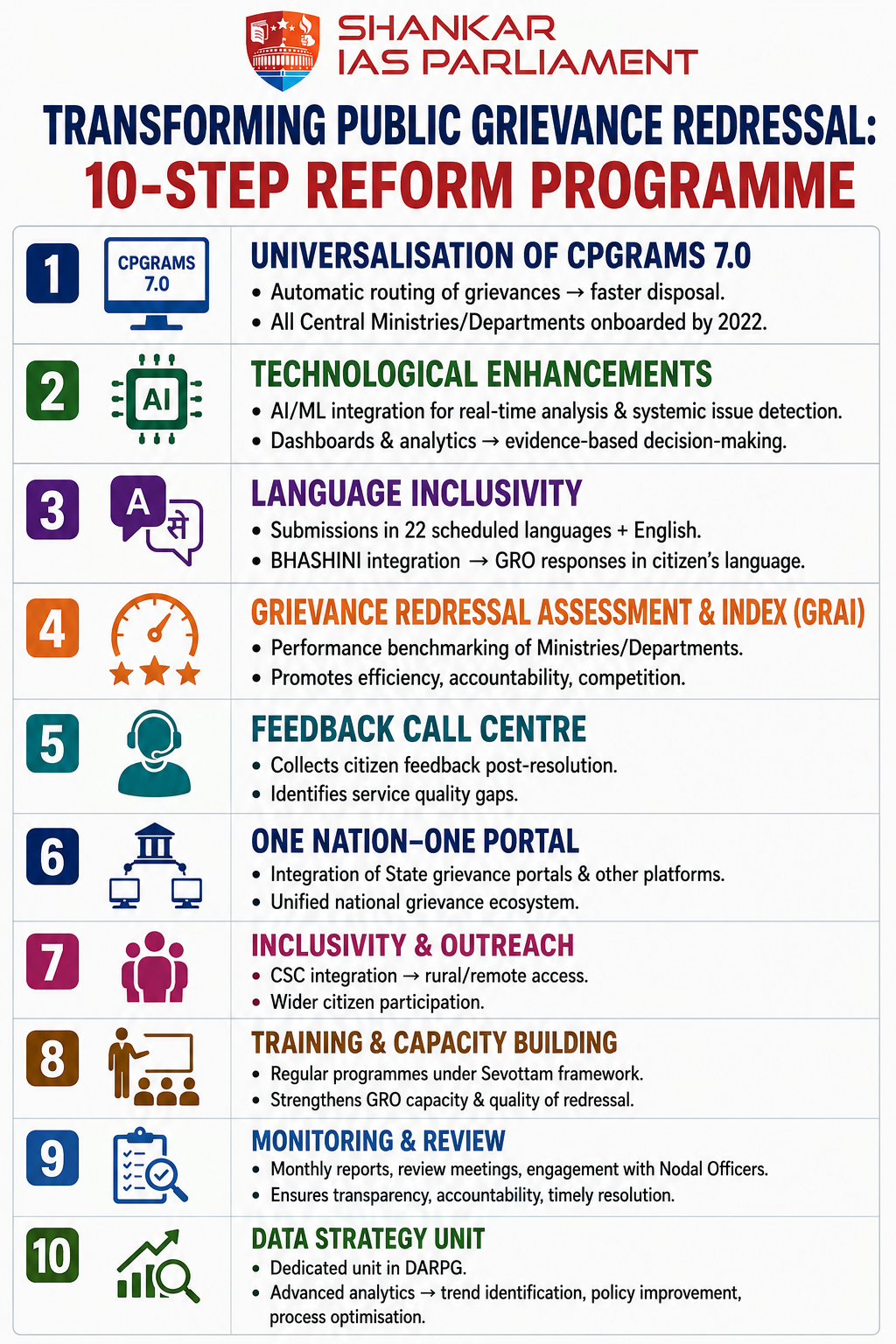
DARPG is advancing the Next Generation CPGRAMS initiative, a flagship project aimed at modernising India's public grievance redressal ecosystem through cutting-edge digital technologies.
Objective – To enhance accessibility, efficiency and transparency, the platform seeks to deliver a more seamless and citizen-centric grievance redressal experience.
Once operational, NextGen CPGRAMS will incorporate several advanced features, including:
Voice-enabled grievance registration and chatbot support.
AI-based grievance categorisation and intelligent routing.
Integration of State grievance categories into a unified platform.
Multilingual support across 22 scheduled languages, besides English.
Omni-channel grievance registration through email, social media and mobile applications.
Automated escalation mechanisms for timely grievance resolution.
Accessibility features for persons with disabilities.
Real-time analytics and reporting dashboards.
AI-enabled validation of grievance redressal to assess resolution quality and identify cases involving disposal through transfer or closure without effective resolution.
Samadhan Didi: AI‑Enabled Grievance Redressal
Launched on 30 May 2026, the voice chatbot Samadhan Didi integrates AI with BHASHINI to allow citizens to lodge grievances in 22+ languages by simply speaking, ensuring inclusivity, automatic routing, and democratized access to public grievance redressal.
Routing inefficiencies – Multiple layers of complaint transfers between ministries, states, and local offices result in significant delays.
Contextual deficit – Authorities often lack local insights, which leads to superficial case closures.
Tokenistic disposal – Departments may issue standard responses or shift responsibility, resulting in inadequate redress.
Digital access barriers – Rural citizens and those with limited digital literacy face challenges using portals and applications, even with CSC support.
Low public awareness – Many individuals remain unaware of procedures and escalation mechanisms.
Over the past decade, CPGRAMS has evolved into one of the world’s largest digital grievance redressal platforms, ensuring timely resolution, accountability, and citizen‑centric governance aligned with Viksit Bharat vision.
PIB | Centralised Public Grievance Redress and Monitoring System (CPGRAMS)



