Why in News?
El Nino early onset and high intensity could amplify extreme weather events particularly in vulnerable regions.
What is El Nino?
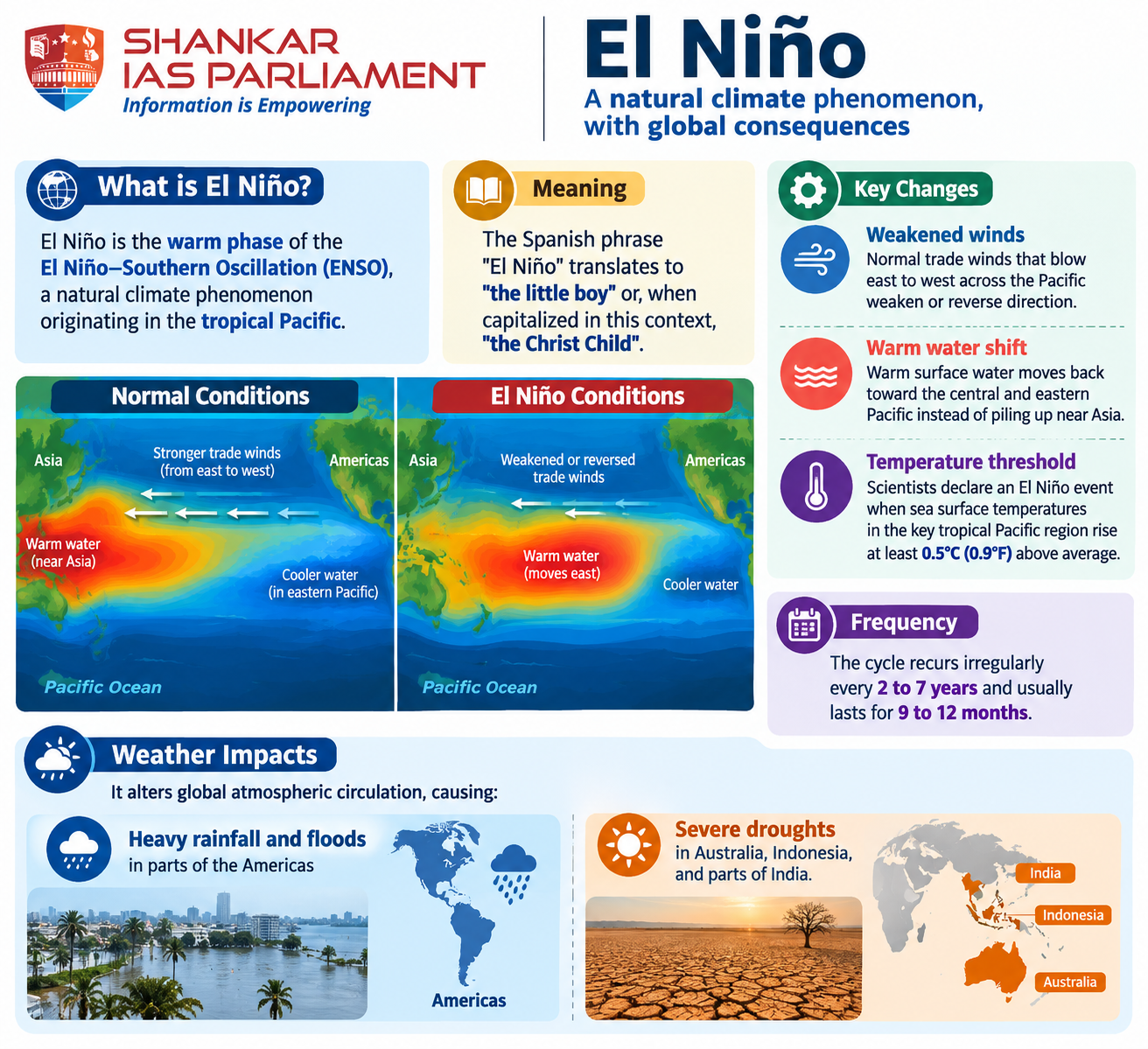
- El Nino – El Nino is the warm phase of the El Nino–Southern Oscillation (ENSO), a natural climate phenomenon originating in the tropical Pacific.
La Nina causes the surface of the Pacific Ocean to cool down. It is the opposite of El Niño. El Nino occurs more frequently than La Nina.
- Meaning – The Spanish phrase "El Nino" translates to "the little boy" or, when capitalized in this context, "the Christ Child".
- Weakened winds – Normal trade winds that blow east to west across the Pacific weaken or reverse direction.
- Warm water shift – Warm surface water moves back toward the central and eastern Pacific instead of piling up near Asia.
- Temperature threshold – Scientists declare an El Nino event when sea surface temperatures in the key tropical Pacific region rise at least 0.5°C (0.9°F) above average.
- Frequency – The cycle recurs irregularly every 2 to 7 years and usually lasts for 9 to 12 months.
- Weather impacts – Pacific Region, Warmer waters can alter the location and intensity of tropical cyclones, particularly over the central and eastern Pacific.
- Countries around the Pacific may experience heightened risks of storms, droughts, floods and heatwaves.
- It triggers severe droughts in Australia, Indonesia, and parts of India.
- This can increase drought and bushfire risks
Why is the Current El Nino Exceptional?
- Early Peak – El Nino events typically reach their maximum strength between November and January.
- The current event has reached unusually high temperatures well before its expected summer peak.
- Record Relative Heat – Relative index data for August reached 2.3°C above average, outpacing previous strong El Nino years.
- Severe Climate Impacts – In Australia, El Nino generally triggers hotter and drier conditions, though specific impacts vary with each event.
- On a global level, this particular event is projected to drive record-breaking temperatures in 2027.
What are the Impacts associated with El Nino?
- Improper uniform impacts – previous strong El Nino events have produced both severe dryness and substantial rainfall in different parts of Australia.
- Agriculture concerns – Changing rainfall patterns can cause crop failures, droughts and floods.
- Parts of South America may face excessive rainfall, while some African regions could experience severe drought.
- Food Security – Vulnerable communities are particularly exposed to acute hunger and livelihood losses.
- Coral bleaching – Higher ocean temperatures increase the risk of coral bleaching, including on the Great Barrier Reef.
- Wildfire risks – Hot and dry conditions can increase wildfire risks.
- Reduced water availability – Drought can reduce water availability for agriculture and human consumption.
- Biodiversity stress – Repeated heat and moisture stress can disrupt ecosystems and species distributions.
What are the challenges associated with El Nino?
- Limited prediction – Limited ability to accurately predict regional impacts of an exceptionally strong El Nino.
- Complex interactions – Interaction between El Nino and anthropogenic climate change remains complex.
- Limited adaptive capacity – Greater risks to small farmers and vulnerable populations with limited adaptive capacity.
- Potential disruption to food systems, water security and livelihoods.
- Compound events risk – Rising frequency and intensity of compound events such as heatwaves, droughts, wildfires.
What could be done?
- Strengthen ENSO monitoring, climate modelling and seasonal forecasting.
- Develop region-specific early-warning systems for droughts, floods, cyclones and wildfires.
- Improve climate-resilient agriculture through drought-resistant crops, efficient irrigation and crop diversification.
- Strengthen disaster preparedness and social-protection mechanisms for vulnerable communities.
- Protect climate-sensitive ecosystems such as coral reefs, forests and wetlands.
- Accelerate reduction of greenhouse-gas emissions to limit the long-term warming that amplifies climate extremes.
What lies ahead?
- The emerging strong El Nino demonstrates how a natural climate variability event can interact with anthropogenic global warming to intensify extreme weather.
- While El Nino cannot be prevented, better forecasting, resilient food systems, ecosystem protection can reduce its human and ecological costs.
Reference
Down To Earth| El Nino 2026-Implications for Global Weather



