Prelims: Current events of national and international importance| Environment
Why in News?
A landmark paleoclimatological study by researchers from the University of Michigan has analyzed a 1,000-year archive preserved in fossil corals from the Galápagos Islands.
Key Highlights of the Study
- Researchers sampled core records from 13 coral colonies including living structures and ancient fossilized coral boulders in the Galápagos archipelago to reconstruct ocean temperature variations.
- The study revealed that El Niño events have intensified by nearly 36% over the past 40 years compared to pre-industrial baselines (~1850).
- El Niño events over the past 4 decades (including major events in 1982–83 and 1997–98) are roughly 36% stronger than during the pre-industrial era, exceeding any natural variability seen over the last 1,000 years.
- The data demonstrates that the strength of El Niño events changes in direct parallel with rising global surface temperatures.
- Climate model simulations revealed that natural internal climate processes alone could not account for such a massive shift in intensity during the recent 40-year window.
Scientific Context
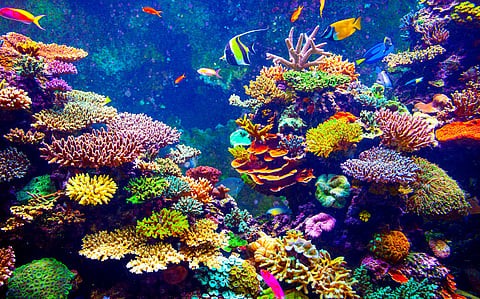
- Corals as Natural Thermometers- Massive corals grow by 1 to 2 centimetres annually by secreting layers of calcium carbonate (CaCO3).
- The chemical composition of these layers preserves an accurate record of seawater temperature and salinity at the time of growth.
- Galápagos as Ground Zero - The Galápagos Islands are located in the eastern tropical Pacific Ocean, where El Niño's sea surface temperature (SST) anomalies and upwelling disruptions exert their maximum physical impact.
- ENSO Disruption - Under normal conditions, equatorial trade winds push warm surface waters westward toward Australia.
- During El Niño, these trade winds weaken, causing warm water to shift back eastward toward South America, altering global atmospheric circulation and driving extreme weather worldwide.
Reference
Down To Earth | Climate change is strengthening El Niño



