Mains: GS III - Food Processing
Why in News?
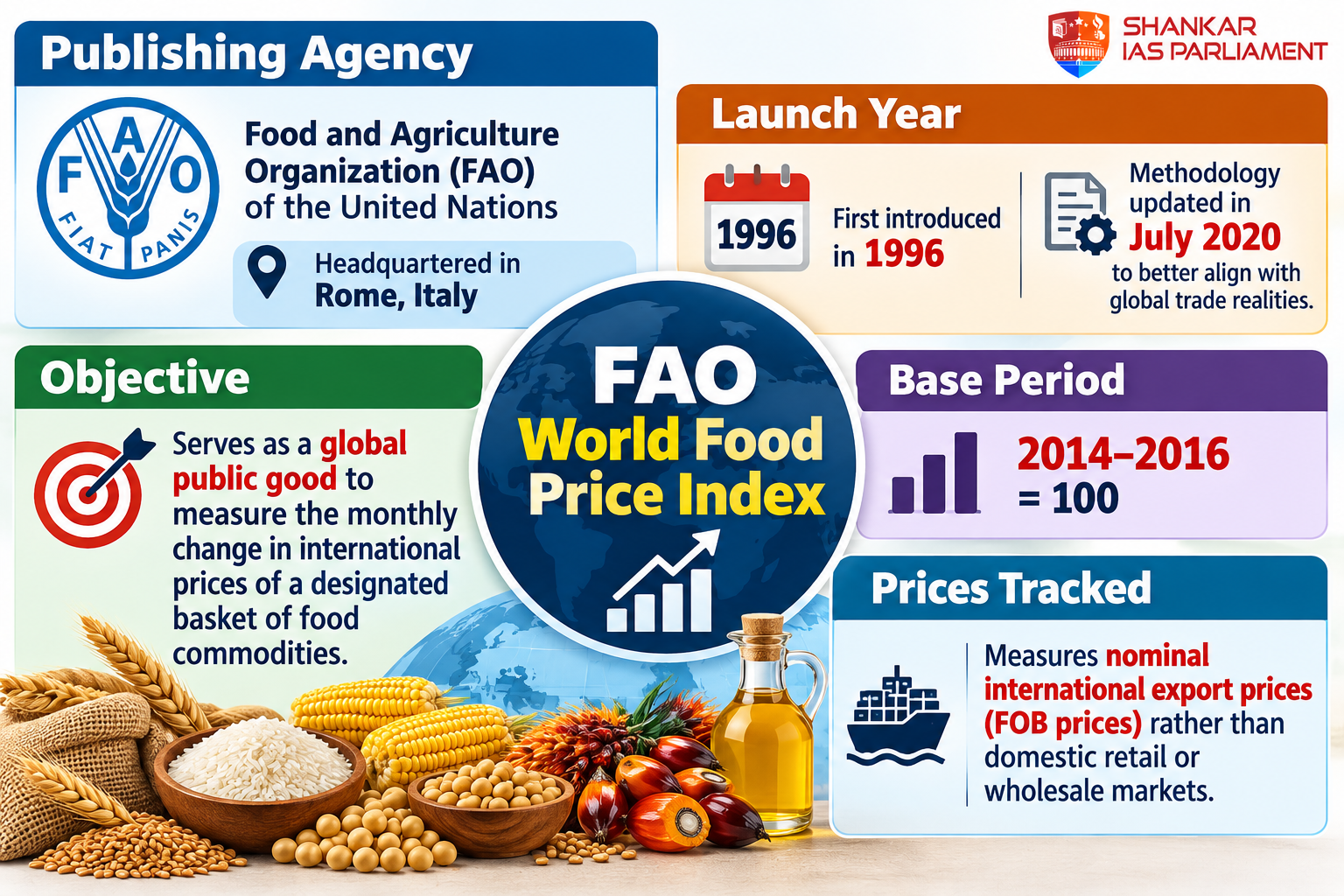
The United Nations Food and Agriculture Organization (FAO) Food Price Index averaged 136 points in September, marking its highest level since November 2022.
What is the reason for vegetable oil price inflation?
- Triple-Trigger Volatility – Global prices are driven by three intersecting pressures –
- Escalating geopolitical conflict (Russia-Ukraine war, West Asia tensions),
- Climate stress (El Niño-induced droughts), and
- Aggressive national biofuel mandates.
How do aggressive global biofuel mandates drive "food-to-fuel" diversion?
- Chemistry of Biodiesel Production – Vegetable oils (palm, soy, rapeseed) undergo transesterification reacting triglycerides with methanol to produce Fatty Acid Methyl Esters (FAME), which substitutes or blends directly with diesel.
- Significant Global Supply Diversion – Approximately 25% of global soyabean oil, 28% of palm oil, and 29% of rapeseed oil are now consumed as feedstock for biodiesel rather than human food consumption.
- United States – Diverting 8.07 million tonnes (54%) of its 14.94 million tonne soyabean oil output toward biofuels.
- European Union – Directing 6.1 million tonnes (57.2%) of its 10.67 million tonne rapeseed oil output to biodiesel and bio-ATF.
- Aggressive Blending Mandates in Southeast Asia –
- Indonesia – Implemented B40 blending and raised the mandate to B50 in July 2026, absorbing 14.7 17.4 million tonnes of palm oil locally.
- Malaysia – Rolled out B15 phased blending starting mid-2026.
What are the key supply-side bottlenecks – Climate shocks and logistical disruptions?
- El Nino Lag Impact on Palm Yields – Oil palm trees abort female flowers and young fruit bunches during severe water stress, causing a lagged yield drop of 8 to 12 months.
- Indonesia's total palm oil production is projected to decline from 58.5 million tonnes to 56.6 million tonnes, drastically cutting net exportable surplus.
- Geopolitical and Logistical Blockades in the Black Sea – Despite record harvests of sunflower seeds in Russia (21 million tonnes) and Ukraine (13 million tonnes), reciprocal military strikes on port infrastructure and storage terminals have severely disrupted exports.
- Closure of the Sea of Azov and suspension of Black Sea port operations force reliance on expensive, overloaded Baltic, Caspian, and overland rail routes.
What are the specific implications and structural risks for India?
- High Import Dependence and Structural Deficit – India relies on imports for nearly 60% of its domestic edible oil consumption, making its domestic price stability directly vulnerable to external supply shocks.
- Shrinking Domestic Production and Soaring Import Bills – Due to El Niño impact on domestic oilseed harvests, India's domestic production is estimated to drop to 9.2 million tonnes (down from 9.7 million tonnes). Imports are projected to reach a record 17.2 million tonnes (comprising 8.2 mt palm, 5 mt soyabean, and 3.5 mt sunflower oil).
- Export Squeeze from Donor Nations – Indonesia's B50 mandate will absorb an additional 4.7 million tonnes locally, shrinking global export availability precisely when India requires higher import volumes.
What policy measures are needed to ensure long-term edible oil security?
- Scaling National Mission on Edible Oils – Oil Palm (NMEO-OP) – Accelerate high-yielding oil palm cultivation across North-East states and Andaman and Nicobar Islands to reduce foreign import reliance.
- Dynamic Import Duty Rationalization – Calibrate import tariffs on crude and refined palm/soya oils to balance domestic consumer inflation against local farmer price protection.
- Promoting Non-Conventional Domestic Oils – Expand processing infrastructure for rice bran oil, cotton-seed oil, and tree-borne oilseeds to build domestic cushioning against global supply chain shocks.
- Global Bilateral Trade Agreements and Buffer Stocks – Establish long-term supply agreements with alternative producers (e.g., South America for soy, East Africa for sunflower) and maintain strategic domestic buffer stocks.
Reference
Indian Express | FPI



