Mains: GS II – Bilateral Relations
Why in News?
Recently, China agreed to loan two giant pandas (named Ping Ping and Fu Shuang) to Zoo Atlanta in Georgia.
What is Animal Diplomacy and how has it evolved historically?
What is India’s historical and contemporary engagement with Animal Diplomacy?
|
Historical Era |
Milestone |
Strategic and Cultural Significance |
|
Medieval Transit (1414) |
Malindi (Kenya) envoys gifting a giraffe to Ming Admiral Zheng He in Bengal. |
Highlighted Bengal's role as a major Indian Ocean maritime trade hub. |
|
Early Modern (1515) |
Sultan of Gujarat gifting a one-horned rhinoceros to King Manuel I of Portugal. |
Inspired Albrecht Dürer’s iconic woodcut, introducing Indian fauna to European art. |
|
Mughal Era (1600s) |
Emperor Jahangir acquiring exotic species (e.g., North American turkey) via Portuguese Goa. |
Demonstrated royal interest in natural history and global trade networks. |
|
Post-Independence |
PM Nehru gifting Asian elephants (e.g., Indira to Japan, USSR, China, USA). |
Post-war soft power projection and building people-to-people ties with children globally. |
|
Contemporary (2020s) |
Transcontinental translocation under Project Cheetah (Namibia, South Africa, Botswana) and Gifting peacocks to UN Geneva (2026). |
Repositioning India as a global leader in ecological restoration and biodiversity stewardship. |
What is the strategic value of Animal Diplomacy?
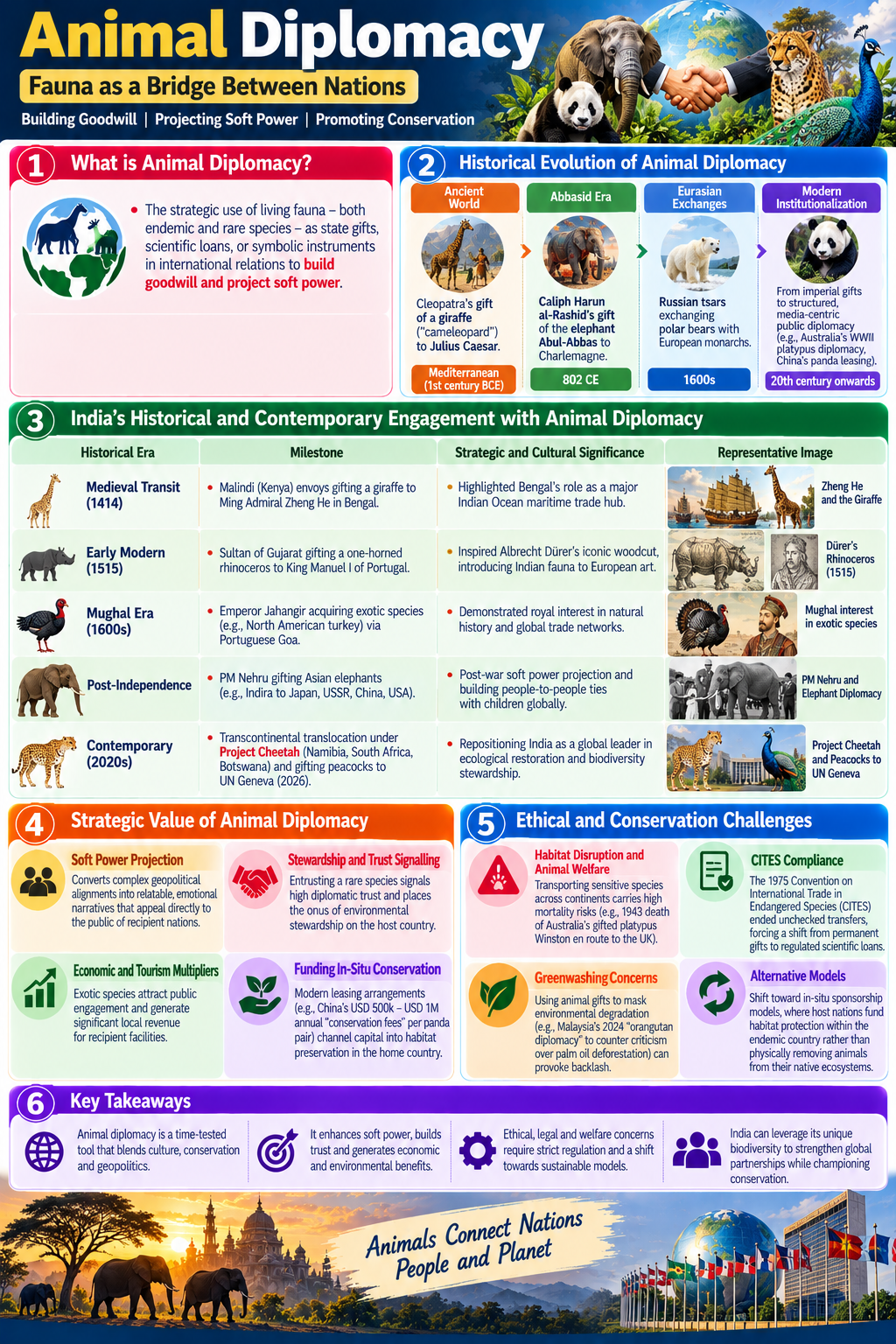
What are the ethical and conservation challenges?
Reference



