Mains: GSIII – Disaster Management
Why in News?
3 years after the 2023 Sikkim GLOF, India has expanded monitoring of glacial lakes, but gaps remain in early-warning systems, last-mile preparedness, risk-sensitive infrastructure and community resilience.
What is a Glacial Lake Outburst Flood (GLOF)?
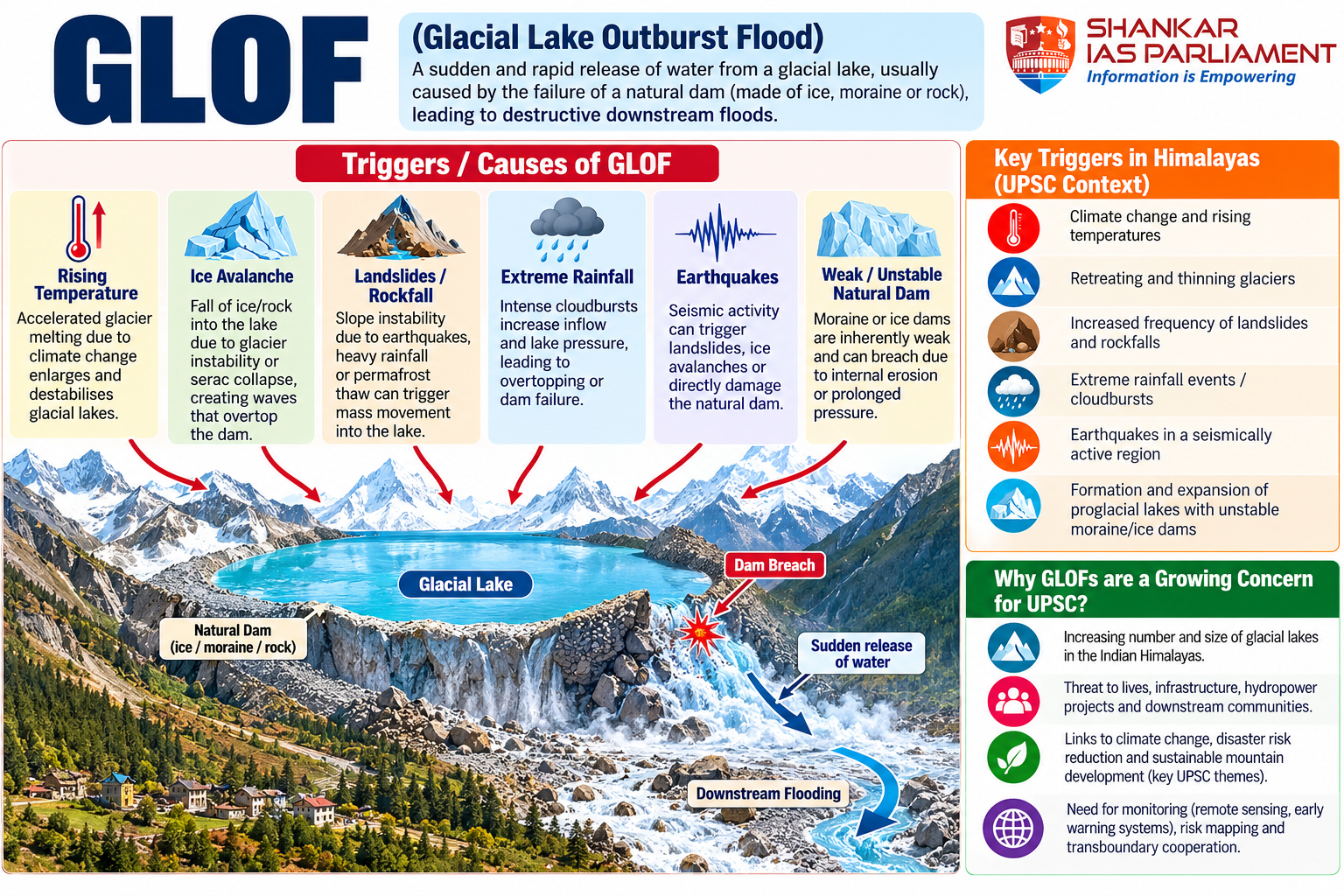
- GLOF – It occurs when a glacial lake suddenly releases a large volume of water.
- It can be triggered by landslides, avalanches, ice falls, earthquakes or failure of moraine dams.
- The sudden water release can cause flash floods, debris flows and landslides downstream.
Why is the GLOF Threat Increasing?
- Climate Change – Rising temperatures are causing glacier retreat and expansion of glacial lakes.
- Larger lakes increase the volume of water that can be suddenly released.
- Fragile Himalayan Geography – Steep slopes, unstable terrain and seismic activity increase the vulnerability of Himalayan valleys.
- GLOFs can rapidly transform into landslides, mudflows and debris floods.
- Increasing Human Intervention – Hydropower projects, roads, dams and settlements in fragile valleys can increase exposure to GLOF hazards.
- Infrastructure located along river valleys faces particularly high risks.
- Growing Exposure – Himalayan communities depend heavily on agriculture, tourism, hydropower and river systems.
- Thus, a GLOF can simultaneously affect lives, livelihoods and critical infrastructure.
|
Impact of the 2023 Sikkim GLOF
|
- Human Impact – The October 2023 GLOF affected around 80,000 people across 100 villages.
- It officially resulted in 55 deaths, 74 missing persons and 7,025 displaced people.
- Infrastructure – The disaster damaged bridges, roads, buildings, agricultural land and hydropower infrastructure.
- The Teesta III hydropower dam at Chungthang was severely affected.
- Economic Impact – The estimated damage and losses were around ₹1,480 crore across social, agricultural, tourism and infrastructure sectors.
- Significance – The Sikkim disaster demonstrated how a high-altitude hazard can generate cascading impacts across downstream regions.
|
What is the GLOF Risk in the Himalayan Region?
- Hindu Kush Himalaya (HKH) Vulnerability –
- The HKH region covers eight countries and is a major GLOF hotspot.
- Poverty, dependence on agriculture, rapid population growth and inadequate disaster-management infrastructure increase vulnerability.
- Limited early-warning coverage leaves millions of people exposed.
- India’s Vulnerability –
- India has experienced several GLOF events across the Himalayan region.
- GLOFs pose risks to Sikkim, Arunachal Pradesh, Himachal Pradesh and Uttarakhand, among other Himalayan areas.
- Many settlements and infrastructure projects are located in downstream valleys, increasing exposure.
How is India Strengthening GLOF Monitoring?
- Expansion of Glacial Lake Mapping – The CWC and NRSC have progressively expanded monitoring of glacial lakes and waterbodies.
- NRSC’s 2023 inventory identified 28,043 glacial lakes larger than 0.25 hectares.
- By June 2025, CWC was monitoring 2,485 glacial lakes and 358 waterbodies across Indian Himalayan river basins.
- National Glacial Lake Outburst Flood Risk Mitigation Project (NGRMP) – The Union government approved ₹150 crore for Arunachal Pradesh, Himachal Pradesh, Sikkim and Uttarakhand under the NGRMP.
- It focuses on
- Early-warning systems.
- Real-time remote-sensing monitoring.
- Controlled drainage of high-risk lakes.
- Strengthening lake boundaries.
- Automatic weather stations.
- GLOF-resilient infrastructure.
What are the Major Challenges in GLOF Management?
- Early-Warning Gaps – Many vulnerable locations still lack real-time monitoring and last-mile warning systems.
- Difficult Himalayan Terrain – Remote and inaccessible terrain makes installation and maintenance of monitoring infrastructure difficult.
- Limited Community Preparedness – Warnings are useful only when communities know when, where and how to evacuate.
- Infrastructure Vulnerability – Roads, bridges, dams and settlements in river valleys can become major points of damage during GLOFs.
- Development–Ecology Conflict – Hydropower, tourism and road construction can increase exposure when development is not aligned with carrying capacity and hazard assessment.
- Data and Research Gaps – Limited long-term data on glacial lakes, past GLOFs, losses and changing risk patterns can weaken policy planning.
- Transboundary Nature – Himalayan river systems cross national boundaries, requiring regional cooperation on monitoring, data-sharing and disaster warnings.
What May be the Way Forward?
- Strengthen Early-Warning Systems – Expand real-time lake monitoring, automatic weather stations and downstream sensors.
- Establish reliable last-mile warning mechanisms reaching every vulnerable community.
- Adopt Community-Based Disaster Management
- Prepare village-level evacuation plans.
- Conduct regular mock drills and Train disaster-response teams.
- Use local languages and accessible communication systems.
- Implement Risk-Sensitive Land-Use Planning
- Map GLOF hazard zones.
- Restrict hotels, settlements and critical infrastructure in high-risk areas.
- Integrate GLOF risk into local development plans.
- Build Climate-Resilient Infrastructure – Design bridges, roads, dams and hydropower projects according to GLOF and cascading hazard assessments.
- Strengthen vulnerable downstream infrastructure.
- Improve Science and Technology – Use satellite imagery, remote sensing, AI and predictive modelling for risk assessment.
- Develop a comprehensive national database covering GLOF frequency, lake characteristics, damage and fatalities.
- Strengthen Centre–State Coordination – Ensure coordination among CWC, NRSC, NDMA, State Disaster Management Authorities and district administrations.
- Combine national monitoring with local preparedness.
- Promote Regional Cooperation – Strengthen information-sharing among Himalayan countries.
- Develop mechanisms for transboundary early warnings and disaster-risk reduction.
What lies ahead?
- GLOFs demonstrate the growing interaction between climate change, fragile ecosystems and infrastructure vulnerability.
- India's response must therefore move from post-disaster relief to anticipatory and community-based resilience.
- A combination of scientific monitoring, early warnings, risk-sensitive development, resilient infrastructure and empowered local communities is essential to protect lives and livelihoods in the Himalayan region.
Reference
Down To Earth| India’s GLOF threat is growing



