Mains: GS II – Governance
Why in News?
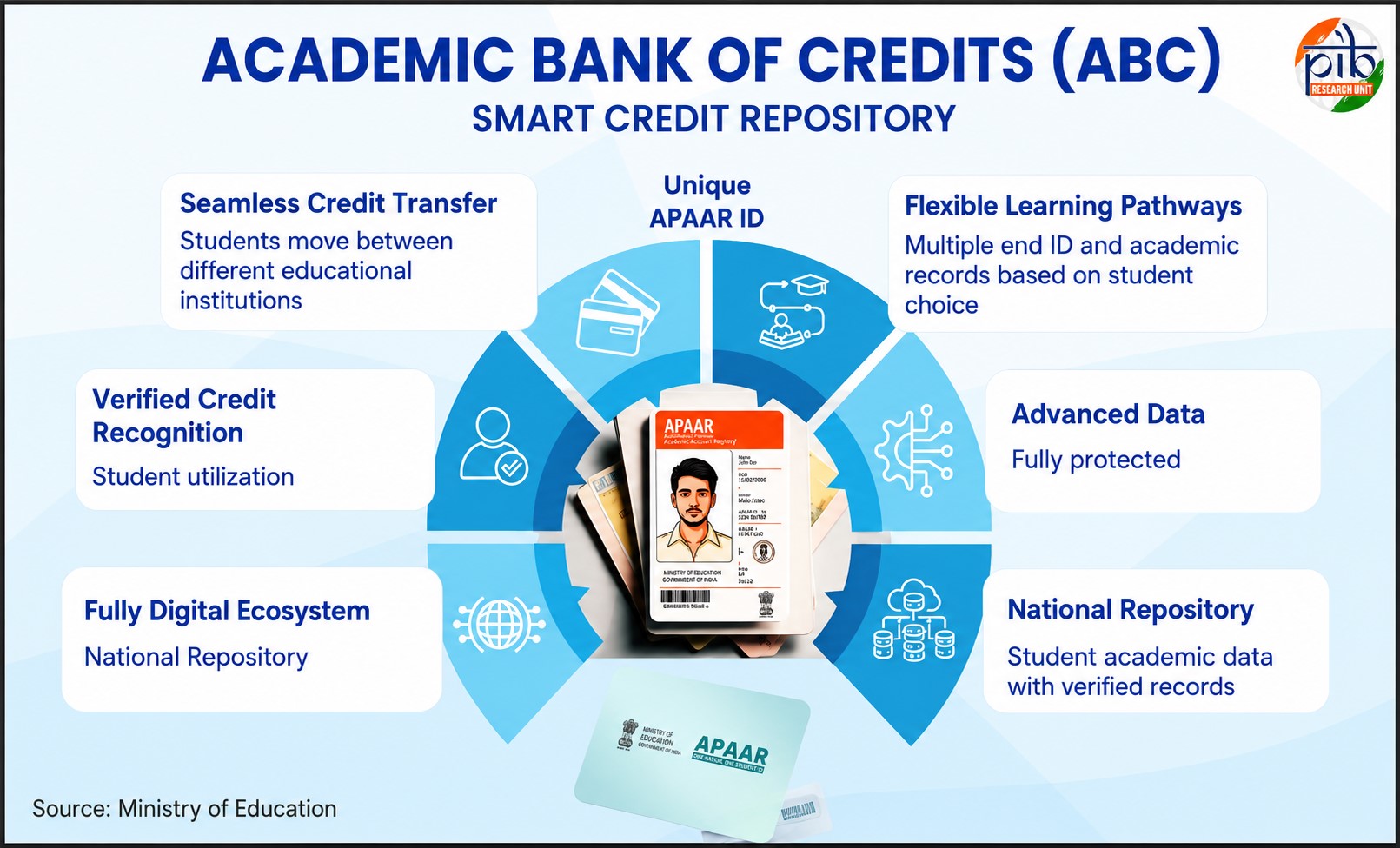
The Academic Bank of Credits (ABC) and APAAR are revolutionizing the education ecosystem of the country.
What is ABC and APAAR?
- The Academic Bank of Credits (ABC) – It is a revolutionary digital platform by the Ministry of Education.
- Regulatory authority – It is regulated by the University Grants Commission (UGC).
- APAAR – Automated Permanent Academic Account Registry, ID.
- It is a unique 12-digit student identification number linked to the ABC system.
- Introduced as part of the “One Nation, One Student ID” initiative, APAAR creates a single academic identity for every learner.
- Accessibility – It is accessible through DigiLocker.
- Feature – It brings together a student's educational records from school, higher education, skill development, and other learning programmes onto one platform.
- APAAR IDs can be generated through the nearest Common Service Centre (CSC), making it accessible in remote and underserved areas too.
- Together, ABC and a student’s APAAR ID helps build their education brick by brick, across institutions and over time.
What are the objectives?
- Providing a Platform – It is built to support every learner’s journey by providing a digital platform for storing, managing, transferring, and redeeming academic credits earned by students from recognised educational institutions.
- Reforming education system – The main objective of ABC is to create a flexible, learner-friendly education system in which learning achievements can be recognised, stored, and used throughout a person's life.
- Supports NEP – It supports the vision of the National Education Policy (NEP) 2020 and the National Credit Framework (NCrF) by enabling credit transfer, multiple entry and exit options, and recognition of learning across different institutions and disciplines.
- This means that if a student chooses to drop out of studies after having completed it partially, the credits that he earned are stored in this data bank.
- Integration of Stakeholders – The platform also supports integration with schools, universities, skill institutions, and other education stakeholders, creating a connected education ecosystem.
How does ABC work?
- Registration by students – Students register on the ABC portal and receive a unique ABC ID or APAAR ID linked to their Aadhaar and DigiLocker account.
- Students belonging to eligible Higher Education Institutions (HEIs) can use the ABC facility.
- Data Upload by institution – Academic institutions upload credit data directly to the ABC portal against each student's account.
- Students can accumulate, transfer, and redeem credits across HEIs without losing academic progress.
- Credits are valid for a maximum of 7 years or the duration prescribed by the relevant academic discipline. Once redeemed, credits cannot be reused.
- Credit redemption and certificate issuance are handled by academic institutions via the National Academic Depository (NAD) platform.
- The NAD serves as the backbone of ABC, securely storing all academic awards and records.
- Data Security Management – The platforms adopt robust security protocols and encryption standards to ensure data privacy and integrity.
- Access is authenticated via APAAR ID and Aadhaar-linked DigiLocker credentials, safeguarding user information while maintaining seamless accessibility across all integrated systems and institutional frameworks.
What are the key features and outcomes?
- Academic Mobility – Students can study across multiple HEIs and transfer their credits seamlessly between programmes and institutions.
- ABC provides students with a seamless, consent-based document exchange system that streamlines verification and significantly reduces processing time.
- Multiple Entry and Exit (MEE) – ABC enables the MEE framework under NEP 2020.
- This allows provisions for obtaining a Certificate after completion of one year, Diploma after two years, Degree after three or four years.
- Students can access their digital certificates from anywhere, at any time.
- Reducing dropouts – Reduced dropout rates and improved motivation to learn continuously.
- ABC is bridging the gap between the formal, informal and experiential learning.
- Student-linked benefits – By authenticating the APAAR ID, students between the ages of 13 and 30 can unlock exclusive travel benefits, including up to a 10% discount on base airfares and an extra 10kg baggage allowance.
- SWAYAM Integration – Students may avail up to 40% of credits from the SWAYAM online platform.
- About 388 universities have adopted this regulation, broadening access to quality learning.
- National Credit Framework (NCrF) – ABC is aligned with the NCrF, covering academic, vocational, and experiential learning. NCrF has been adopted by 170 universities across India as of 2026.
- ABCs Digital Public Infrastructure – ABC is a key component of India's Digital Public Infrastructure (DPI) for education, under the Digital India Programme.
- Integration with NAD-DigiLocker allows students secure, anytime access to their own verified academic records.
What lies ahead?
- Together, ABC and APAAR are building a trusted digital ecosystem for academic records, making education more flexible, transparent, and accessible for every learner.
- By enabling seamless credit mobility, secure record management, and lifelong learning, these initiatives are laying the foundation for a future-ready education system.
- As these platforms continue to evolve and scale, emerging technologies offer new opportunities to further strengthen the security and authenticity of digital academic credentials.
To take mains test click here
Reference
PIB| ABC & APAAR



