Prelims: Current events of national and international importance | Economy
Why in News?
Recently, the Development Data Group of the World Bank Group (WBG) released its annual Country Income Classifications for the fiscal year 2026–2027.
Methodology
- The classifications are based on Gross National Income (GNI) per capita estimates from the previous calendar year (2025).
- The Conversion Mechanism (The Atlas Method)- To smooth out impacts from short-term exchange rate fluctuations, the World Bank uses the Atlas conversion factor.
- This method applies a 3-year moving average of inflation-adjusted exchange rates to convert local currencies into US Dollars.
4-Tier Division
|
Low-Income
|
USD 1,175 or less
|
|
Lower-Middle Income
|
USD 1,176 to USD 4,635 (India remains in this category)
|
|
Upper-Middle Income
|
USD 4,636 to USD 14,375
|
|
High-Income
|
Greater than USD 14,375
|
Key Findings
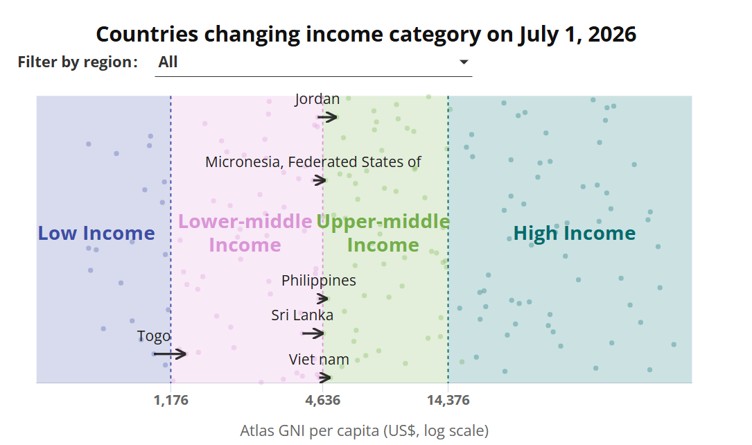
- Elevation of nations - The updated figures show that 6 countries moved into higher income categories, while 0 countries moved down.
- 5 moved from lower-middle to upper-middle income - Jordan, Micronesia, the Philippines, Sri Lanka, and Viet Nam.
- 1 moved from low to lower-middle income - Togo. They reached the same thresholds through very different paths.
- Long-Term Global Shifts - The proportion of economies classified as low-income has shrunk from 30% to just 11% in 2026.
- Implications - These categories influence whether a country can access concessional financing and development assistance from multilateral lenders.
Reference
World Bank Blogs | World Bank Group Country Income Classifications



