Prelims: Current events of national and international importance | Environment
Why in News?
Recently, the Union Ministry of Environment, Forest and Climate Change's (MoEFCC) seventh draft notification proposing to declare 56,825.7 sq. km across 6 states as an Ecologically Sensitive Area (ESA).
Key Highlights of the 7th Draft Notification
- Geographical Scope - Encompasses 4,402 villages across 56,825.7 sq. km of the Western Ghats (covering ~37% of the mountain range):
- Karnataka: 20,668 sq. km (largest proposed area across 10 districts).
- Maharashtra: 17,340 sq. km.
- Kerala: 9,993.7 sq. km.
- Tamil Nadu: 6,914 sq. km.
- Goa: 1,461 sq. km.
- Gujarat: 449 sq. km (lowest proposed coverage).
- Prohibited Activities - Complete ban on new commercial mining/quarrying, sand mining, red-category polluting industries, new thermal power plants, and large construction/township projects.
- Existing mines must phase out within 5 years or upon lease expiry.
- Regulated & Exempted Activities - Hydroelectric power projects remain permissible subject to strict environmental clearances and lean-season environmental flows.
- Agriculture, plantation practices, housing repairs, and routine livelihoods are explicitly exempted.
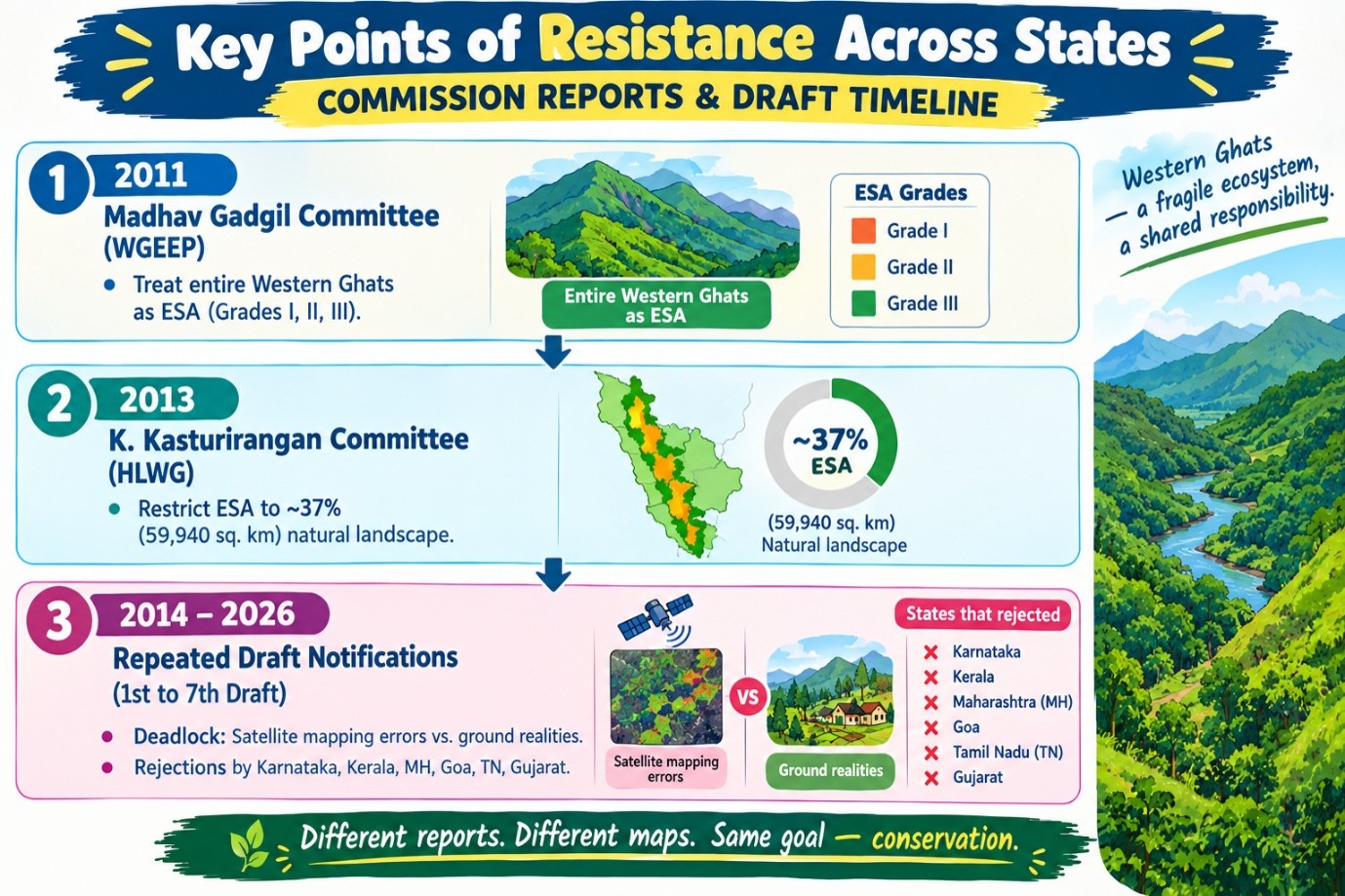
- Karnataka (Unanimous Legislative Rejection)
- Opposes satellite-based remote sensing mapping, arguing it fails to distinguish natural forests from human settlements, coffee/cardamom plantations, and public infrastructure.
- Demanded a 1-year window to conduct a comprehensive ground-level physical survey.
- Kerala (Exclusion Demands)
- Requested reducing its proposed ESA footprint from 9,993.7 sq. km to 8,590.69 sq. km, insisting on excluding all human-inhabited areas, agricultural belts, and plantations.
- Other States (Boundary Realignment)
- Maharashtra, Goa, Tamil Nadu, and Gujarat have raised objections regarding village-level boundary overlaps, fears of land depreciation, and restrictions on regional infrastructure development.
Significance
- The Western Ghats, one of the world's eight "hotspots" of biodiversity, acts as the water tower of Peninsular India and sequesters ~10% of India's forest carbon.
- A piecemeal, state-by-state political exclusion compromises landscape-level ecological continuity and wildlife corridors.
- Highlights the challenge of balancing environmental regulation with local economic fears (such as land value drop and commercial interests in quarrying/tourism).
- Citing the Kerala Model of ground-truthing, experts recommend combining high-resolution spatial mapping with local Gram Sabha consultations to achieve consensus before the 2027 committee deadline.
Reference
Down to Earth | Western Ghats ESA



