Mains: GS -II Polity and Governance
Why in News?
The Election Commission of India (ECI) is facing an acute institutional credibility crisis, marked by severe public outcry, media attention, and internal friction among its commissioners.
What is the core thesis of the ECI's current credibility crisis?
- Critics point to a troubling trajectory – Lax or discriminatory enforcement of the Model Code of Conduct (MCC) during elections.
- High-handed dismissal of opposition grievances and civil society concerns regarding electoral roll transparency.
- The sweeping rollout of the Special Intensive Revision (SIR) of electoral rolls starting in mid-2025 across nearly a billion voters.
- Structural Vulnerabilities in Appointments – The passage of the Chief Election Commissioner and Other Election Commissioners Act in December 2023 altered the selection panel.
- Embedding executive dominance and damaging the perceived initial independence of the commissioners.
What controversies surround the modifications to Form 6 and the Special Intensive Revision (SIR)?
- Statutory Role of Form 6 – Under the Registration of Electors Rules, 1960, Form 6 is the statutory application form for first-time voter enrolment or shifting constituencies, requiring basic details of identity, age, and residence, backed by a penal declaration against false information under Section 31 of the Representation of the People Act, 1950.
- The Unilateral Addition of Annexure-D – During the SIR process initiated in June 2025, the ECI attached a Declaration Form (Annexure-D) requiring applicants to align their birth dates with Citizenship Act provisions and submit detailed historical lineage documents.
- Lack of Legislative Competence – Section 28 of the Representation of the People Act empowers only the Central Government to make rules carrying out the Act.
- Legal experts and former commissioners argue that the ECI lacked the competence to unilaterally modify a statutory form or create a differential framework between SIR and non-SIR states.
- Quasi-NRC Fears and Dual Rulebooks – By maintaining two versions of Form 6 (with declarations in active SIR states like Maharashtra, Karnataka, and Delhi, and without them elsewhere).
- The ECI has exposed itself to accusations of attempting to introduce a National Register of Citizens (NRC) through the back door, raising serious Article 14 (equality before law) and Article 326 constitutional questions.
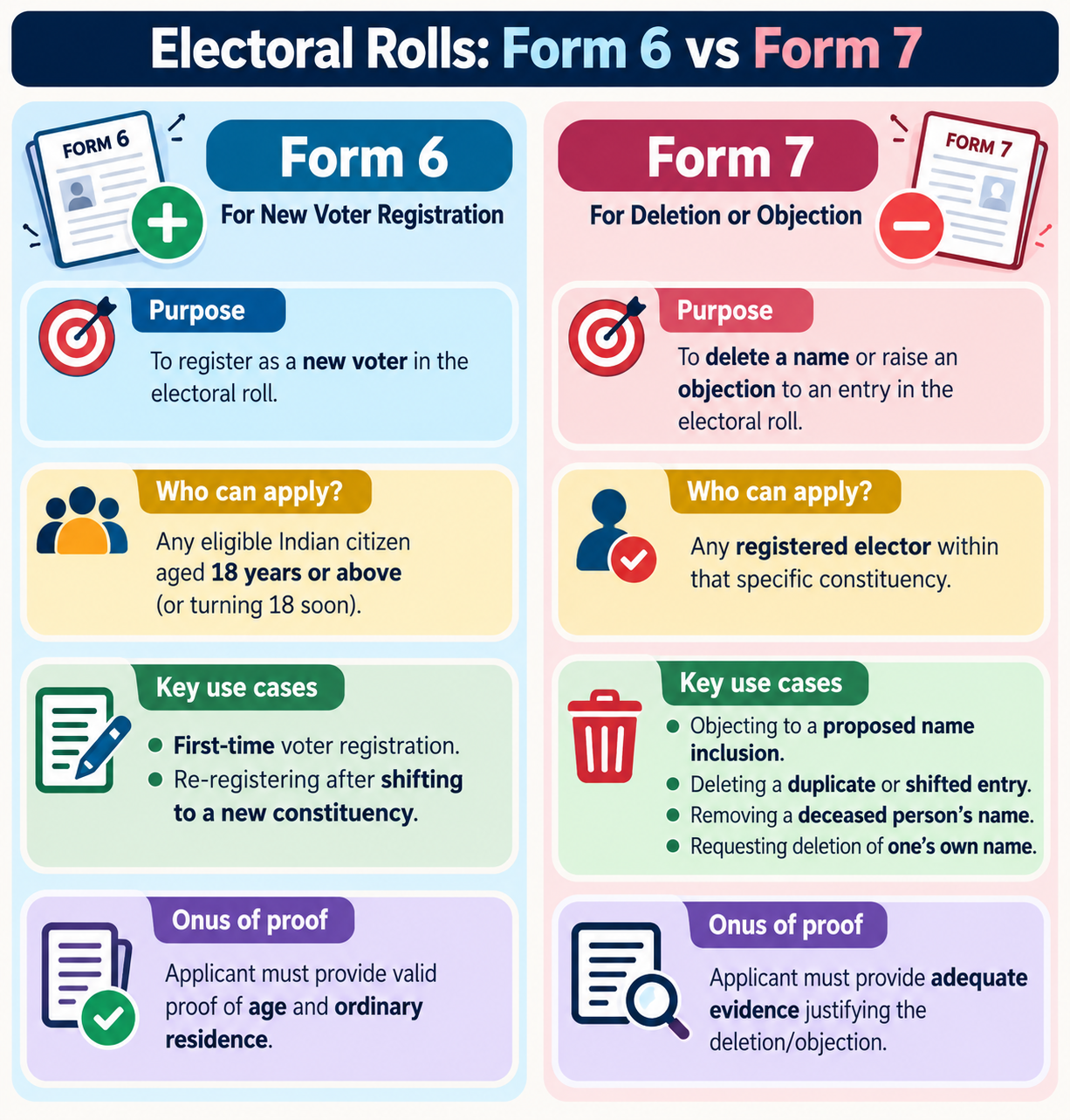
What issues have arisen from the alleged misuse of Form 7?
- Rampant Mass Deletions – Form 7 is legally mandated for objecting to an entry or seeking the deletion of an ineligible or deceased voter from rolls.
- However, recent reports from states like Uttarakhand and Karnataka reveal rampant, coordinated misuse by unidentified entities filing bulk, frivolous objections to delete validly registered voters.
- Institutional Laissez-Faire Attitude – The ECI's failure to penalize frivolous objectors or launch criminal proceedings against fake deletion applications has fostered a perception that it is lax in protecting voter rights.
- Opaque Centralized Software (ECINet) – Centralized data management via digital portals drew sharp protests from ground-level functionaries, including Appellate Tribunal judges in West Bengal.
- The Maharashtra CEO, who noted that automated technical constraints impeded Electoral Registration Officers (EROs) from exercising their independent statutory judgement.
What structural reforms are essential to restore the ECI’s independence?
- Restoring Selection Neutrality – Reconstruct the ECI selection committee to exclude executive majority dominance and include independent constitutional functionaries to insulate appointments from partisan perceptions.
- Ensuring Equal Tenure and Removal Protection – Amend Article 324(5) to grant Election Commissioners the same constitutional protection against removal (Parliamentary impeachment process) currently reserved solely for the CEC, removing internal power asymmetries.
- Safeguarding Electoral Roll Integrity – Establish stringent multi-factor verification protocols for Form 7 deletion requests to prevent bulk electoral roll manipulation, and make objection data transparently accessible at the booth level.
- Strict Adherence to Statutory Rule-Making – Ensure all procedural alterations to electoral documents strictly follow statutory rule-making channels via the Union Government, preserving uniformity across all states without creating discriminatory sub-classifications.
Reference
The Hindu | ECI



