Mains: GS II – International Relations
Why in News?
Recently, the U.S and Saudi Arabia signed a significant nuclear deal.
What is the deal about?
- Technology and Material Transfer – The agreement permits the transfer of civilian nuclear materials, technology and equipment from the United States to Saudi Arabia.
- It gives U.S. nuclear companies preferential access when Saudi Arabia begins constructing its nuclear infrastructure.
- Safeguard agreements – A parallel bilateral safeguards agreement introduces additional verification measures covering proliferation-sensitive activities such as:
- Uranium enrichment
- Uranium conversion
- Nuclear fuel fabrication
- Spent fuel reprocessing
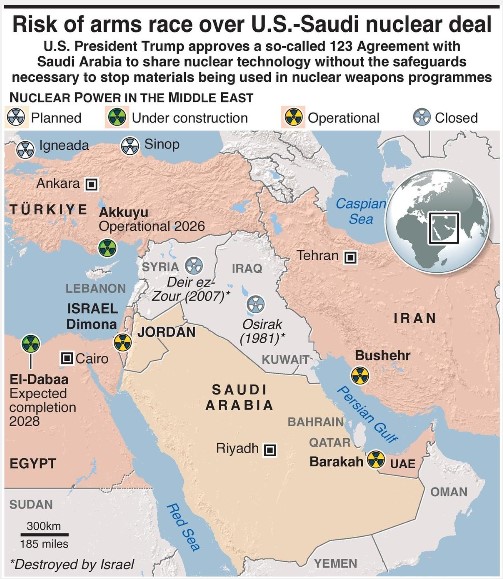
What are the core components of the agreement?
- Commercial and Energy Goals – Designed to supply multi-billion-dollar contracts for American firms (such as Westinghouse) to generate civilian electricity, power energy-hungry data centers, and free up more Saudi oil for export.
- Uranium Enrichment & Oversight – Initial plans propose a joint two-year study to evaluate the feasibility of a local enrichment facility run by U.S. companies, though Trump asserted that domestic material enrichment would not be permitted.
- Congressional Review – The pact has been submitted to the U.S. Congress for a mandatory 90-day review period before it can formally take full effect.
What are the benefits for Saudi Arabia through agreement?
- Energy Diversification – Shifting domestic electricity generation, air conditioning, and water desalination from oil and gas to atomic power.
- Increased Oil Revenues – Saving extracted crude oil from domestic burning to sell on the global market instead.
- Economic Transformation – Fueling advanced, power-hungry domestic sectors ranging from artificial intelligence data centers to industrial manufacturing.
- Regional Prestige – Elevating the kingdom's strategic and scientific standing within the Middle East.
- Potential Fuel Cycle Autonomy – Establishing a legal framework to explore domestic uranium enrichment under a joint two-year viability study.
What are the benefits for United States?
- Commercial Windfall – Positioning American companies like Westinghouse at the forefront of a 30-year, multi-billion-dollar infrastructure market.
- Countering Global Rivals – Blocking geopolitical competitors like China and Russia from securing the contracts and expanding their influence in the Gulf.
- Geopolitical Alignment – Deepening the long-term strategic partnership between Washington and Riyadh through critical infrastructure dependencies.
- Non-Proliferation Oversight – Gaining deep insight and monitoring access into the kingdom's atomic roadmap through bilateral safeguards.
- Diplomatic Leverage – Using the highly sought-after deal as a transactional tool to nudge Saudi Arabia toward regional normalization, including the Abraham Accords.
To know more about Abraham Accords click here
What are the concerns raised?
- Potential Nuclear Weapon Development – Nuclear nonproliferation groups have warned for years that such a deal could set Saudi Arabia on the path to develop a nuclear weapon.
- Riyadh has in the past said it would need a nuclear weapon if its regional rival, Iran, acquired one.
- Suppressing Iran’s capability – The US is engaged in a war with Iran that is in part being fought to prevent Tehran from acquiring a nuclear bomb or enriching uranium to weapons-grade level.
- Lacks of Oversight and guardrails – Saudi Arabia will reportedly not be subject to the most rigorous monitoring from the UN nuclear watchdog, the International Atomic Energy Agency (IAEA).
What lies ahead?
- India should Support diplomatic frameworks that tie energy growth to cooperative security.
- India should also align its own growing civil nuclear roadmap with broader Middle Eastern infrastructure shift.
Reference
The Hindu| US-Saudi Nuclear Deal
The Times of India| US-Saudi Nuclear Deal



