Why in News?
India’s TFR has dropped to 2.0, below the replacement level of 2.1; the UNFPA Survey (2025) finds youth still value marriage and parenthood but are delaying family formation due to various uncertainties, showing intact aspirations but shifting conditions.
Why are young Indians delaying family formation?
- Economic Insecurity – Economic stability is now the primary consideration for individuals prior to marriage and childbirth.
- Rising cost of living and inflation
- Job insecurity and contractual employment
- High housing and childcare expenses
- Challenges in achieving financial independence
- For example, nearly 40% of young respondents identified financial constraints as the primary obstacle to starting a family.
- As a result, marriage and childbirth are increasingly postponed until economic security is achieved.
- Educational and Career Aspirations – Expanded access to education has significantly altered individual life priorities.
- There has been a notable increase in educational attainment, especially among women.
- Participation in professional careers has risen across various sectors.
- There is a growing desire for financial independence prior to marriage.
- Individuals are increasingly postponing the assumption of family responsibilities.
- Positive Outcomes
- Enhanced human capital
- Development of a more skilled workforce
- Advancement of gender empowerment
- Gender Inequality in Caregiving – Despite substantial improvements in women's educational attainment, the allocation of household responsibilities continues to be unequal.
- Consequences
- Conflict between career and family responsibilities
- Decreased participation of women in the workforce
- Postponement of childbirth
- Reduction in family size
- As a result, motherhood is frequently regarded as an impediment to career advancement for women.
- Pressures Associated with Housing and Urbanisation – Rapid urbanisation has increased the financial burden on families.
- Key challenges arising from urbanisation include the following:
- Rising housing costs
- Restricted availability of living space
- Increased migration that separates individuals from traditional family support systems
- Elevated costs associated with childcare
- As a result, young nuclear families often delay childbearing until they attain stable housing conditions.
- Climate Anxiety and Uncertainty Regarding the Future – The United Nations Population Fund (UNFPA) survey identifies an emerging factor influencing reproductive decision-making.
- Young people are expressing growing concerns about several interrelated issues:
- climate change,
- environmental degradation,
- economic instability,
- armed conflicts, and
- natural disasters.
- Nearly half of survey respondents reported concerns regarding multiple uncertainties that may affect future family life.
- Contemporary Mental Health Challenges– Contemporary youth experience significant and historically unparalleled psychological pressures.
- Contributing factors include the following:
- Intense academic competition
- Employment-related stress
- Financial burdens
- Pressure associated with social media engagement
- Anxiety related to climate change
- Many young adults prioritise achieving emotional stability prior to assuming parenting responsibilities.
What are the positive aspects of India’s demographic transition?
- Improvements in female education – Women with higher levels of education are more likely to delay marriage, participate in the workforce, and make informed reproductive choices.
- Enhancements in maternal healthcare – Initiatives under the National Health Mission have contributed to the expansion of:
- Institutional deliveries
- Maternal care
- Family planning services
- Contraceptive access
- Reduction in the prevalence of child marriage – The proportion of girls married before the age of 18 has declined substantially, resulting in improvements in:
- Women's health
- Educational attainment
- Economic participation
- Increased reproductive autonomy – Young couples are increasingly empowered to make informed decisions regarding:
- Timing of marriage
- Number of children
- Birth spacing
- This trend reflects the adoption of a rights-based approach to family planning.
What are the key challenges in India’s demographic transition?
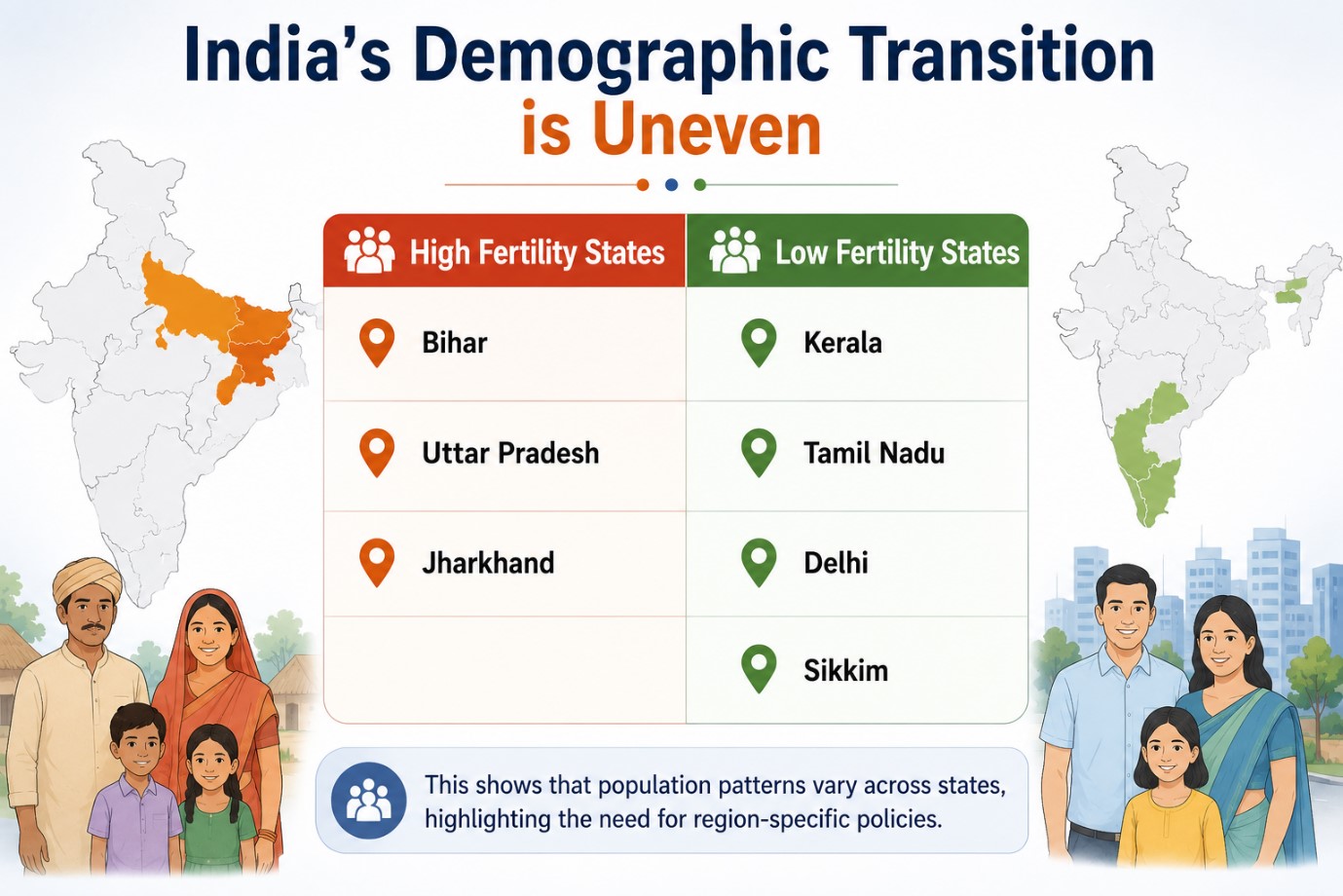
- Regional Disparities – The demographic transition in India exhibits significant regional variation.
- Therefore, uniform national policies are insufficient to address the diverse demographic realities across different regions.
- Low Female Labour Force Participation – Women frequently exit the workforce following marriage or childbirth for several reasons:
- Insufficient access to childcare services
- Prevalence of workplace discrimination
- Disproportionate caregiving responsibilities
- These factors collectively hinder economic growth and impede progress toward gender equality.
- Risk of Premature Ageing – Persistently low fertility rates may ultimately result in the following outcomes:
- A reduction in the size of the workforce
- An increase in the old-age dependency ratio
- A heightened burden on pension systems and healthcare services
- It is essential for India to implement proactive measures before the demographic dividend period concludes.
What lies ahead?
- Strengthen Youth Employment – Prioritise quality job creation, skill development, formal employment opportunities, and comprehensive entrepreneurship support.
- Economic security serves as a key driver for family formation.
- Expand Affordable Childcare – Develop community childcare centres, workplace crèches, and early childhood care facilities to increase accessibility.
- This approach alleviates the burden on working parents.
- Promote Shared Caregiving – Promote paternity leave, equitable distribution of household responsibilities, and gender-sensitive social norms.
- Such measures prevent the caregiving burden from being placed exclusively on women.
- Family-Friendly Workplaces – Implement flexible working hours, hybrid work arrangements, paid parental leave, and comprehensive childcare support.
- These policies facilitate improved work–life balance.
- Address Youth Mental Health – Enhance counselling services, campus-based mental health programmes, climate anxiety interventions, and community awareness initiatives.
- Emotional security constitutes a critical factor in family decision-making.
- State-Specific Demographic Policies – Adapt policy interventions to the specific demographic stage of each state:
- In high-fertility states, prioritise education, healthcare, and family planning initiatives.
- In low-fertility states, emphasise elderly care, workforce participation, and productivity enhancement.
Reference
The Hindu | India's Youth and the New Family Paradigm



