|
One Liners 20-01-2026
|
|
History, Art and Culture
|
|
Zehanpora Stupas – Kashmir's Buddhist Past
Archaeological excavations at Zehanpora, Baramulla (North Kashmir) have revealed a man-made plateau with stupas, chaityas, and viharas dating to the Kushan era (1st–3rd century CE).
- Historical Significance
- Ancient Kashmir is confirmed to have been a major center of Buddhism in India.
- The discovery supports the historical records of Kalhana’s Rajatarangini and Hiuen Tsang’s writings.
- The site is connected to Emperor Kanishka’s reign, when Mahayana Buddhism flourished.
- Key Historical Facts
- The 4th Buddhist Council at Kundalvana under Kanishka led to the split between Hinayana and Mahayana.
- Kashmir was a key route for Buddhism’s spread to Central Asia and China.
- The site’s architecture reflects Gandhara influence with Greco-Buddhist stone and stucco figures.
- Regional Significance
- Kashmir was a major center of learning that drew scholars from China and Central Asia.
- Its composite culture, or Kashmiriyat, was shaped by religious diversity.
- The region reflects strong pan-Indian and pan-Asian connections.
|
|
Polity & Governance
|
|
PRAGATI
A Decade of Cooperative, Outcome-Driven Governance.
- PRAGATI –Pro-Active Governance and Timely Implementation.
- It is a digital platform for fast-tracking projects, schemes, and grievance redressal through direct, real-time review by the Prime Minister, in partnership with States and Union Ministries.
- Launched in – 2015, by Prime Minister Narendra Modi.
- It brings together 3 modern technologies such as digital data management, video conferencing, and geo-spatial technology.
- Key takeaways
- PRAGATI has significantly accelerated India’s development by fast-tracking projects worth more than Rs.85 lakh crore.
- Under PRAGATI, 382 major national projects have been systematically reviewed and closely monitored.
- Out of 3,187 identified issues, 2,958 have already been resolved, significantly reducing delays and cost overruns.
- The platform ensures real-time coordination between the Centre and States under direct Prime Ministerial supervision, strengthening accountability.
|
|
Economy
|
|
KYC for Crypto Customers
- Guidelines issued by – Financial Intelligence Unit (FIU) under Union Finance Ministry.
- Mandatory KYC measures
- Selfie with liveness detection.
- Recording of geographical coordinates (latitude, longitude) of onboarding location with date/timestamp.
- Verification of bank account by 'penny-drop' method.
- Mandatory Permanent Account Number (PAN).
- IP (Internet Protocol) address of the customer.
- Objective – To update Anti-Money Laundering (AML) and Combating Financing of Terror (CFT) guidelines for Virtual Digital Assets (cryptocurrency).
|
|
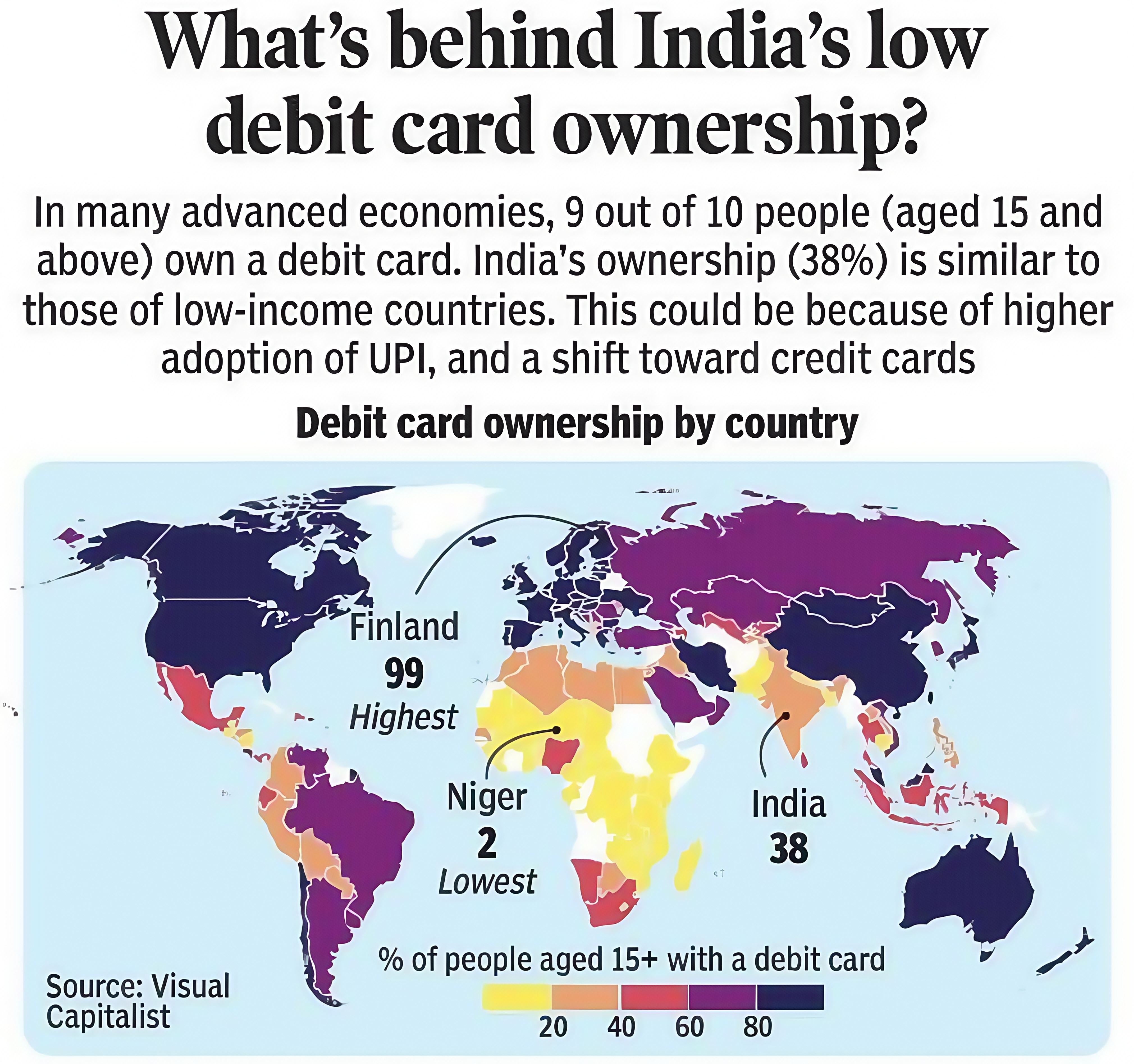
Debit Card Ownership
|
|
Agriculture
|
|
Dairy Sector Development
- MoU between – Indian Council of Agricultural Research (ICAR) and National Dairy Development Board (NDDB).
- Key focus areas – Dairy production, processing, and value addition, with a strong emphasis on empowering its primary stakeholders - millions of dairy farmers across the country.
- Objectives –
- To enhance collaboration in multidisciplinary research, innovation, and capacity building across the entire dairy sector.
- To facilitate the effective translation of research outcomes into practical, field-level solutions, thereby enhancing productivity, profitability, and sustainability across the dairy sector.
|
|
Environment
|
|
Major Groundwater Contamination in A.P
- Source of report – CGWB Annual Ground Water Quality Report, 2025.
- Key contaminants – Seawater intrusion (coastal aquifers), high electrical conductivity (EC), fluoride, uranium, residual sodium carbonate, nitrate, iron, chromium, cobalt, manganese, nickel, zinc, arsenic, selenium, cadmium, lead.
- Key findings
- Uranium – Elevated concentrations (>30 ppb) in 16 villages of Sri SathyaSai district and 3 in Tirupati district.
- Arsenic – 5 hotspots (>10 ppb).
- Fluoride – Above 1.50 mg/l, especially in hard rock aquifers.
- Residual Sodium Carbonate – Beyond permissible limits in 26.87% ofsamples.
- Impact – Extensive pollution detected in line with BIS norms.
- Mitigating factor – Monsoon showed some improvement in water quality, particularly for EC and fluoride.
|
|
Orobanche Aegyptiaca (Threat to Mustard Crop)
A parasitic weed that has inflicted damage in major mustard-growing areas of Rajasthan and Haryana.
- Category – Holoparasite, does not photosynthesize and is completely dependent on host-provided nutrition.
- Mechanism – Connects to the host’s roots, drains essential resources, resulting in stunted development and plant wilting.
- Seed Longevity – One shoot produces 40–45 flowers; the resulting seeds persist in soil for as long as 20 years.
|
|
NIRANTAR
- NIRANTAR – National Institute for Research & Application of Natural Resources to Transform, Adapt and Build Resilience.
- A platform of institutions under the Ministry of Environment, Forest and Climate Change (MoEFCC).
- Objective – To strengthen coordination and collaboration among MoEFCC Institutions.
|
|
Security
|
|
Bhairav Battalions
The Indian Army's newly raised Bhairav Battalions, designed for Special Forces tasks and modern warfare.
- Nature – High-speed, offensive units capable of Special Forces tasks at multiple levels.
- Current Status – 15 battalions raised, deployed along borders; plans for 25 in total.
- Purpose
- To bridge gap between Para Special Forces and regular infantry.
- To conduct special operations from tactical to operational depth.
- To be a part of force restructuring in line with new technologies and evolving operational requirements.
- Modern Warfare Focus – To create a pool of over one lakh drone operatives across the force.
|
|
Science
|
|
ICEGATE–LPMS Integration
- ICEGATE–LPMS – Integration of the Indian Customs Electronic Gateway–Land Port Management System.
- Inaugurated by – Central Board of Indirect Taxes & Customs (CBIC), at the Integrated Check Post (ICP), at Agartala, Tripura.
- Focus on – Critical customs data elements, including Bill of Entry, Shipping Bill, Out of Charge (OOC), and Let Export Order (LEO), along with event-based updates tracking cargo movement, from slot booking to gate-in and gate-out.
- Objective – To enable real-time, bidirectional exchange of data between ICEGATE and the Land Port Management System, creating a seamless digital ecosystem at land ports.
- Significance – It is a practical embodiment of Coordinated Border Management, promoting harmonised functioning among multiple border agencies through shared data, common risk assessment, and synchronized decision-making.
|



