|
One Liners 17-11-2026
|
|
History, Art and Culture
|
|
Türkiye Grants GI Recognition to Pakistani Basmati Rice
- Türkiye recognised Pakistani Basmati rice as a Geographical Indication (GI), strengthening Pakistan's position in the India–Pakistan basmati trade competition.
- Registration Authority – Turkish Patent and Trademark Office.
- Registration – February 2026 (application submitted in June 2024).
- Pakistani GI Coverage – Punjab, Sindh, Khyber Pakhtunkhwa and parts of Balochistan.
- India's Position – India has also applied for GI recognition in Türkiye, but equivalent approval was pending at the time of reporting.
- Significance
- It provides Pakistan with legal protection for basmati origin claims in Türkiye.
- It strengthens its branding and potential premium-market access.
- It may create future disputes over basmati labelling and geographical origin.
- Impact on India
- Increases competition in premium basmati export markets.
- India retains advantages in production scale, varietal diversity and competitive export pricing.
- Price Outlook – Global rice prices are firming due to tighter supplies and weather-related production risks, including El Niño concerns.
- Key Risk – GI-related disputes, origin certification and substitution towards cheaper non-basmati rice.
|
|
Red Dot Design Award 2026
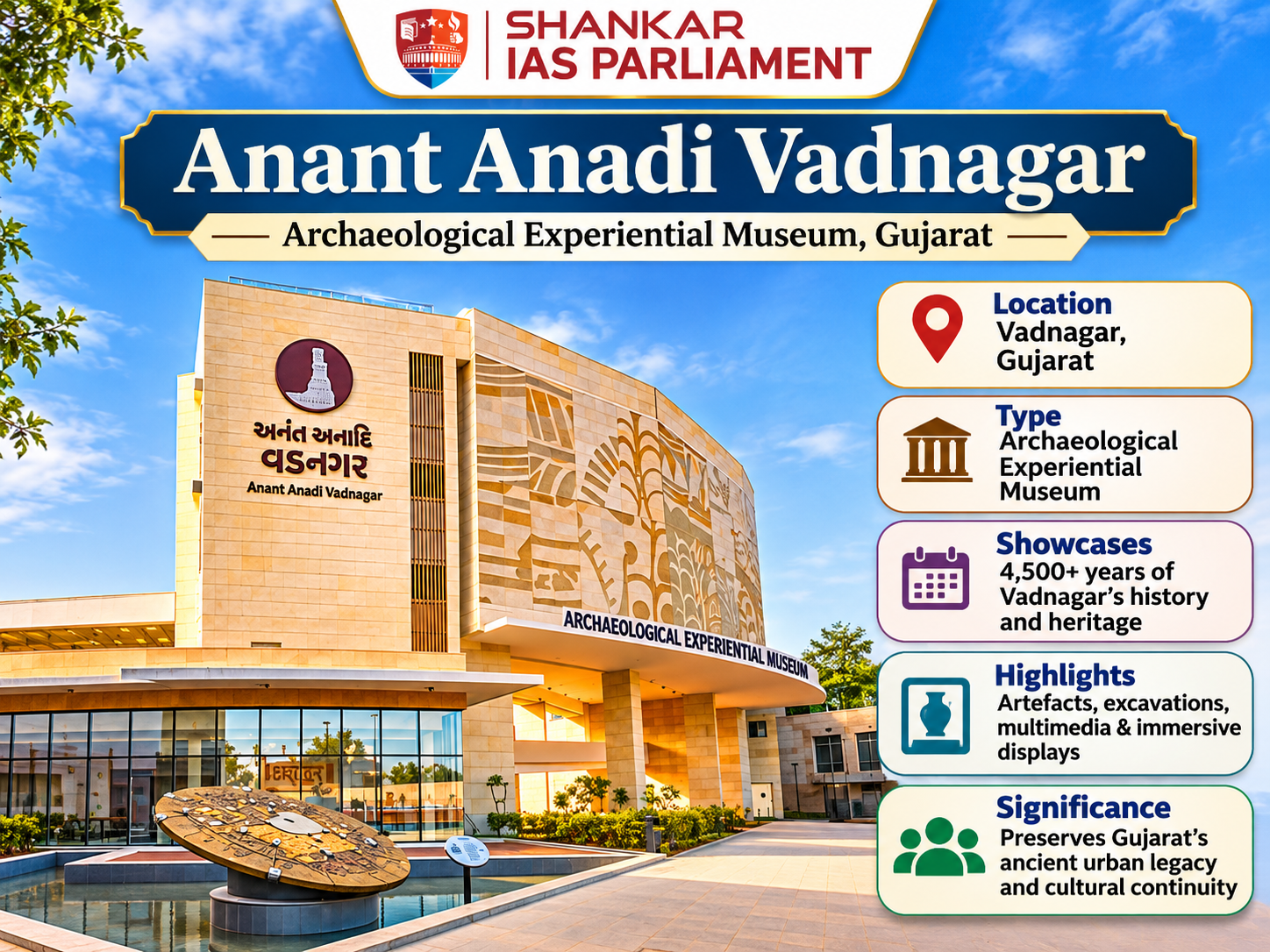
- Anant Anadi Vadnagar, an archaeological experiential museum in Vadnagar, Gujarat, won the Red Dot: Best of the Best Design Award 2026 in Berlin, Germany.
- Significance
- 1st museum in India to receive the Red Dot: Best of the Best award.
- 2nd Red Dot Design Award recipient in Gujarat after Smriti Van.
- Received its 2nd international recognition within 2 months, following a Platinum A' Design Award in Italy.
- Key Features of the Museum
- Location – Vadnagar, Gujarat.
- Historical significance – Showcases over 2,300 years of history.
- Structure – Four-storey building covering approximately 12,500 sq. m.
- Galleries – Eight thematic galleries.
- Collection – Over 6,000 excavated artefacts, including:
- Ceramics, coins and weapons.
- Sculptures and ornaments.
- Experiential features
- 3D projection of a Buddhist vihara.
- Recreated Buddhist monastery experience.
- Interactive excavation experience for children.
- Spatial storytelling using sound and visuals.
- Award and Institutions
- Award – Red Dot: Best of the Best Design Award 2026.
- Award ceremony – 6 November 2026, Konzerthaus, Berlin.
- Design firm – Design Factory India (DFI), Noida.
- Client – Directorate of Archaeology and Museums, Government of Gujarat.
|
|
Geography
|
|
Cyclone Akvan – Bay of Bengal
IMD forecast Cyclone Akvan to intensify into a Very Severe Cyclonic Storm (VSCS) over the Bay of Bengal.
- Location – Central parts of the South and adjoining West-Central Bay of Bengal.
- Movement – Moving north-northwest wards at approximately 3 km/hr.
- Expected Landfall – Andhra Pradesh–Yanam coast, between Nellore and Tuni, around Friday noon (as per the provided report).
- Expected Wind Speed – 120–130 km/hr, with gusts up to 145 km/hr.
- Potential Impact – Andhra Pradesh coast.
- Atmospheric Features
- Cyclones have a wide atmospheric influence beyond their immediate surroundings.
- Upper-level divergent winds transport moisture and ice crystals, potentially forming high-level clouds over distant regions.
- Cloud formations may produce spectacular sunset colours due to light scattering.
|
|
Environment
|
|
Water Rail (Rallus aquaticus)
Migratory Water Rail was sighted at TS Chanakya wetlands, Nerul, Navi Mumbai, after nearly 8 years.
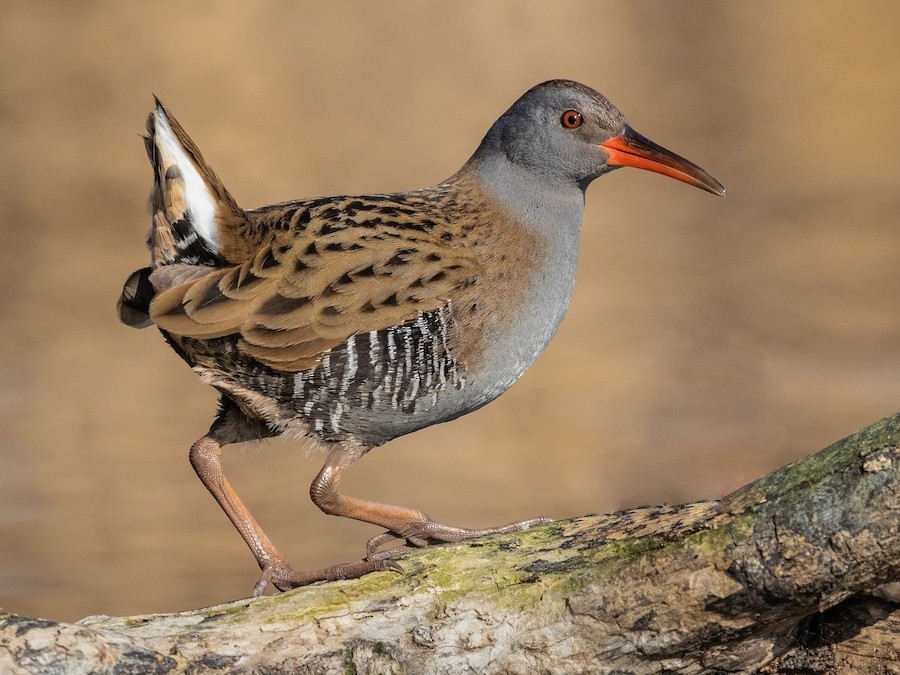
- Family – Rail family (Rallidae).
- Geographical Distribution – Europe, Asia and North Africa.
- Breeding Habitat – Well-vegetated wetlands of the Palearctic region (Eurasia).
- Migration
- Migrates to warmer countries during harsh European winters.
- Generally, stays from October to February/March.
- Habitat – Reeds, marshes and densely vegetated wetlands.
- Food – Insects and other invertebrates.
- Behaviour
- Shy and elusive bird; prefers skulking among reeds rather than open areas.
- Uses dense vegetation for feeding and protection from predators.
- Identification – Both sexes look similar during non-breeding plumage.
|
|
Five New Diminutive Horned Frog Species
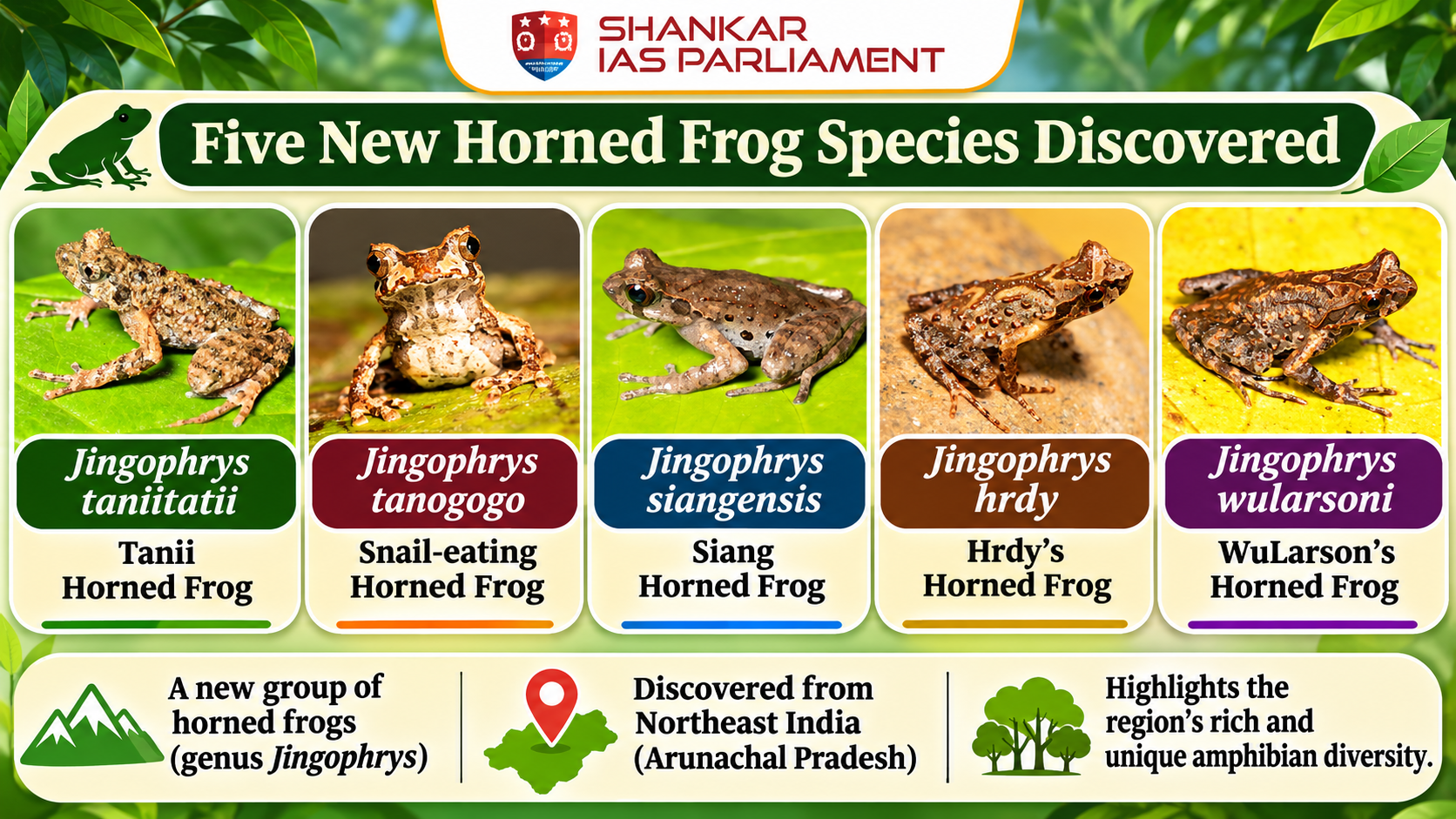
Five new species of diminutive horned frogs discovered in Arunachal Pradesh after five years of field exploration.
- Genus – Jingophrys (Diminutive Horned Frogs).
- Research Institutions – University of Delhi and Harvard University (USA).
- Published in – Royal Society Open Science (November 2026).
- Newly Discovered Species
- Jingophrys taniitatii – Tanii Horned Frog.
- Tanii tribe – The name Jingophrys taniitatii honours the Tanii tribe of Ziro Valley, Arunachal Pradesh.
- In the Apatani language, “Tatii” means frogs/toads.
- Jingophrys tanogogo – Snail-eating Horned Frog.
- Jingophrys siangensis – Siang Horned Frog.
- Jingophrys hrdy – Hrdy's Horned Frog.
- Jingophrys wularsoni – WuLarson's Horned Frog.
- Unique Feature – J. tanogogo is the first snail-eating frog recorded in India.
- It is the 1st member of the family Megophryidae reported to exhibit snail-eating behaviour (entire snail shells found in its gut).
- Identification Methods – DNA-based molecular phylogeny, external morphology and male mating calls.
- Significance
- More than doubled the known global diversity of Jingophrys from 6 to 11 species.
- Two new country records for India were also reported.
- Highlights the Eastern Himalayas as a centre of hidden biodiversity and evolutionary diversification.
- Recognises indigenous communities and local ecological knowledge.
|
|
Security
|
|
SUPER ICE – Long-Range Cruise Missile
Israel's Rafael Advanced Defense Systems unveiled SUPER ICE, a new long-range precision-guided cruise missile.

- Manufacturer – RAFAEL Advanced Defense Systems Ltd. (Israel).
- Warhead – 1,000-pound warhead (MK83 compatible).
- Launch Platforms – Air-, land- and sea-based platforms.
- Key Features
- Autonomous navigation and low-altitude terrain-following flight.
- All-weather operational capability.
- Advanced electro-optical guidance using image-matching technology.
- High-precision engagement of strategic targets.
- Stand-off strike capability.
- Technology – Builds on the technological foundation of ICE BREAKER missile.
- Significance
- Expands Rafael's long-range precision-strike missile portfolio.
- Shares launch systems, mission-planning infrastructure and logistics with the ICE BREAKER family.
- Aims to reduce life-cycle costs (LCC) through common architecture.
|
|
Miscellaneous
|
|
International Day for Tolerance
- Annually observed on – 16th November.
- Proclaimed by – UN General Assembly through Resolution 51/95 (1996).
- Background – Follows UNESCO’s adoption of the Declaration of Principles on Tolerance on 16 November 1995.
- Meaning of Tolerance
- It is not indulgence or indifference, but respect and appreciation of cultural diversity, different forms of expression and ways of life.
- It recognises the universal human rights and fundamental freedoms of others.
- It promotes peaceful coexistence and survival of diverse communities worldwide.
- UNESCO-Madanjeet Singh Prize – Awarded once every two years.
- Aim – To recognise outstanding contributions in science, arts, culture or communication that promote tolerance and non-violence.
- Significance – It encourages mutual respect, acceptance of diversity and peaceful coexistence among different communities.
|
|
International Day of the Mediterranean Diet 2026
- Annually observed on – 16th November.
- Established by – UN General Assembly through Resolution A/RES/80/174.
- 1st official celebration – 16 November 2026.
- Organised by – Permanent Representations of Greece, Italy and Lebanon to the UN.
- Theme (2026) – Science, Sustainability, and Cultural Heritage.
- Mediterranean Diet – Key Features
- High consumption of whole cereals, legumes, fruits, vegetables, nuts and olive oil.
- Low to moderate consumption of dairy products and low consumption of meat and poultry.
- UNESCO Recognition – Inscribed in the Representative List of Intangible Cultural Heritage of Humanity in 2010.
- Significance
- It helps prevent non-communicable diseases (NCDs).
- It promotes sustainable agrifood systems, biodiversity and local economies.
- It preserves traditional food knowledge, culinary practices and cultural heritage.
- It encourages seasonal, local food production and social cohesion.
|
|
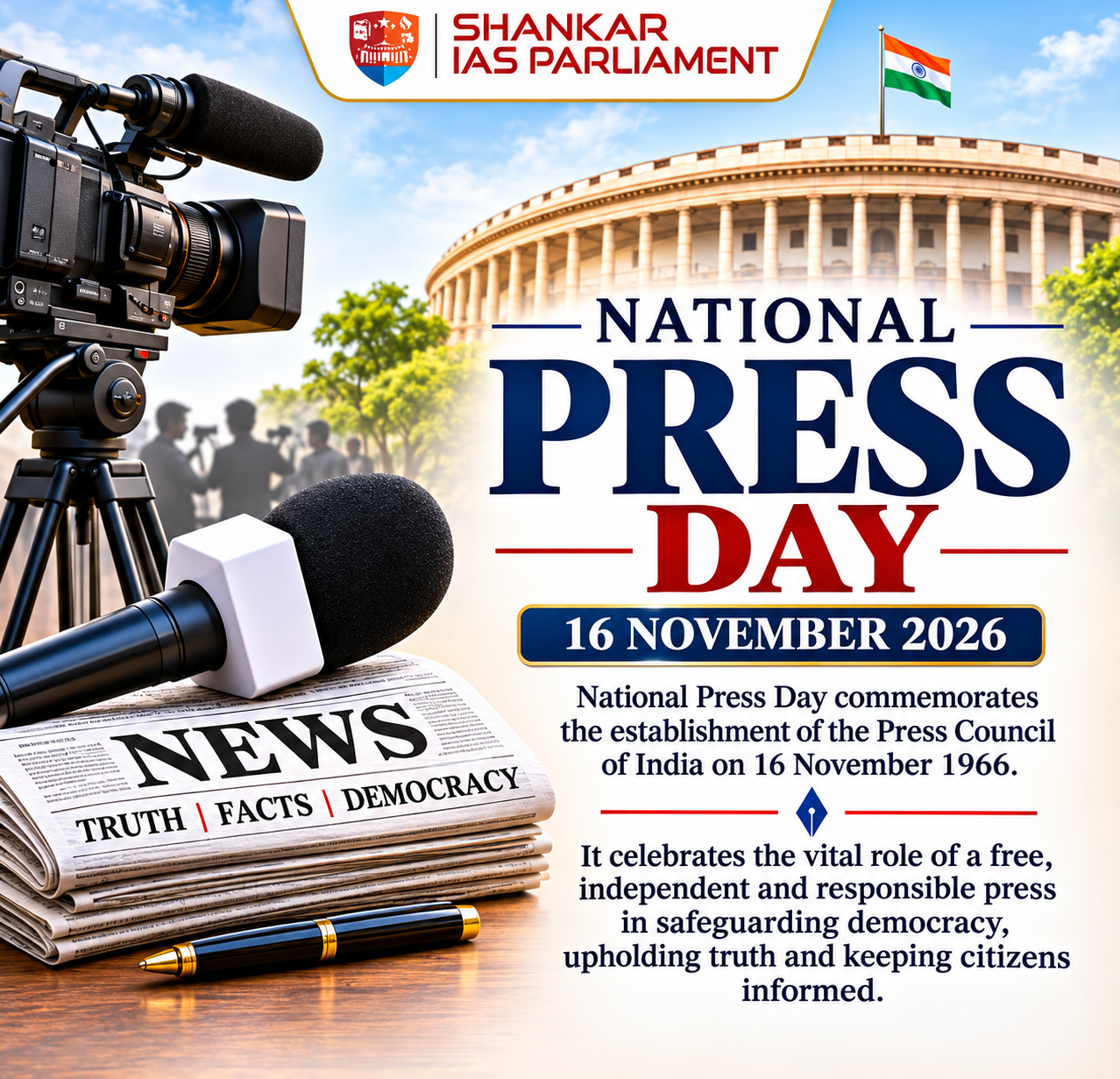
National Press Day
- Annually observed in India on – 16th November.
- 2026 Theme – “Journalism: Populist or Responsible.”
- Aim – To highlight the importance of a free, independent and responsible press.
- Significance – It commemorates the day the Press Council of India (PCI) began functioning in 1966.
Press Council of India (PCI)
- It is an independent statutory, quasi-judicial body.
- Established in – 16 November 1966.
- Mandate
- Safeguard freedom of the press.
- Maintain and improve standards of journalism.
- Prescribe professional conduct and ethics for newspapers and news agencies.
- Examine complaints relating to violations of journalistic standards.
|
|
National Epilepsy Day
- Annually observed in India on – 17th November.
- Aim – To raise awareness about epilepsy, promote timely diagnosis and treatment, and address the stigma associated with seizures.
Epilepsy
- It is a chronic neurological disorder characterised by a tendency to experience recurrent, unprovoked seizures.
- Seizures occur due to sudden, abnormal electrical activity in the brain, temporarily affecting movement, awareness, sensations, emotions or behaviour.
- Types
- Generalised Epilepsy – Seizures involve networks on both sides of the brain.
- Focal Epilepsy – Seizures originate in a specific area or network on one side of the brain; they may spread to both sides.
- Unknown-Onset Epilepsy – The beginning of the seizure is not witnessed or cannot be determined.
|



