|
One Liners 11-11-2026
|
|
Government Policies & Interventions
|
|
Continuation of Stand-Up India Scheme
- Approved by – Union Cabinet
- Extended period – 5 years (up to 31 March 2031)
- Aim – To promote entrepreneurship among women, SCs and STs.
Stand-Up India Scheme
- Launched in – April 2016.
- Nodal Ministry – Ministry of Finance.
- Objective – To promote entrepreneurship and financial inclusion among Women, Scheduled Castes (SCs) and Scheduled Tribes (STs).
- Target – Minimum 2.5 lakh additional beneficiaries over 5 years.
- Achievement – Facilitated loans to over 2.75 lakh entrepreneurs since launch.
- Eligible Borrowers – Women and SC/ST entrepreneurs setting up Greenfield enterprises (first-time ventures).
- Eligible Sectors – Manufacturing, Services, Trading and Agriculture-allied activities.
- Loan Amount – Above Rs.10 lakh and up to Rs.1 crore.
- Nature of Loan – Composite loan (Term Loan + Working Capital) or Term Loan.
- Loan Coverage – Up to 85% of project cost.
- Credit Guarantee – 85% of loan amount; standard guarantee fee of 0.50%.
- Recent Approval – Credit Guarantee Corpus of Rs.4,111 crore.
|
|
International Relations and Issues
|
|
UAE Launches Digital ATA Carnet System – 2026
- The UAE launched the electronic ATA Carnet (eATA Carnet) system, becoming the 1st country outside Europe to adopt the paperless customs facility.
- Supported by – Dubai Chambers, in coordination with customs authorities and the International Chamber of Commerce (ICC).
- Key Features
- Enables electronic issuance and processing of ATA Carnets using digital declarations and QR codes.
- Provides digital notifications and transaction histories for improved transparency and tracking.
- Simplifies temporary imports and exports by reducing paperwork, clearance time and business costs.
- Facilitates the movement of goods and equipment for exhibitions, trade fairs, conferences and professional activities.
- Dubai Chamber of Commerce is implementing the system as the UAE's National Guaranteeing and Issuing Association.
ATA Carnet – Passport for Goods
- An international customs document that permits temporary import of eligible goods into participating countries without payment of customs duties and taxes.
- Goods must be re-exported within the prescribed period.
- Validity – Up to 1 year, with repeated use across multiple participating countries.
- Eliminates the need for separate customs guarantees in each participating country.
- Goods coverage
- Commercial samples.
- Professional equipment.
- Broadcasting and filming equipment.
- Goods intended for exhibitions and trade fairs.
Not covered - Consumable and perishable goods.
International Context
- In June 2026, eATA Carnet was rolled out across 30 countries, including:
- All 27 European Union member states.
- Norway.
- Switzerland.
- United Kingdom.
- The ICC expects the global transition to digital ATA Carnet procedures to be completed by 1 January 2028.
|
|
Commonwealth Heads of Government Meeting 2026
- Held in – St. John’s, Antigua and Barbuda, from 1 to 4 November 2026.
- Hosted by – Antigua and Barbuda (making it the smallest nation ever to host a CHOGM).
- Chaired by – Prime Minister Gaston Browne of Antigua and Barbuda.
- Theme – "Accelerating Partnerships and Investment for a Prosperous Commonwealth".
- Participants – More than 4,000 delegates representing the 56 member states of the Commonwealth.
- Core Focus Areas – Trade and investment, climate resilience, sustainable development, equality, and reparatory justice.
|
|
Universal Periodic Review (UPR) – United Nations Human Rights Council
- The United States is set to become the 1st country to completely refuse participation in its UPR under the UN Human Rights Council (UNHRC).
- UPR – A mechanism to periodically examine the human rights records of all 193 UN Member States.
- Review Frequency – Generally once every 4–5 years.
- Conducted through – UN Human Rights Council in Geneva, Switzerland.
- Review Process – Countries present their human rights records and respond to questions and recommendations from other member states.
- Aim – To improve human rights protection through constructive dialogue and recommendations.
- Key Highlights
- Reason for Boycott – The Trump administration withdrew from the UNHRC, alleging anti-US and anti-Israel bias and failure to address serious human rights violations.
- Scheduled Review – Originally scheduled for November 2025 but postponed to November 2026.
- Impact of US Boycott – May undermine the credibility of the UPR mechanism and encourage other countries to avoid international human rights scrutiny.
UN Human Rights Council
- Established in – 2006.
- Headquarters – Geneva, Switzerland.
- Membership – 47 Member States, elected by the UN General Assembly.
- UPR Coverage – Applies to all 193 UN Member States, irrespective of their membership in the Human Rights Council.
- Nature – State-driven, cooperative and universal human rights review mechanism.
|
|
Economy
|
|
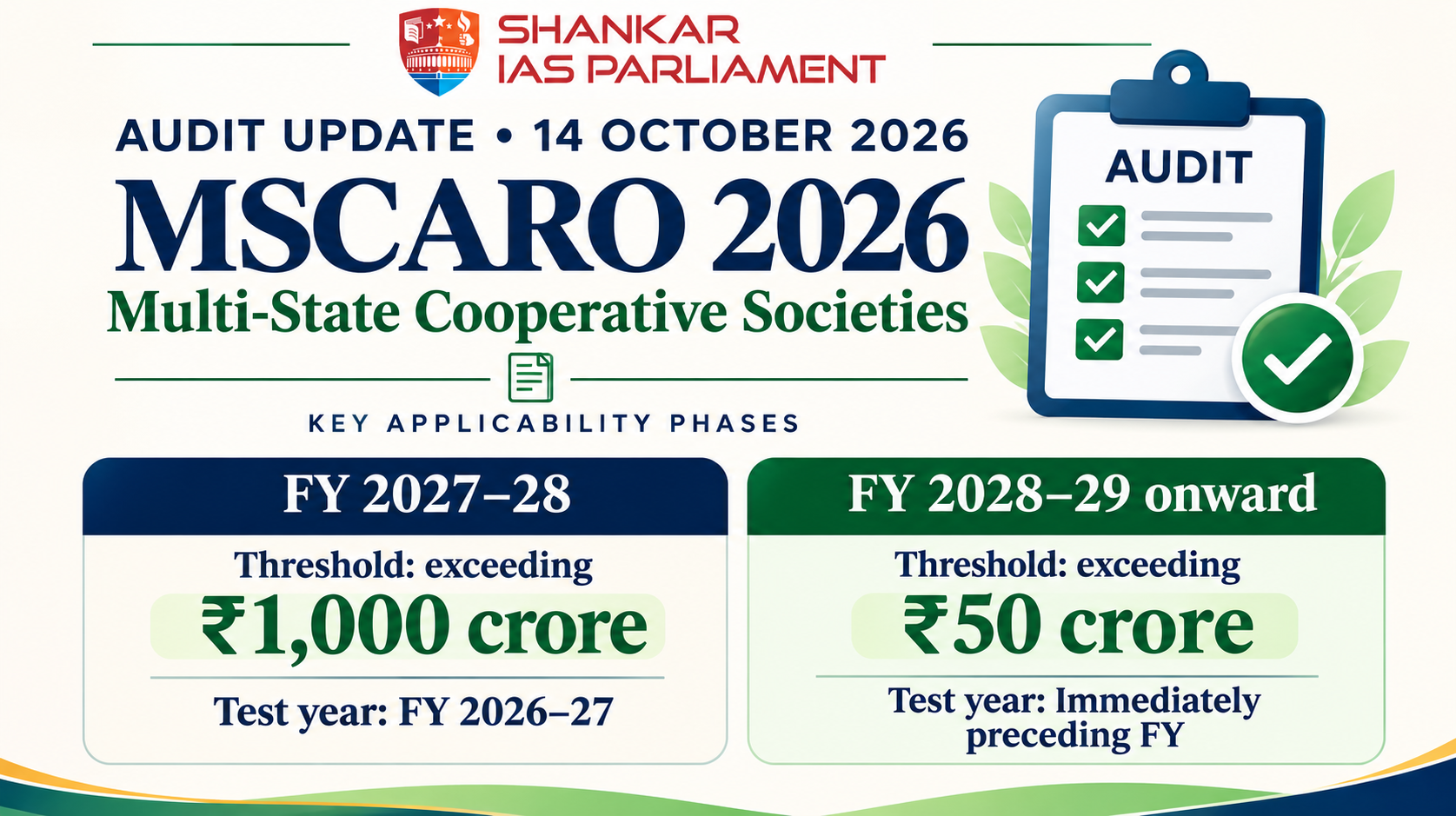
Multi-State Co-operative Societies (Auditor’s Report) Order (MSCARO), 2026
- Notified by – Ministry of Cooperation.
- Legal Basis – Section 73(6) of the Multi-State Co-operative Societies Act, 2002, empowered by the Multi-State Co-operative Societies (Amendment) Act, 2023.
- Objectives
- To strengthen transparency, financial discipline, accountability and good governance in Multi-State Co-operative Societies (MSCS).
- To introduce a uniform, structured and risk-based statutory audit reporting framework.
- Modelled on – Companies (Auditor’s Report) Order (CARO) applicable to companies.
- Formulation – Based on inputs from RBI, ICAI, CAG and Multi-State Cooperative Societies.
- Standardised Reporting – Auditors must provide structured Yes/No responses with remarks on financial, administrative, governance and statutory compliance.
- Financial Monitoring - Covers NPAs, overdue loans, liquidity, deposits, advances, repayment defaults and borrowings.
- Governance Oversight – Examines Board composition, directors' eligibility, AGM/Board meetings, statutory committees and related-party transactions.
- Member Protection – Verification of investments, utilisation of funds, share capital and membership records.
- Regulatory Supervision – Enables the Central Registrar of Cooperative Societies (CRCS) to identify high-risk societies and undertake targeted inspections and corrective action.
- Technology Integration – CRCS Portal facilitates automated scrutiny, risk scoring, dashboards and AI-based monitoring.
- Additional Compliance – Cybersecurity and anti-money laundering (PMLA) requirements, wherever applicable.
|
|
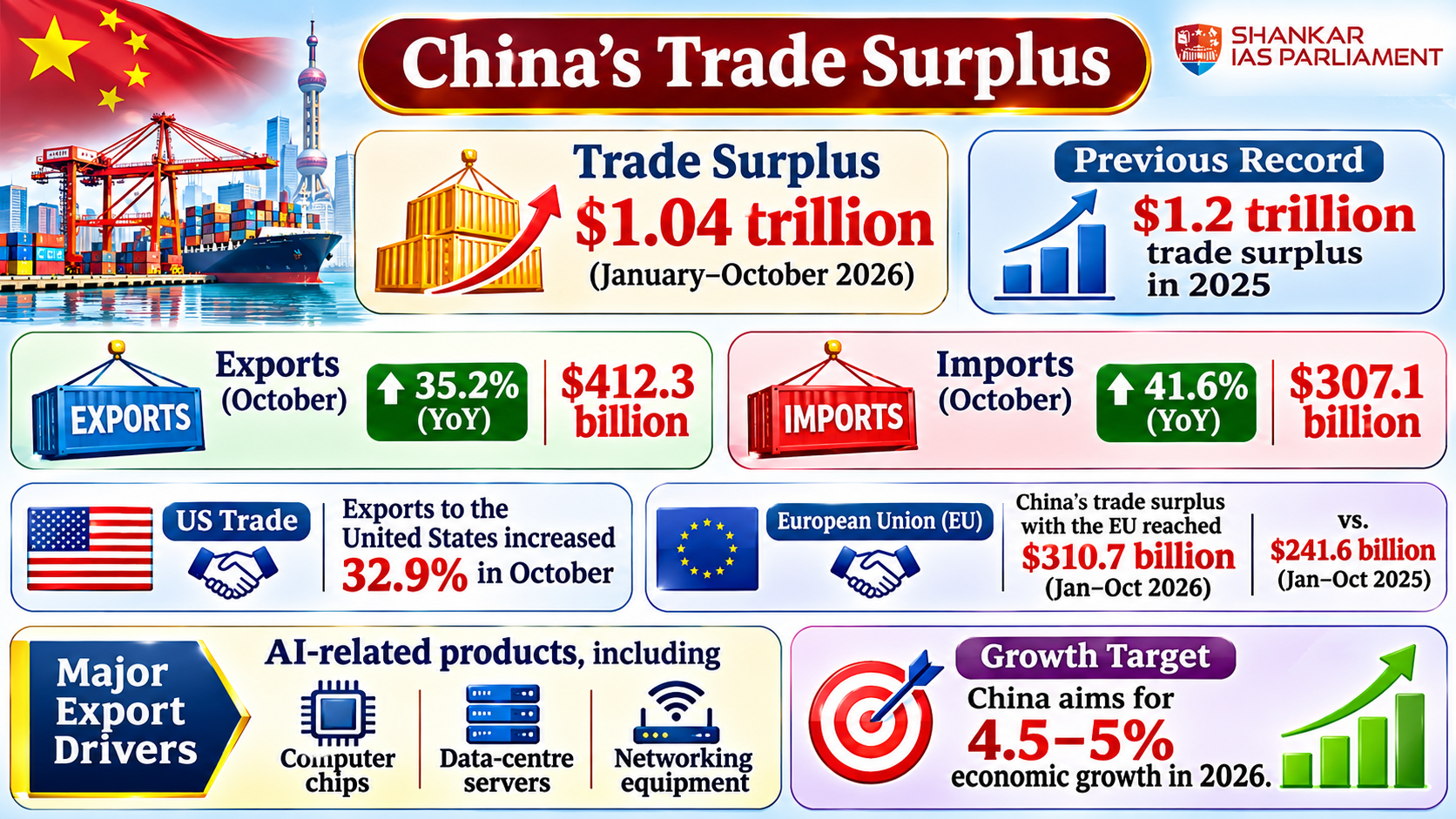
China's Trade Surplus Crosses $1 Trillion (2026)
- China's trade surplus crossed $1 trillion during January–October 2026, reaching the milestone earlier than in 2025, according to the General Administration of Customs (GAC).
- Major Concerns
- Global Trade Imbalance – Rising Chinese exports may widen trade deficits of trading partners.
- Protectionism – Concerns over cheaper Chinese goods crowding out domestic industries.
- Domestic Weakness – Sluggish domestic consumption and prolonged property-sector crisis increase dependence on exports.
- Trade Tensions – Growing trade friction with the US and EU.
|
|
Index
|
|
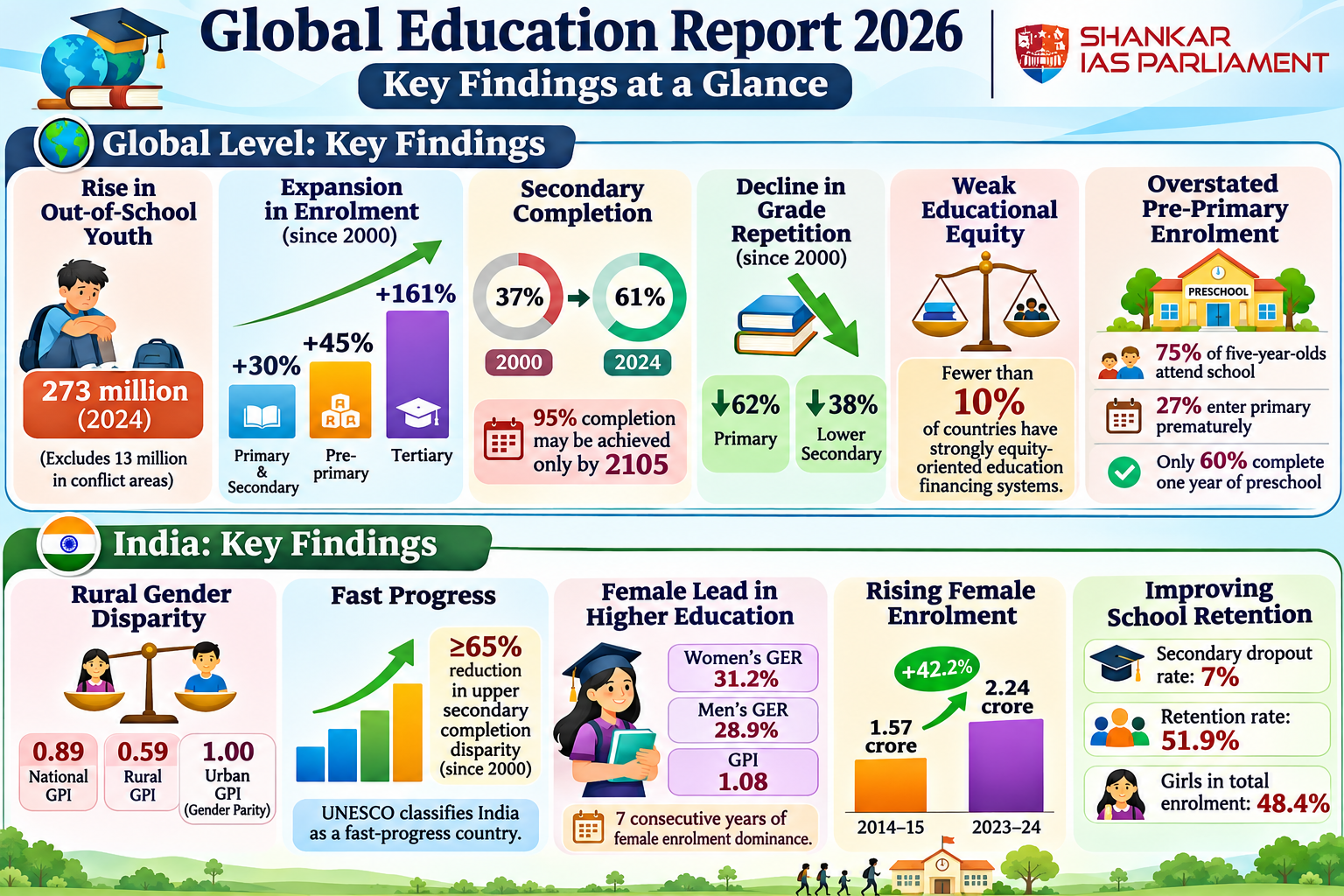
Global Education Monitoring (GEM) Report 2026
- It offers a comprehensive assessment of global progress toward Sustainable Development Goal 4 (SDG 4).
- Annually published by – UNESCO
- Objective – To ensure inclusive and equitable quality education for all by 2030.
- 2026 Focus – Access and equity in education, especially for marginalised and vulnerable learners.
- Coverage – Early childhood, primary, secondary and post-secondary education.
- Key Assessment Areas – Education financing, teacher quality, infrastructure, technology and equitable learning opportunities.
|
|
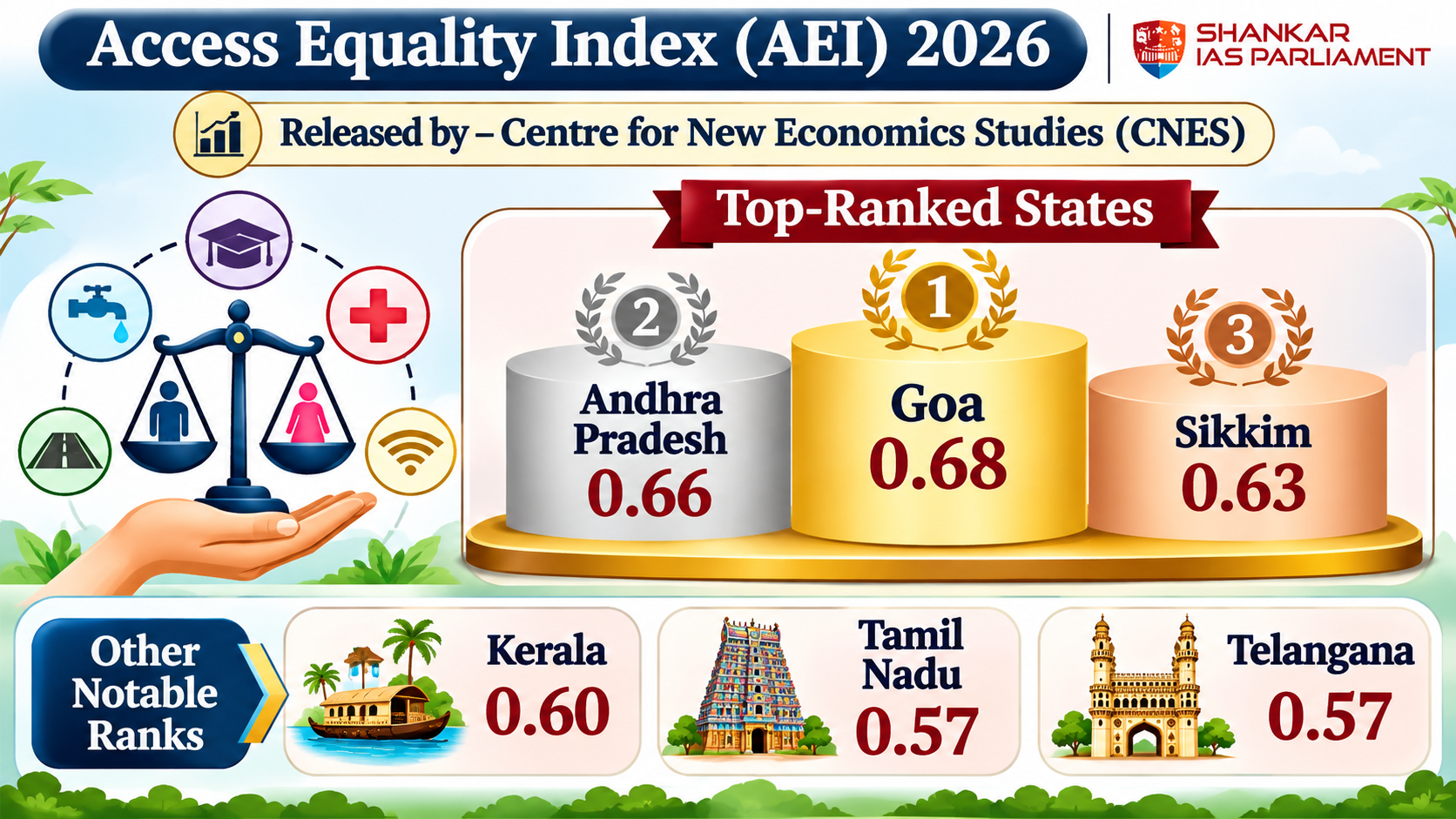
Access Equality Index 2026
- Released by – Centre for New Economics Studies (CNES), O.P. Jindal Global University.
- It evaluates 28 Indian states on their effectiveness in providing equitable access to opportunities and public goods.
- It evaluates states across 5 pillars, with equal weightage:
- Basic infrastructure
- Healthcare
- Education
- Socio-economic security
- Legal services
- Based on – 23 domains and 60 indicators.
- Measures access to drinking water, sanitation, housing, clean energy, healthcare, education, credit, pensions, insurance and judicial services.
- Key findings
- Andhra Pradesh ranks 13th in per capita income, but 2nd in access equality.
- Its actual access score (0.66) exceeded its income-based expected score (0.51), recording the highest positive differential (+0.15) among states.
- Ranked 1st in socio-economic security, with a score of 0.69.
- Significance – It highlights that equitable access to public services depends not only on income but also on effective governance and resource distribution.
|
|
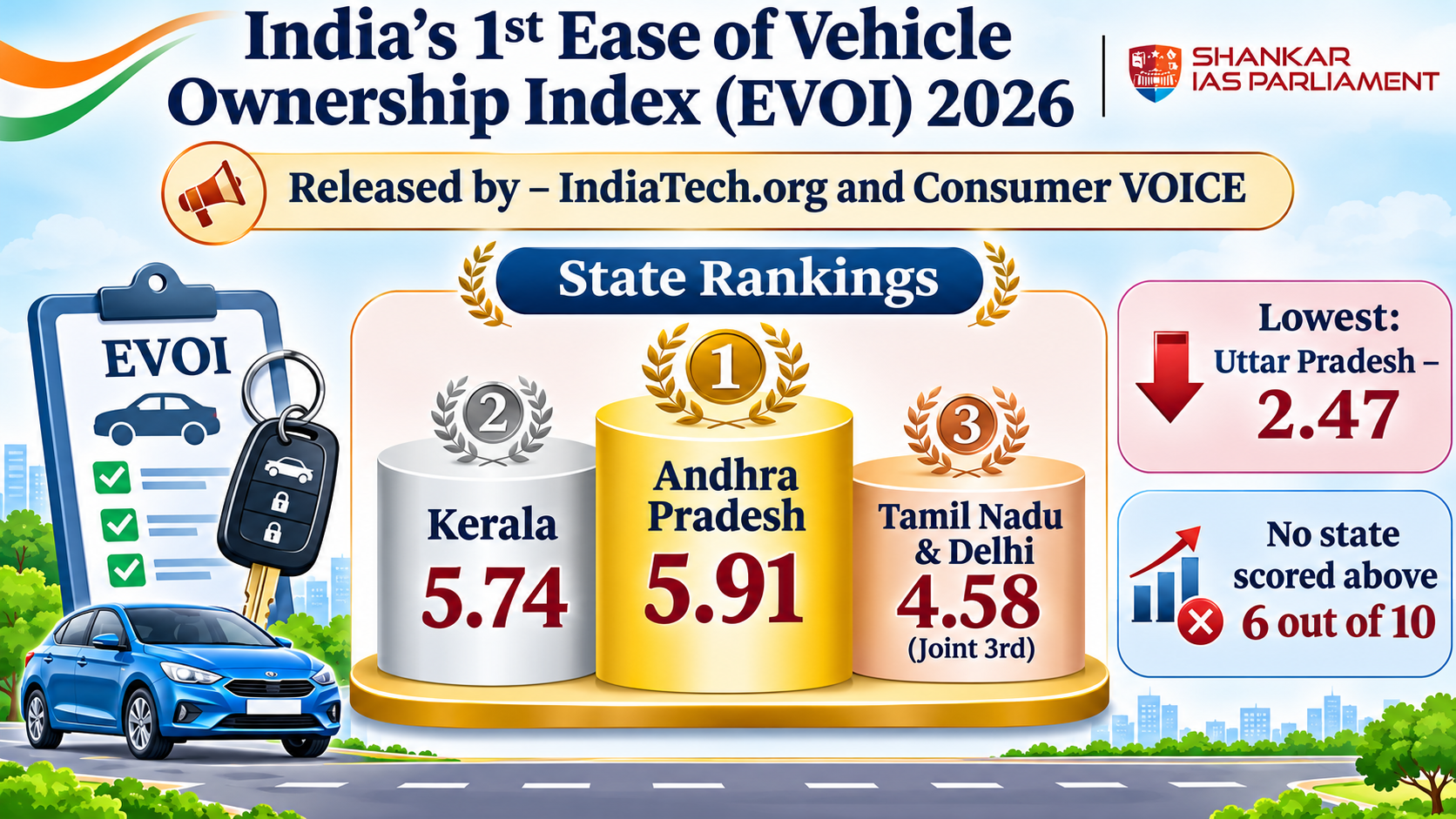
India’s 1st Ease of Vehicle Ownership Index (EVOI) 2026
- It assesses the ease of buying, selling and transferring pre-owned vehicles.
- Released by – IndiaTech.org and Consumer VOICE.
- 6 parameters – Policy and regulation, digital infrastructure, process efficiency, transparency, dealer support, cost and affordability.
- Based on – Surveys of 1,000+ buyers and sellers, stakeholder interviews and review of motor vehicle rules.
- States covered represent over 85% of India's organised used-car market.
- Key findings
- Cost was the weakest parameter; 12 of 15 states scored below 3.5.
- Informal payments can increase ownership transfer costs to nearly 10 times the official fee.
- 39% of sellers had pending RC transfers; only 9.6% completed transfers within two weeks.
- 28.1% received challans or legal notices even after selling their vehicles.
- RC transfer timelines range from 7–10 days in Andhra Pradesh to over 30 days in Uttar Pradesh.
- Recommendations
- Time-bound digital RC transfers and road-tax refunds.
- Accept DigiLocker and mParivahan documents across RTOs.
- Integrate banks with VAHAN for automatic hypothecation removal.
- Promote a national framework of ‘One Bharat, One Road Tax’.
|
|
Adolescent Physical Inactivity – WHO Report (2026)
- WHO released estimates (4 November 2026) highlighting widespread physical inactivity among adolescents worldwide
- Published in – The Lancet Global Health.
- Key Findings
- Global Inactivity – Nearly 240 million adolescents (11–17 years), or one in four, reported zero active days in a week.
Definition of Active Day – At least 60 minutes of moderate-to-vigorous physical activity (MVPA).
- Daily Activity – Only 14% of adolescents were physically active for at least 60 minutes on all 7 days.
- Global Average – 2.7 active days per week.
- Gender Gap (2025) – 28% of girls reported zero active days, compared to 22% of boys.
- Study Coverage – 389 population-based surveys covering over 3.2 million adolescents across 140 countries and territories.
- Progress – Little improvement in adolescent physical activity over the past 15 years.
- Highest Activity – Serbia, Canada, Ireland, Kazakhstan and Finland (4.5–4.8 active days/week).
- Lowest Activity – Cambodia, Philippines, Timor-Leste, Vietnam, Nepal, Gabon, Liberia, Madagascar, Mauritania and Jordan (1.7–1.9 days/week).
- 2030 Target – No country is on track to achieve the global target of reducing physical inactivity by 15%.
- WHO Recommendations
- Promote safe schools, public spaces and community sports programmes.
- Improve access to walking and cycling infrastructure.
- Address gender-based barriers to physical activity, particularly among girls.
|



