|
One Liners 10-11-2026
|
|
History, Art and Culture
|
|
Ningol Chakouba Festival – Manipur
- It is a traditional festival symbolising the bond between married women, their brothers and paternal families.
- Celebrated in – Manipur.
- Celebrated annually on – 2nd day of Hiyangei month of the Meitei calendar.
- Tradition
- Married women visit their parental homes with their children.
- Brothers and family members host a special feast and give gifts to the women.
- Traditional dishes include fish curry, an essential part of the celebration.
Fish Fair
- Manipur's Department of Fisheries organises the Annual Fish Fair-cum-Fish Crop Competition ahead of the festival.
- Venue – Imphal.
- Objective – To make fish available to the public at affordable prices.
|
|
4,000-Year-Old Rock Paintings

- Discovered at – Karadimalai, Ottampattu Thandari village, Villupuram district, Tamil Nadu.
- Key Findings
- Location – Rock overhang near the foothills of Karadimalai.
- Material – Paintings executed in red ochre.
- Depictions
- Plant resembling the Peruvian Apple Cactus.
- Deer-like figures and a wild boar.
- Geometric square patterns, rectangular boundaries and parallel vertical strokes.
- Animal figures, including bovids, with stylised bodies.
- Interpretation – Geometric motifs may represent enclosures or settlement maps and reflect prehistoric/protohistoric rock-art traditions.
- Other Archaeological Evidence
- Three rock depressions discovered at nearby Karadichunai.
- It is believed to have been formed by Neolithic people while sharpening or polishing stone tools.
- It indicates the presence and activities of ancient hunter-gatherer communities.
|
|
Geography
|
|
Maharashtra’s 3 Blue Flag Beaches
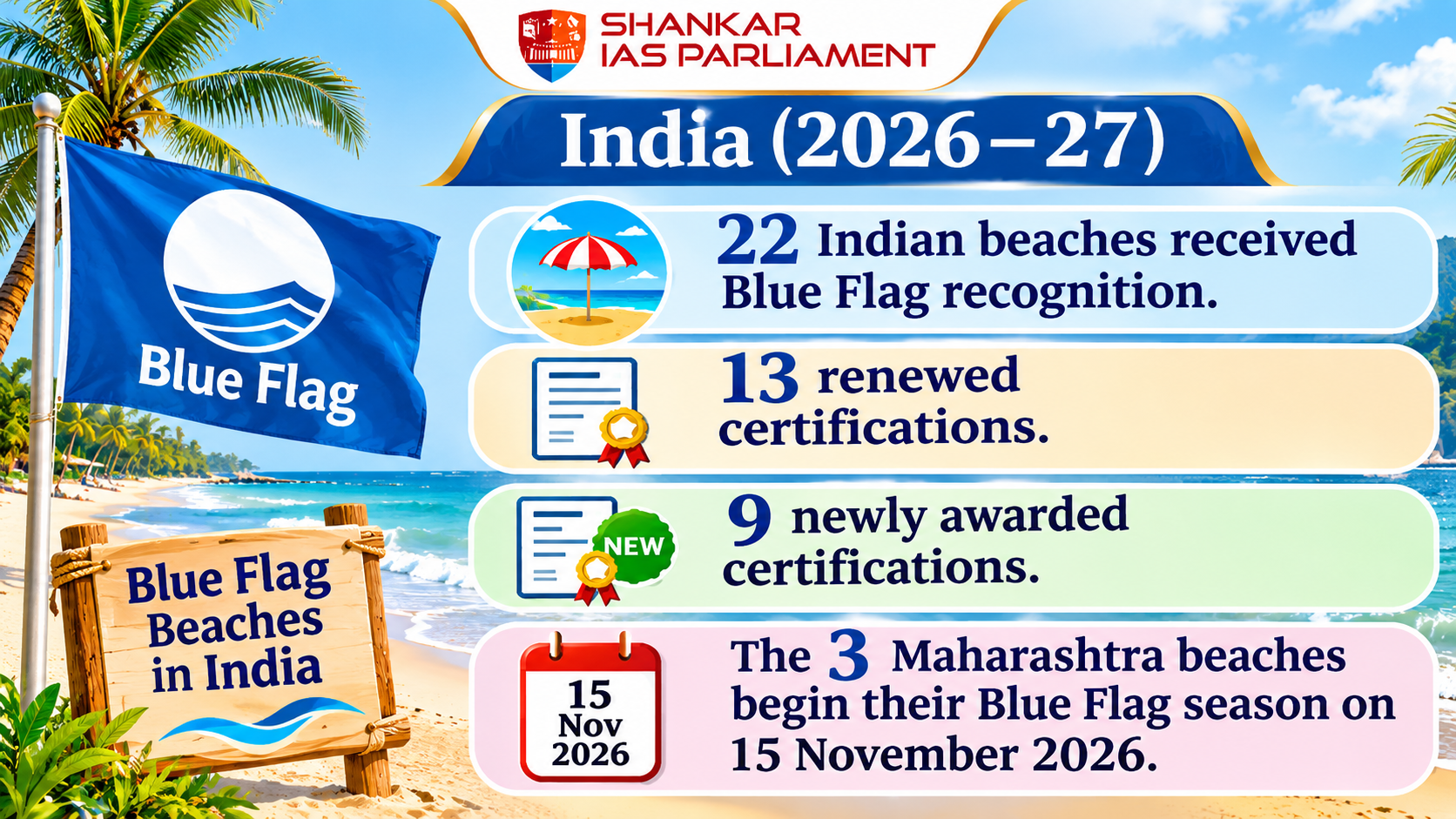
Recently, 3 Maharashtra beaches received the International Blue Flag certification for the 2026–27 season.
- It marks the state's 1st entry into the international list of Blue Flag beaches.
- Newly Certified Beaches
- Shrivardhan – Raigad district.
- Ladghar – Ratnagiri district.
- Guhagar – Ratnagiri district.
Shrivardhan is the 1st beach in Raigad district to receive this recognition.
Blue Flag Certification
- An international eco-label awarded by the Foundation for Environmental Education (FEE), Denmark.
- It recognises beaches that meet standards relating to:
- Water quality and beach cleanliness.
- Environmental management and biodiversity conservation.
- Tourist safety and emergency services.
- Sanitation, waste management and basic facilities.
- Environmental education and accessibility for persons with disabilities.
|
|
Economy
|
|
COP31 – Global Electrification Initiative
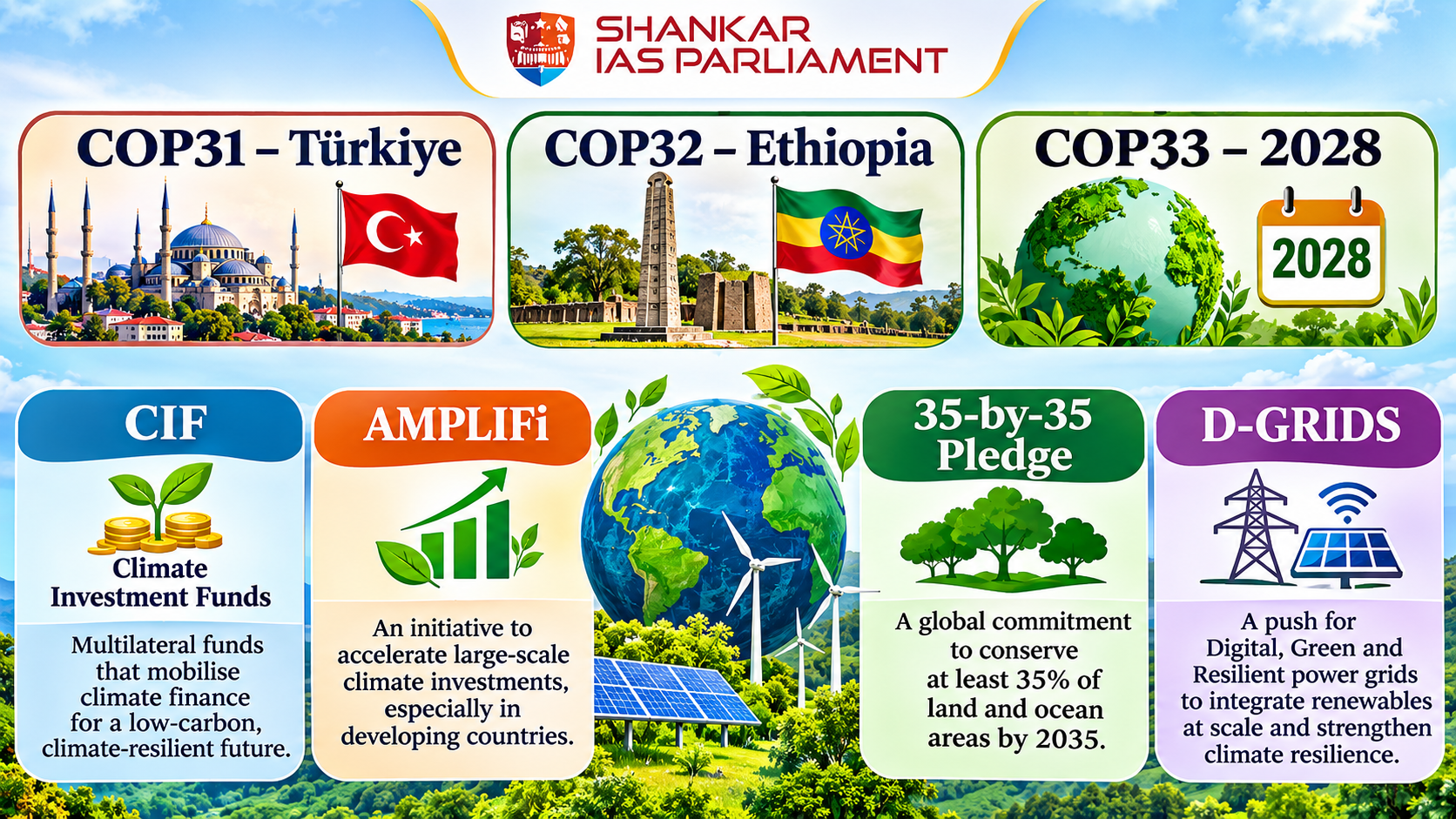
COP31 (Antalya, Türkiye) launched the Electrify Now Finance Coalition on 10 November 2026.
- Aim – To accelerate clean electrification investments in developing countries.
- Electrify Now Finance Coalition:
- Backed by COP31 Presidency and Ethiopia (COP32 host).
- Co-chaired by World Bank Group and African Development Bank (2027).
- Operates until COP33 (2028).
- Climate Investment Funds (CIF)
- Announced $94 million catalytic finance under AMPLIFi programme.
- Aims to mobilise over $1.2 billion in private investment for clean power, grids, storage and electrification.
- Investment Gap
- Developing economies account for 80% of global electricity demand growth.
- Advanced economies and China receive 90% of energy-transition investments.
- Africa receives only 2%.
- Global Electrification Pledge (35-by-35)
- Increase electricity's share in final energy consumption from 23% to 35% by 2035.
- Focus – Transport, buildings and industries.
- Supports the 1.5°C climate goal.
- Associated Initiatives
- Grids Technical Assistance Solutions Hub – Grid modernisation and renewable integration.
- IEA – Global Electrification Tracking Mechanism.
- IRENA – D-GRIDS programme for distribution-grid development.
|
|
India’s Russian Fossil Fuel Imports – Record High
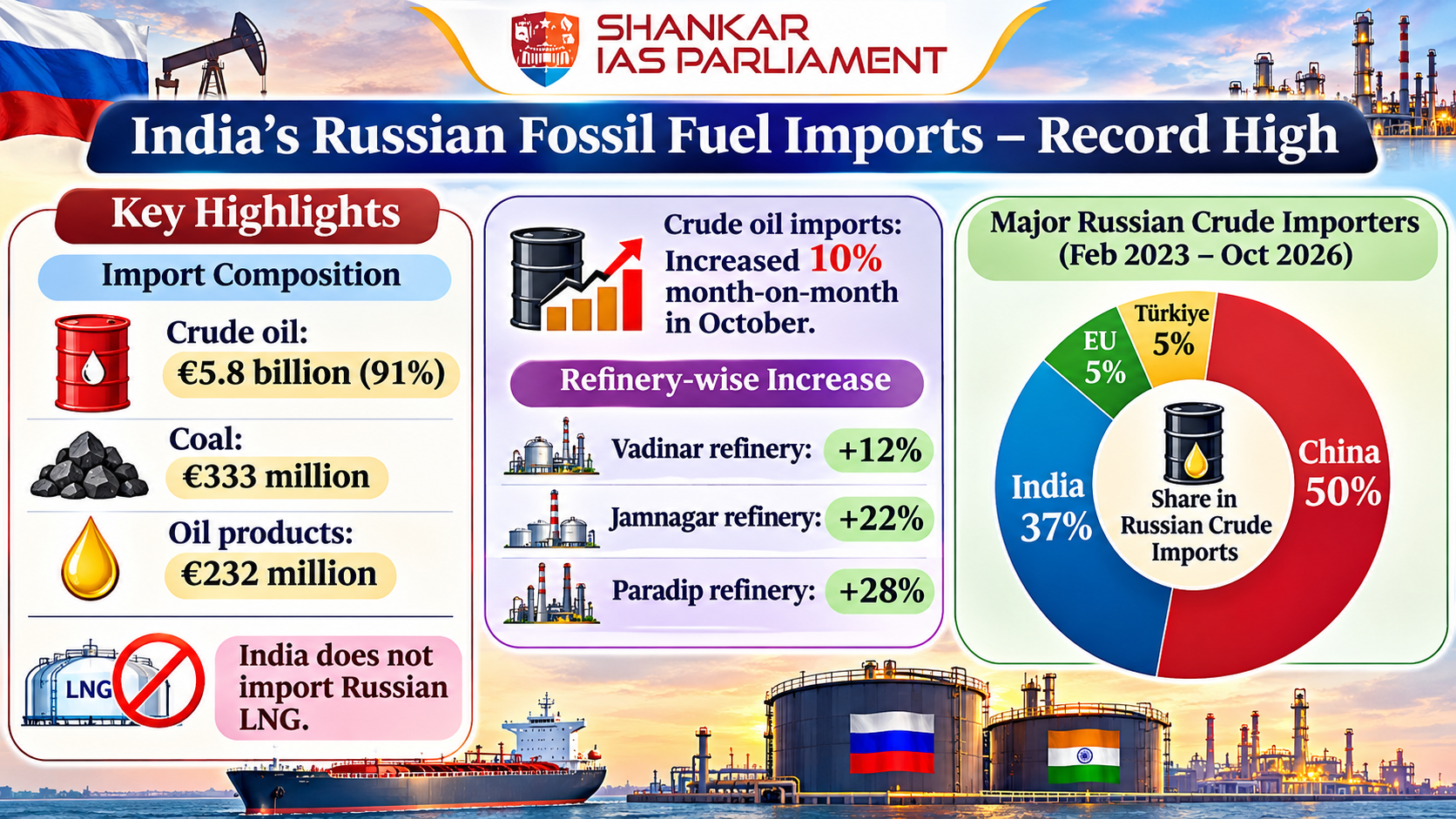
- India’s imports of Russian fossil fuels reached a record €6.4 billion in October 2026, according to the Europe-based Centre for Research on Energy and Clean Air (CREA).
- Global Trends
- China remained the largest buyer of Russian fossil fuels (€10.7 billion), followed by India (€6.4 billion).
- Russia’s fossil fuel export revenue rose 14% month-on-month to €754 million/day in October 2026, despite broadly unchanged export volumes.
- Russian Urals crude price increased 13% to $101.7/barrel, its highest monthly average since at least October 2021.
- Higher global energy prices, partly linked to the West Asia and Russia–Ukraine conflicts, boosted Russian export earnings.
- Significance for India
- It supports energy security through diversified crude oil sourcing.
- It provides access to alternative crude supplies, but increases exposure to geopolitical risks, sanctions and price volatility.
|
|
India – Renewable Energy Expansion (IEA Report 2026)
- According to the India Renewable Energy Market Report 2026 by IEA, India's renewable energy expansion has saved over $100 billion in coal and natural gas import costs over the past 15 years.
- Key Highlights
- Installed Capacity – India has around 300 GW renewable energy capacity, becoming the world's 2nd-fastest-growing renewables market.
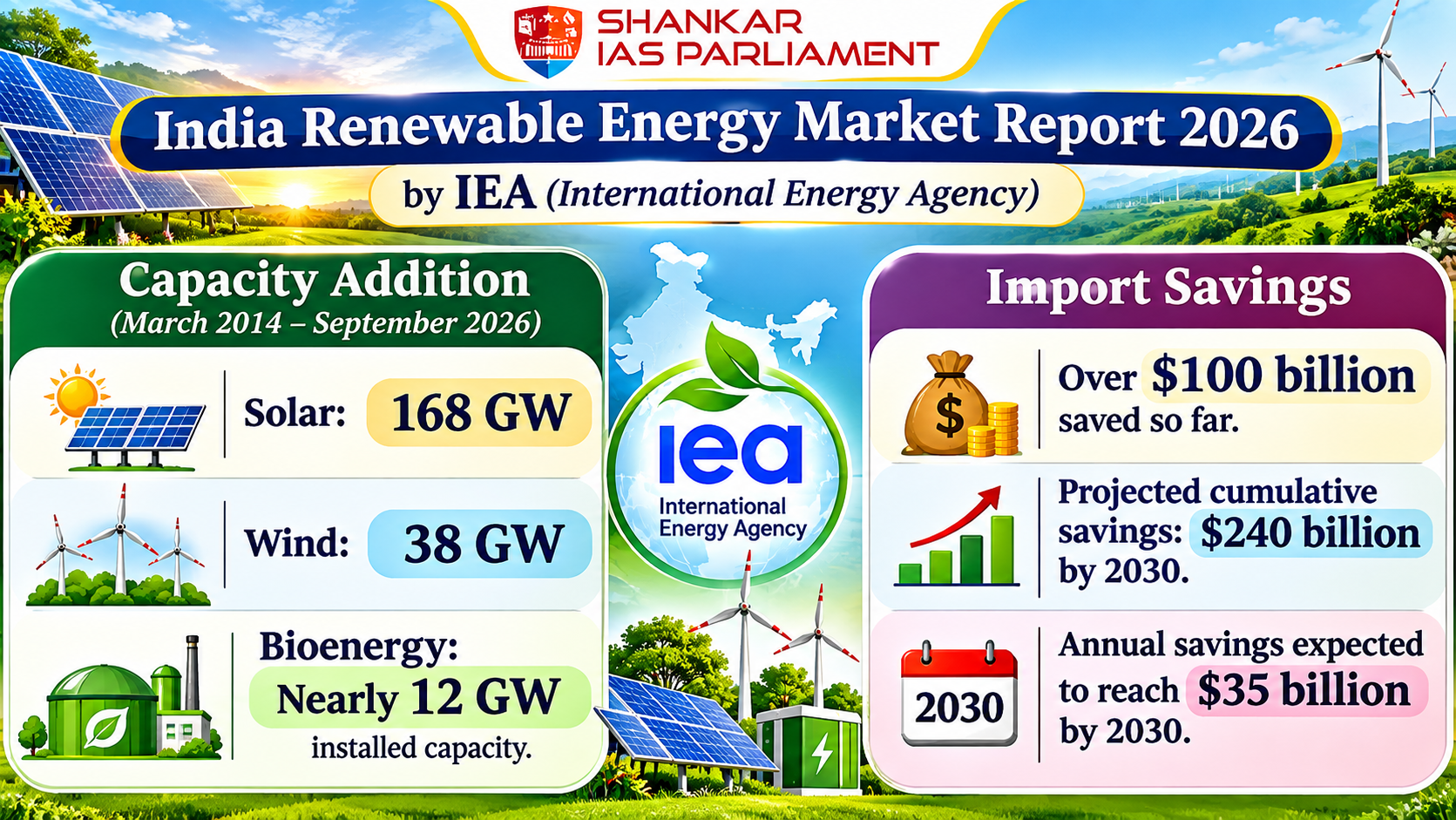
- 2030 Target – Renewable energy capacity expected to reach 530 GW.
- Climate Achievement – Achieved the target of 50% installed electricity capacity from non-fossil fuel sources in 2025, five years ahead of schedule.
- Government Initiatives
- PM Surya Ghar Muft Bijli Yojana – It promotes rooftop solar installations.
- PM-KUSUM – It promotes solar-powered agricultural pumps and farm feeders.
|
|
Agriculture
|
|
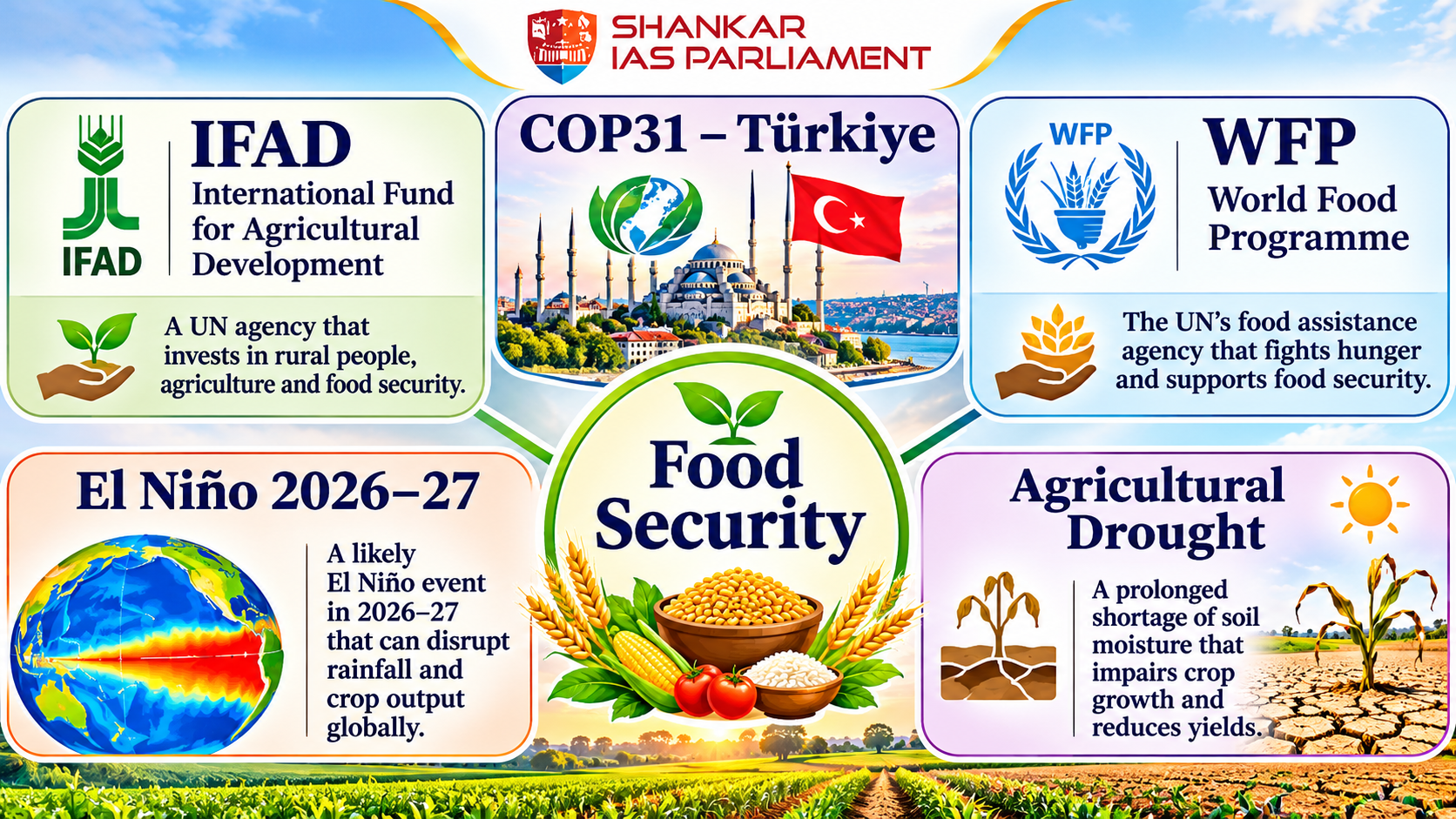
El Niño – Impact on Global Food Security (COP31)
- A new IFAD report, Food Systems Under Stress: Building Resilience from the First Mile, warns of $11 trillion global income losses due to El Niño over 5–6 years.
- Key Highlights
- 2026–27 El Niño – Expected to peak during October 2026–January 2027, with prolonged agricultural impacts.
- Agricultural Impact
- Southern Africa faces over 50% drought probability (Oct 2026–Mar 2027).
- South and Southeast Asian rice-producing regions are vulnerable.
- 2015–16 El Niño reduced regional rice production by 15 million tonnes.
- Food Security – Additional 49 million people may face acute food insecurity by end-2027 (WFP estimate).
|
|
Agriwaste-to-Fuels Plant
- India’s proposed largest agriwaste-to-fuels plant at Khed City, near Pune, Maharashtra.
- Key Highlights
- Production capacity – Up to 2 lakh litres of bio-crude per day.
- Technology – Proprietary Integrated Catalytic Thermo Cracking (ICTC) process.
- Converts agricultural waste at around 600°C, using multiple catalysts, into bio-crude.
- Feedstock – Paddy straw and husk, groundnut and cashew shells, and sugarcane bagasse.
- End Products – Bio-crude can be refined into renewable diesel and bio-naphtha.
- Around 75% of bio-crude can yield renewable diesel.
- Renewable diesel can be used in existing vehicles without modification.
- Expansion Plan
- Existing Chakan plant – 15,000 → 30,000 litres/day.
- Target – 5 lakh litres/day total capacity by 2028.
- Funding of Rs.250 crore
- Rs.100 crore from Technology Development Board (TDB), Ministry of Science and Technology.
- Rs.150 crore through Series B funding from investors including Amazon’s Smbhav Venture Fund, Climate Pledge Fund, Rainmatter and Strategic Autonomy Fund.
- Significance
- It utilises agricultural waste and helps reduce stubble burning.
- It avoids the food-versus-fuel conflict associated with food crops and vegetable oils.
- It supports renewable fuel production and circular economy.
|
|
Environment
|
|
Global Covenant of Mayors (GCoM) – 2026 Impact Report
- GCoM released its 2026 Impact Report at COP31 (Türkiye), highlighting cities' growing leadership in climate action.
- Key Highlights
- Climate Targets
- 7,500 out of 14,000 signatories (58%) have more ambitious emission-reduction targets than national governments.
- 28% aim to achieve targets earlier.
- Potential to reduce 4.8 Gt CO₂e annually by 2050.
- Climate Action
- Net-zero targets with implementation plans increased from 211 (2025) to 580 (2026).
- 3,078 cities completed climate-risk assessments covering 735 million people.
- Climate Finance Gap
- Emerging economies receive only $6 billion annually, against estimated requirements of $147 billion/year by 2030.
- Only 1% of tracked urban climate finance goes towards adaptation.
- Global South
- 61% of the population represented by GCoM signatories lives in the Global South.
- 81% of national climate commitments now include strong urban components (UN-Habitat).
|
|
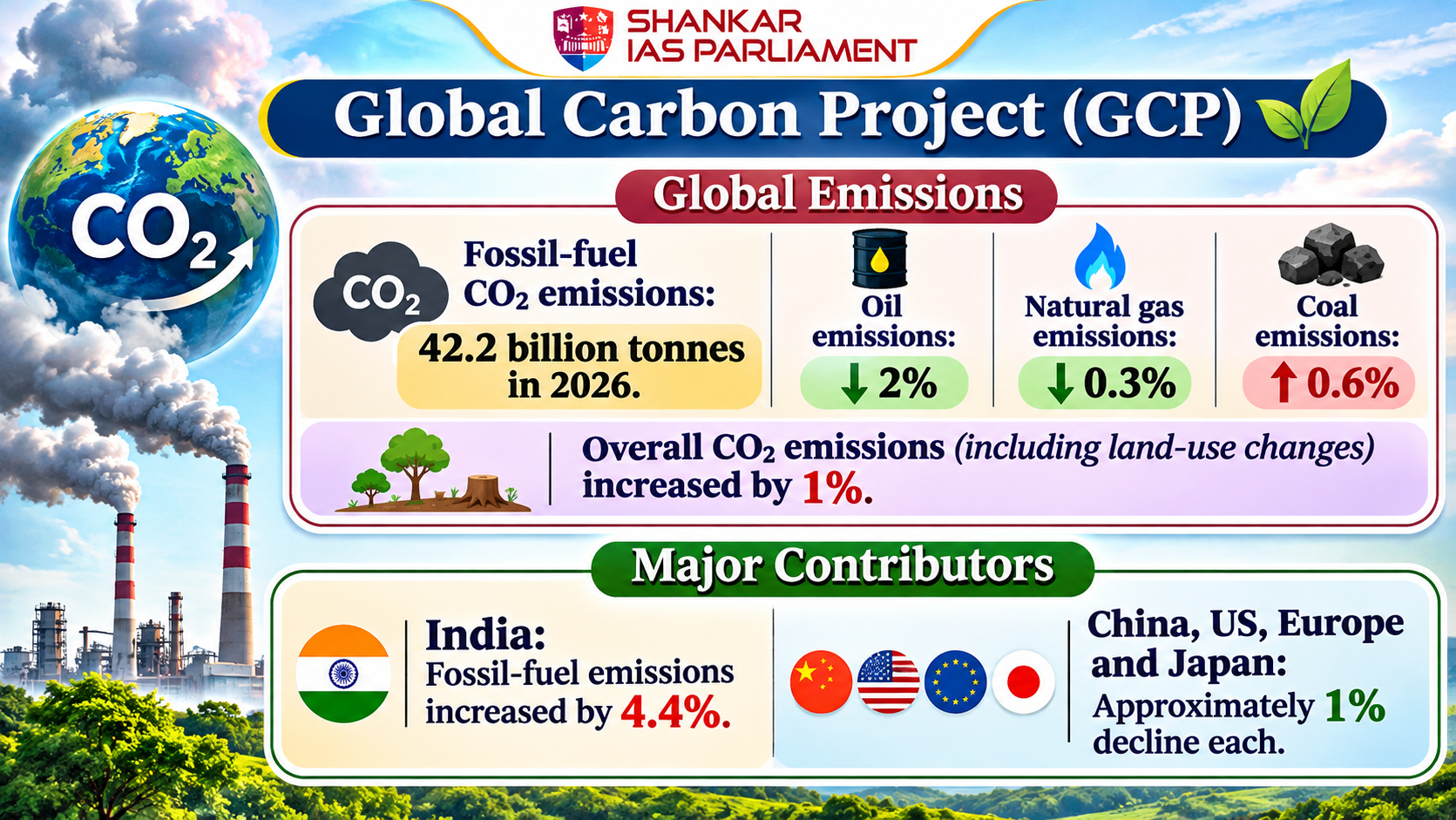
Global Carbon Emissions – 2026
- Global fossil-fuel CO₂ emissions declined by 0.4% in 2026, largely due to Iran war-related energy shocks, according to the Global Carbon Project (GCP).
- Key Highlights
-
- Historical Decline – 3rd global emissions decline in the 21st century, after the 2009 global recession and 2020 COVID-19 pandemic.
- Key Concern – Decline is largely driven by geopolitical energy disruptions rather than a structural transition to clean energy.
|



