|
One Liners 03-10-2026
|
|
Disaster Management
|
|
Real-time glacial lake early-warning system in Uttarakhand
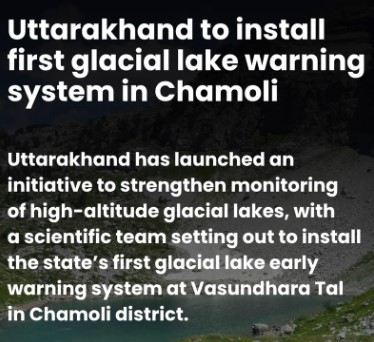
Uttarakhand is installing its first real-time glacial lake early-warning system at Vasundhara Tal in the Chamoli district to detect and mitigate the risks of Glacial Lake Outburst Floods (GLOFs).
- Key Details of the Project
- Location – Vasundhara Tal is a high-altitude glacial lake situated at approximately 4,795 meters above sea level in the Raikana valley (Dhauliganga basin / Alaknanda river system).
- Risk Level – Classified under Category A (the highest-risk category) among 13 to 15 high-risk glacial lakes identified in Uttarakhand by the National Disaster Management Authority (NDMA).
- Timeline – The installation expedition began on September 29, 2026, and is scheduled to run through October 15, 2026.
- Implementing Agencies – Conducted by the Uttarakhand State Disaster Management Authority (USDMA) under the National GLOF Risk Mitigation Programme, featuring a 22-scientist team from the Wadia Institute of Himalayan Geology and the Central Building Research Institute (CBRI), Roorkee.
- Field & Security Support – Backed by personnel from the State Disaster Response Force (SDRF), National Disaster Response Force (NDRF), and the Indo-Tibetan Border Police (ITBP).
|
|
International Relations and Issues
|
|
Project Meridian
Project Meridian is a 120-day U.S. Department of War initiative announced on October 1, 2026, to study the future of warfare and identify critical capability gaps.
- Leadership and Structure
- Supervisor – Department Chief Technology Officer Emil Michael.
- Co-Leaders – SpaceX CEO Elon Musk, Anduril Industries founder Palmer Luckey, and former House Speaker Newt Gingrich.
- Participants – Representatives from government, industry, academia, and public policy.
- Core Goals
- Focus – Forecast future conflicts and identify advanced technologies, such as autonomous warfare systems.
- Scope – Map future battlefields and propose actionable solutions for military overmatch.
- Limit – The 120-day effort will not create new military strategies, policies, or binding procurement contracts.
|
|
California Bans Child Marriage
California has become the first U.S. state to completely ban child marriage through Assembly Bill 1267 (AB 1267).
- Signed by Governor Gavin Newsom on 30 September 2026, the law will come into effect on 1 January 2027.
- Key Provisions
- AB 1267 sets 18 years as the minimum age for marriage and domestic partnerships, with no exceptions.
- It removes earlier provisions permitting minors to marry with parental consent and judicial approval.
- Significance
- Before the law, California was among three states—along with New Mexico and Mississippi—without a fixed minimum marriage age. California now becomes the 18th U.S. state to prohibit marriage below 18.
- Campaign Background
- The legislation was supported by child-marriage survivors and advocates, including Courtney Stodden, Christina Sutton and Sara Tasneem.
- Unchained at Last and the California Commission on the Status of Women and Girls sponsored the measure.
|
|
Agriculture
|
|
Global Horticulture Hub at Madanapalle
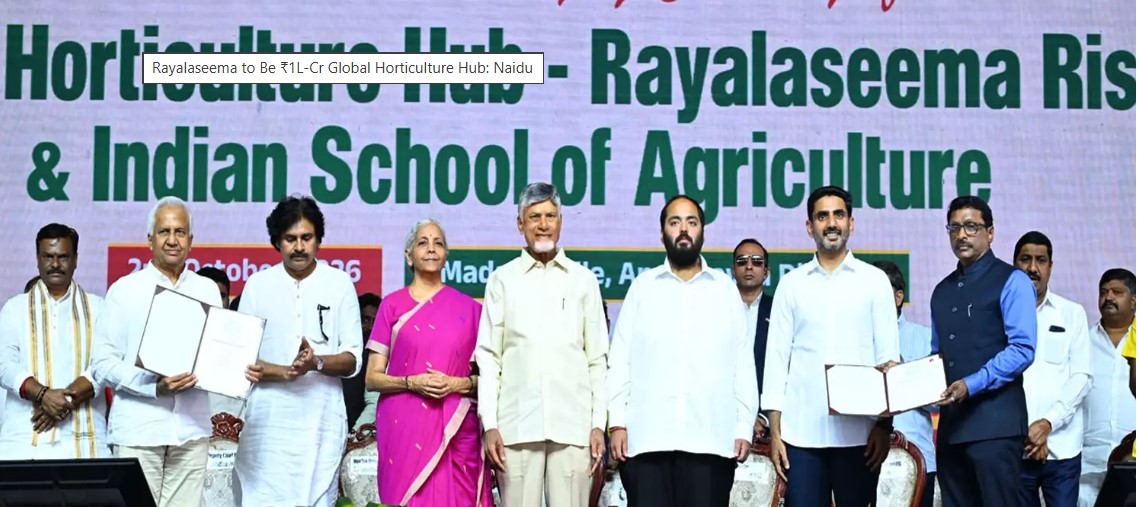
The Global Horticulture Hub at Madanapalle is a ₹1 lakh-crore mega agricultural initiative launched on October 2, 2026, to transform the Rayalaseema region into the "Fruit Bowl of India."
- Key Project Details
- Investment – Total outlay of ₹1 lakh crore split into ₹40,000+ crore from the government and ₹60,000 crore from private-sector investments.
- Scope – Covers 10 districts, 201 clusters, and expands horticulture cultivation across 6 lakh hectares in Andhra Pradesh.
- Phases – Implemented across three structured phases to provide end-to-end support for farmers from seeds to global exports.
- Leadership – Launched by Chief Minister N. Chandrababu Naidu, Union Finance Minister Nirmala Sitharaman, and Deputy Chief Minister K. Pawan Kalyan.
- Core Objectives
- Infrastructure & Storage – Build modern cold storages, food processing units, and logistics networks to minimize post-harvest losses.
- Market Access – Connect local farming produce directly to domestic and international markets, improving overall farm incomes for an estimated 9.6 lakh farmers.
- Indian School of Agriculture (ISA) – A related initiative established alongside the hub—partnering with entities like Reliance—to focus on artificial intelligence in agriculture, precision farming, and smart irrigation.
|
|
India's first Female Farmer Worker Conference
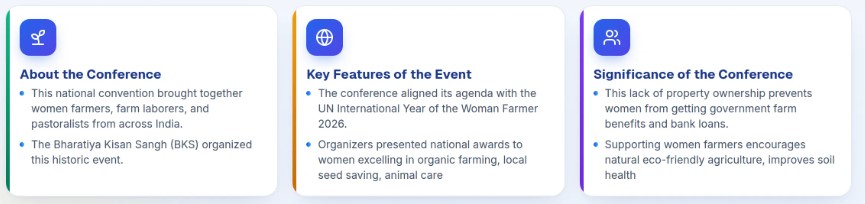
India's first Female Farmer Worker Conference was held on September 30, 2026, at the Indira Gandhi Indoor Stadium in New Delhi.
- Overview of the Event
- Organizer – Bharatiya Kisan Sangh (BKS), the farmer wing of the Rashtriya Swayamsevak Sangh (RSS).
- Attendance – Around 5,000 to 7,000 women farmers and office-bearers from across India.
- Context – Coincided with the UN-designated International Year of the Woman Farmer 2026. Main Objectives
- Legal and Social Identity – Establish women as legitimate "farmers" (Kisan) rather than unpaid family helpers or basic laborers.
- Policy Representation – Advocate for a greater role for women in agricultural policymaking and institutional land and credit rights.
- Felicitation – Honored women for excellence in natural farming, indigenous seed conservation, animal husbandry, and food processing.
- Key Themes – Discussed traditional farming, cow-based agriculture (Gau-Krishi-Vanijyam), and sustainable rural economies toward a developed India by 2047.
|
|
Environment
|
|
National Wildlife Week 2026
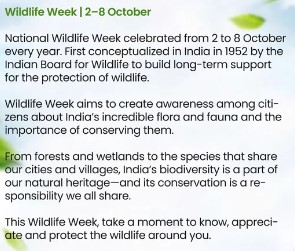
National Wildlife Week 2026 in India is observed from October 2 to October 8.
- Official theme Wildlife Week 2026 – "Connecting Habitats, Thriving Wildlife".
- Key Details
- Dates – October 2–8, 2026 (aligning with Mahatma Gandhi's birth anniversary to promote compassion for all living creatures).
- Theme – "Connecting Habitats, Thriving Wildlife" focuses on safeguarding wildlife corridors, improving habitat connectivity, and encouraging human-wildlife coexistence beyond protected forest boundaries.
- Activities – Zoos, forest departments, and conservation societies across India are hosting awareness walks, expert talks, online competitions, and school programs.
- Global Context – In the United States, National Wildlife Week was organized earlier in the year (April 5–12, 2026) by the National Wildlife Federation under the theme "Color Me Wild".
|
|
World Animal Day
World Animal Day is celebrated globally on October 4, 2026, to raise awareness for animal rights, welfare standards, and conservation.
- 2026 Theme & Focus
- Theme – "See the World Through Their Eyes" (suggested by Zoe from the UK).
- Visual Symbol – An illustration by Emma Jayne featuring a fish-shaped lens focused on the Coral Triangle near Papua New Guinea to highlight marine biodiversity and threats like coral bleaching.
- Core Goal – To encourage people to move beyond a human-centered perspective and understand how animals experience our changing environment.
- History & Significance
- Origin – Founded in 1925 by Heinrich Zimmermann in Berlin, Germany.
- Date Selection – Moved to October 4 to align with the feast day of Saint Francis of Assisi, the patron saint of animals and ecology.
- Coordinator – Led globally by the UK-based animal welfare charity, Naturewatch Foundation.
|
|
Miscellaneous
|
|
International Day of Older Persons
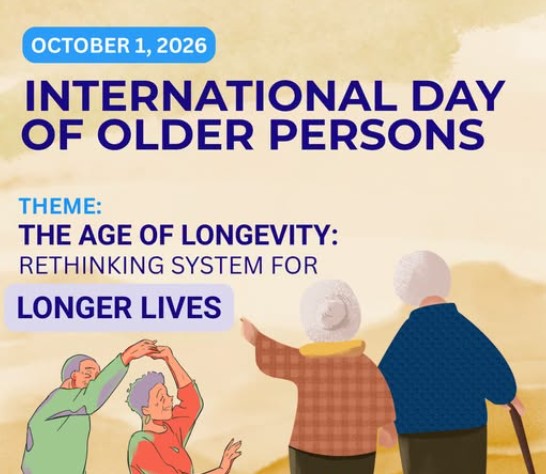
Observed annually on October 1, the International Day of Older Persons recognizes the vital contributions of senior citizens and addresses global aging challenges.
- 2026 Theme – The Age of Longevity – Rethinking Systems for Longer Lives.
- The 2026 theme focuses on redesigning healthcare, social protection, employment, housing, and care systems to match increasing global life expectancies.
- Establishment – The United Nations General Assembly designated October 1 as the observance day via Resolution 45/106 on December 14, 1990.
- First Observed – The day was marked worldwide for the first time on October 1, 1991.
- Key Frameworks – Supported by milestones including the 1982 Vienna International Plan of Action on Ageing and the 2002 Madrid International Plan of Action on Ageing.
- Significance and Goals
- Dignity and Rights – Promotes policies and societal attitudes that combat age discrimination and guarantee independent, secure living.
- Awareness – Highlights the rapid demographic shift of the global population aged 60 and older.
- Community Action – Encourages local initiatives—such as youth-senior mentorship programs via platforms like MY Bharat—to bridge generational divides.
|
|
National Voluntary Blood Donation Day
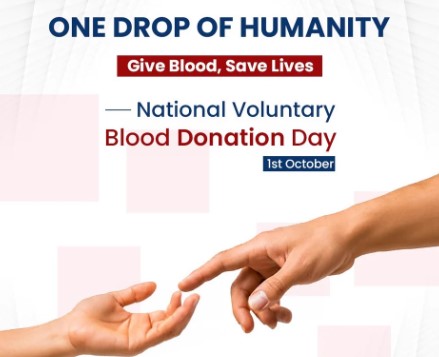
National Voluntary Blood Donation Day was marked across India on October 1, 2026, as detailed in the Ministry of Defence Press Release, focusing on community health and life-saving contributions.
- Campaign Theme – The official theme for 2026 was 'One Drop of Humanity, Give Blood, Save Lives.'
- The drive emphasized grassroots outreach, youth participation, and digital pledges through platforms like MyGov and the e-RaktKosh portal.
- Key Events – The Ministry of Defence and the Armed Forces Transfusion Centre hosted a major donation camp at Kartavya Bhavan-2 in New Delhi.
- A total of 134 officers and staff members donated blood following mandatory health screenings.
- Regional programs took place nationwide, including community recognition ceremonies and camps in areas like Tawang and Tamil Nadu.
|
|
Ig Nobel Prizes
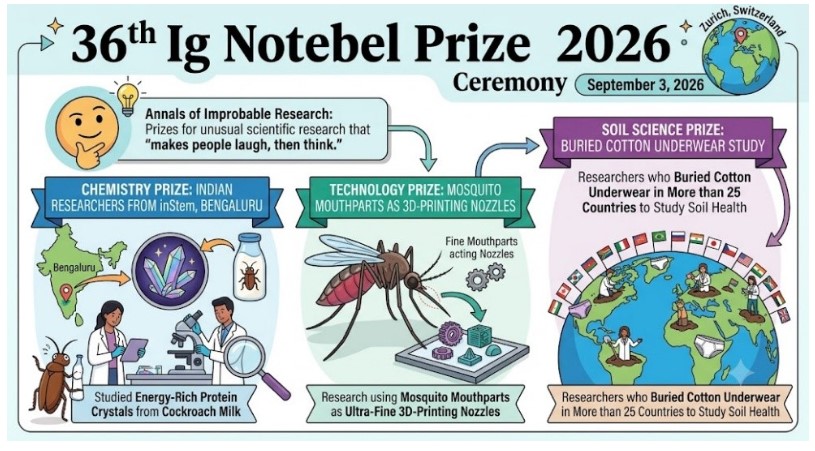
The 36th First Annual Ig Nobel Prizes were awarded on September 3, 2026, at the Kongresshaus in Zürich, Switzerland—marking the first time the ceremony moved outside the United States.
- The 2026 Ig Nobel winners honored research that makes people laugh, then think across ten quirky categories: Medicine – Tokuji Unno, for aerodynamic studies on proper versus improper nose blowing.
- Biology – João Miguel Alves-Nunes et al., for investigating what triggers venomous snake bites by stepping on them (later retracted).
- Biomechanics – Matilda Brindle et al., for establishing a precise cross-species definition of kissing.
- Chemistry – Leonard Chavas, Subramanian Ramaswamy, and Nathan Coussens, for studying the high energy density of cockroach milk protein crystals.
- Economics – Paul Piff et al., for research linking upper-class social status to unethical behaviors like candy-snatching.
- Olfaction – Agnieszka Sorokowska et al., for exploring how parents perceive the scent of babies versus teenagers.
- Peace – Jaimie Arona Krems et al., for studying nuanced preferences in complex friend dynamics.
- Physics – Zhao Pan et al., for theoretical and experimental design of a splash-free urinal.
- Soil Science – S. Franz Bender and Marcel van der Heijden, for assessing soil health by burying and analyzing 1,000 pairs of cotton underpants.
- Technology – Jianyu Li and Changhong Cao, for "3D necroprinting" using deceased mosquito proboscises as high-resolution printing nozzles.
|



