Prelims– Current events of National and International Importance| Science & Technology
Why in News?
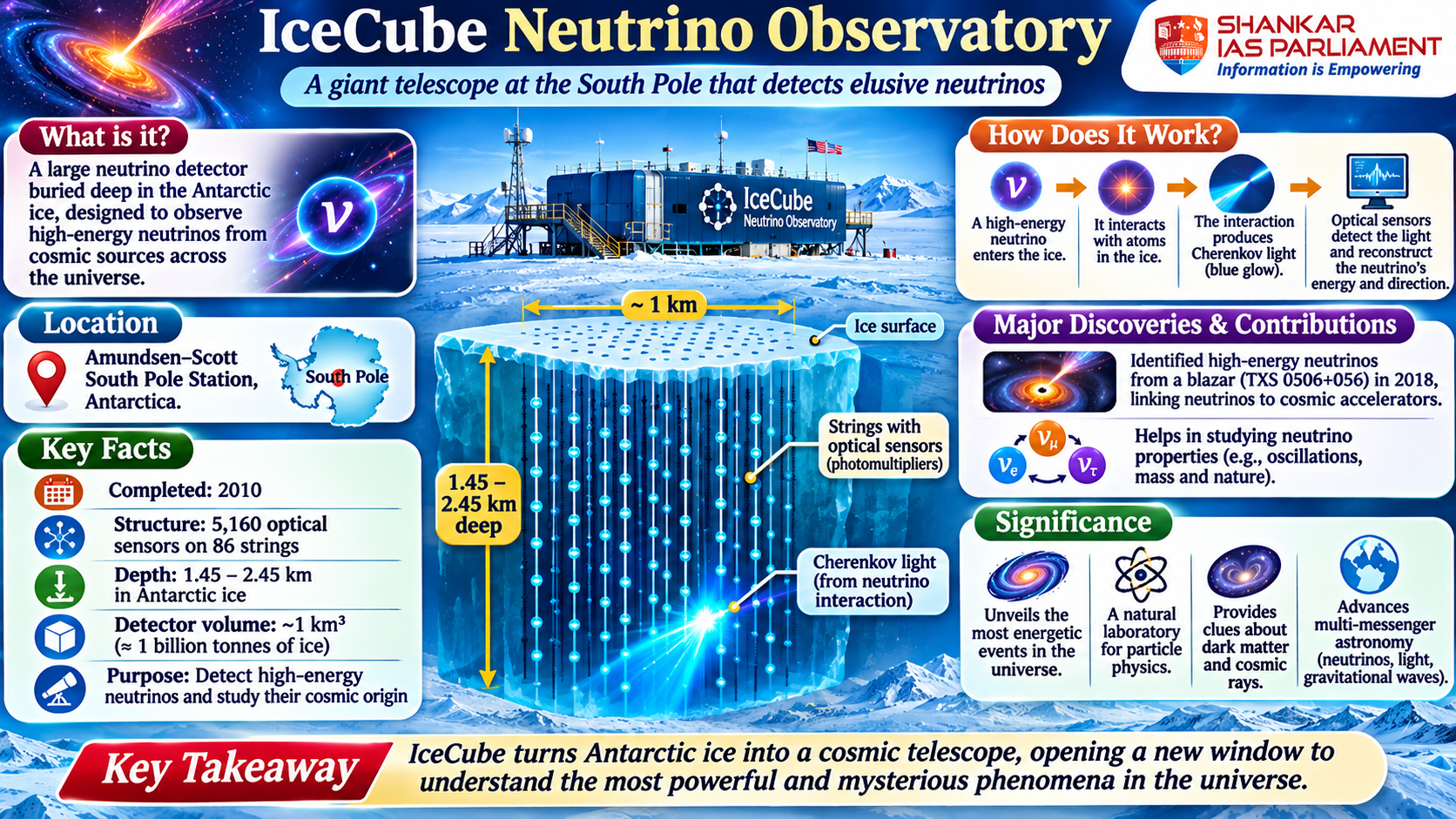
Recently, scientists announced the detection of ultra-high-energy cosmic neutrinos by the IceCube Neutrino Observatory, carrying roughly 10 billion times the energy of typical solar neutrinos.
Details of the Discovery
- Energy Levels– The detected cosmic neutrinos possess energies about 10 billion times higher than standard neutrinos coming from the Sun.
- Detection Date– Reported publicly by researchers on November 2, 2026.
- Observatory– Captured using the Ice Cube Neutrino Observatory.
- Scientific Impact– These ultra-high-energy "ghost particles" travel straight from extreme extragalactic accelerators—such as active galactic nuclei and black hole environments—without getting deflected by magnetic fields, helping solve long-standing mysteries about the origin of high-energy cosmic rays.
What are Neutrinos?
- Neutrinos are tiny, electrically neutral, fundamental subatomic particles that pass through normal matter almost completely undisturbed.
- Often called "ghost particles," they are among the most abundant massive particles in the universe.
- Key Properties
- No Charge– Neutrinos carry zero electric charge, meaning they do not feel electromagnetic forces.
- Tiny Mass– They have an extremely small rest mass—millions of times lighter than an electron—though exact measurements are still being studied.
- Weak Interaction– They interact with other matter only through gravity and the weak nuclear force. Tens of trillions of solar neutrinos stream through your body every second without you feeling a thing.
- Three Flavors– Neutrinos come in three types, or "flavors"– electron neutrino, muon neutrino, and tau neutrino.
- Where Do They Come From?
- The Sun and Stars– Nuclear fusion in the sun produces a massive flow of solar neutrinos.
- Radioactive Decay– They are released when atomic nuclei break apart or transform, such as in radioactive decay, nuclear reactors, or particle accelerators.
- Cosmic Events– Supernovae, cosmic rays, and the ancient aftermath of the Big Bang (forming a cosmic neutrino background) fill space with them.
Reference
Nature| Ultra-High-Energy Cosmic Neutrinos



