Prelims: Current events of National and International Importance| Science & Technology
Why in News?
Scientists at CERN's Large Hadron Collider (LHC) have discovered that quark-gluon plasma—the super-hot primordial matter from just after the Big Bang—can form in surprisingly small and low-energy atomic collisions using oxygen-16 and neon-20 nuclei rather than massive heavy ions like lead.
Key Details of the Discovery
- The Substance– Quark-gluon plasma is an ultra-hot liquid state—over 100,000 times hotter than the center of the Sun—where quarks and gluons break free from protons and neutrons.
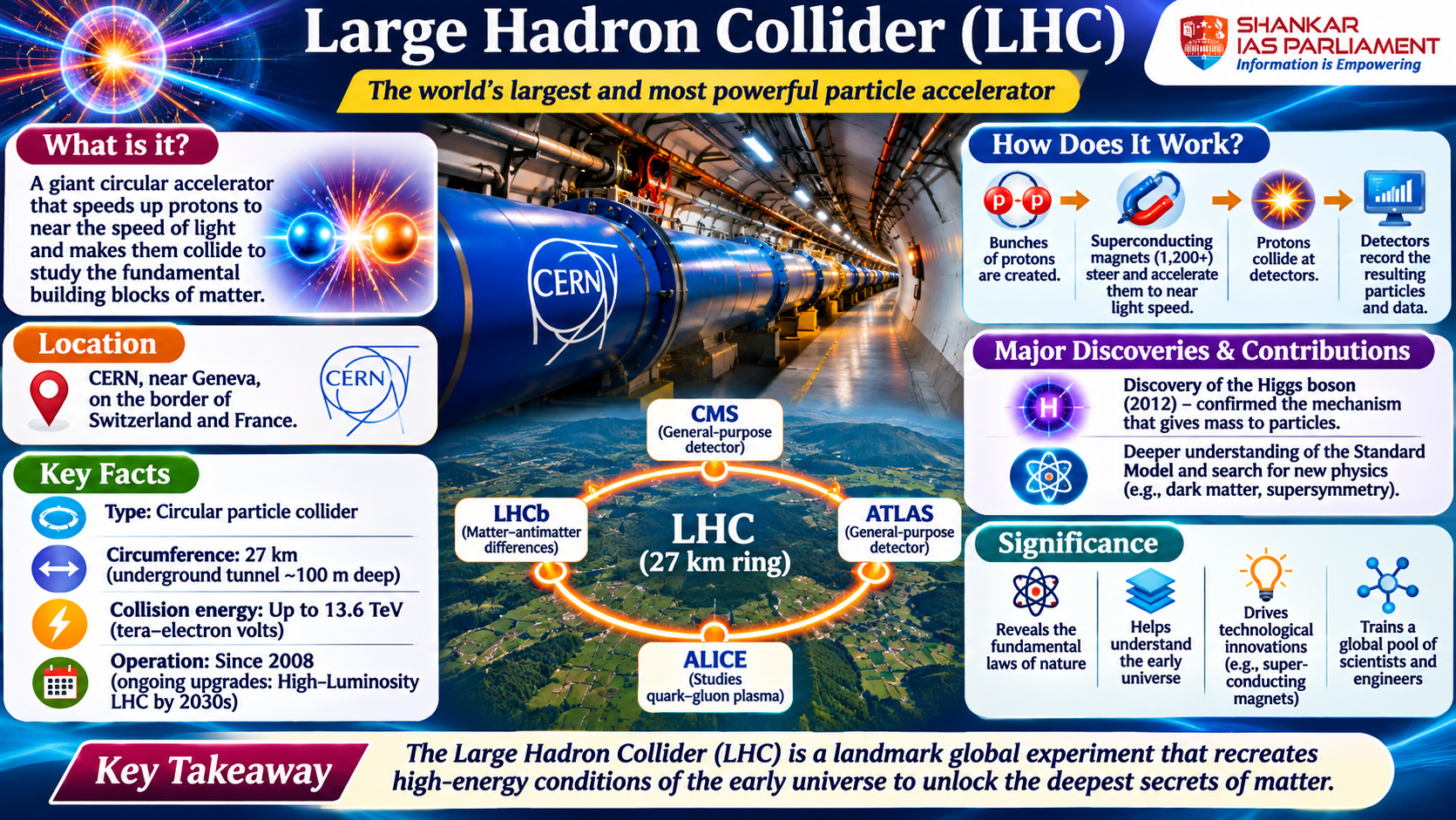
- The Experiment– All four major LHC research collaborations (ALICE, ATLAS, CMS, and LHCb) observed signs of this plasma following the collider's oxygen and neon collision experiments.
- Nuclear Geometry– The expanding debris patterns act like a fingerprint; round oxygen nuclei create rounded particle patterns, while the elongated, bowling-pin shape of neon-20 produces a matching asymmetric pattern.
- Broader Impact– This breakthrough bridges nuclear physics and cosmology, offering a new way to map how protons and neutrons are structured inside smaller atomic nuclei.
Reference
Science Daily| Evidence of Big Bang Matter



