0.0965
7667766266
x

Traditional Herbal Medicines (THMs) in Livestock

iasparliament Logo
September 07, 2026

Prelims: Current events of national and international importance | Science & Techology

Why in News?

In August 2026, the Food and Agriculture Organization (FAO) published a technical brief entitled “Traditional herbal medicines as alternatives to antimicrobials in the livestock sector.”
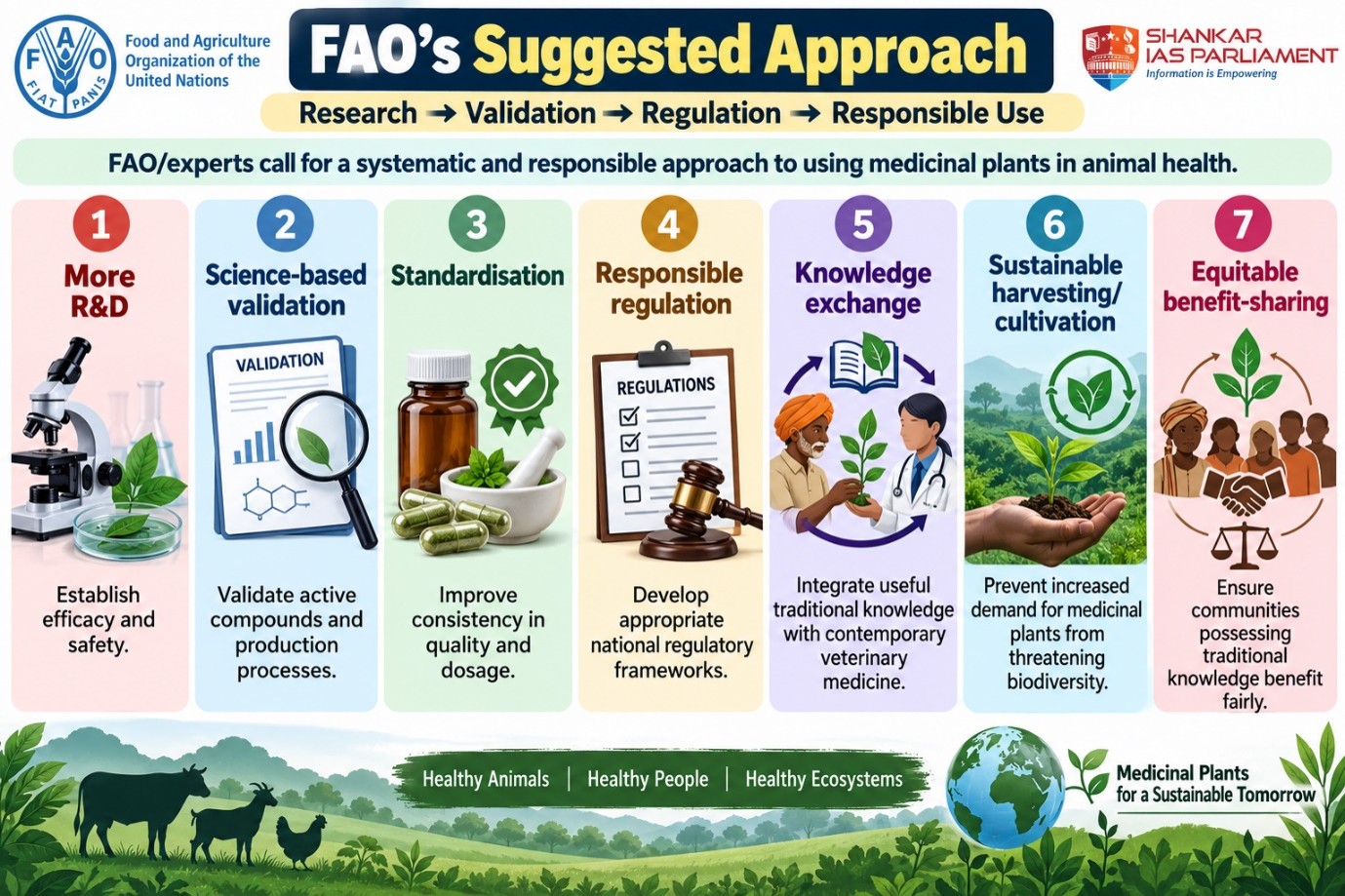
  • Traditional herbal medicines (THMs) – These are primarily plant-based preparations or extracts that contain multiple active compounds.
  • These preparations often possess anti-infective and antimicrobial properties.
  • THMs have traditionally been used to prevent and treat diseases in livestock.
  • Their use is particularly common in low- and middle-income countries.
  • In veterinary medicine, this body of traditional knowledge is also referred to as ethnoveterinary medicine (EVM).

FAO approach on livestock UPSc

  • Benefits
    • It reduces unnecessary use of antimicrobials.
    • It provides supportive treatments that are affordable and locally accessible.
    • It serves as a source for the discovery of new anti-infective compounds.
  • Key Challenges
  • Insufficient Scientific Evidence – The effectiveness remains unproven, and additional clinical research is required.
  • Variability in Active Compounds – Potency and safety vary depending on geographic origin, seasonal factors, species differences, and methods of preparation.
  • Lack of Standardisation – Non-uniform manufacturing and processing methods impede the achievement of consistent product quality.
  • Safety Concerns – Natural products are not inherently risk-free, and variable concentrations of active compounds may result in adverse effects.
  • Regulatory Challenges – The scope of regulation remains unclear, and achieving global harmonisation presents significant difficulties.


Ethnoveterinary Medicine

India has established experience in integrating traditional veterinary knowledge into livestock health programs.

National Dairy Development Board (NDDB)

  • It promotes the use of Ethnoveterinary Medicine (EVM) to rationalize antibiotic use.
  • Implemented through the Disease Control through Alternate Methods project across milk unions and producer organizations in eight states.
  • By March 2025, the following outcomes are anticipated:
    • More than 1.1 million EVM interventions are expected to be conducted.
    • A reported success rate of over 80 percent has been achieved.

Department of Animal Husbandry and Dairying (DAHD)

  • It has recommended the inclusion of EVMs in standard veterinary treatment guidelines for livestock and poultry.
  • It also conducts training and awareness programs for farmers.

Reference

Down to Earth | Traditional Herbal Medicines

There are no reviews yet. Be the first one to review.

ARCHIVES

sidetext


