Prelims: Current events of national and international importance | Disease
Why in News?
Bhutan is the first country in the World Health Organization South-East Asia Region to eliminate dog-transmitted rabies as a public health concern.
Elimination – The reduction of disease transmission or deaths to a specified level within a defined geographical area, with ongoing surveillance and prevention measures remaining necessary.
Eradication – The permanent reduction of a disease to zero cases globally.
- Rabies – It is a viral zoonotic disease that targets the central nervous system.
- It is almost invariably fatal once clinical symptoms appear.
- Transmission primarily occurs via the saliva of infected animals, most commonly through bites.
- Dogs represent the primary source of human rabies fatalities worldwide.
|
Rabies in India
|
- Approximately 59,000 deaths worldwide each year are attributed to rabies.
- Roughly one-third of these deaths occur in India.
- In India, approximately 96% of rabies-related mortality and morbidity is associated with dog bites.
- Rabies is endemic throughout India, with the exception of the Andaman and Nicobar Islands and Lakshadweep.
National Rabies Control Programme (NRCP)
- Objectives
- To reduce human mortality caused by rabies.
- To achieve zero human deaths from dog-mediated rabies by 2030 through progressive interventions.
|
World Health Organization (WHO) validation criteria – For “Elimination as a Public Health Problem”.
- A country is required to demonstrate the following:
- There have been no human deaths resulting from dog-mediated rabies for a minimum of two consecutive years.
- The capacity exists to prevent the re-emergence or further transmission of the disease.
Bhutan's Approach to Achieving Success
- Implementation of the One Health Approach – Integration of human health, animal health, and environmental factors,
- Bhutan integrated the following stakeholders:
- Health workers
- Veterinary professionals
- Local governments
- Community members
- Volunteers
- Key Interventions
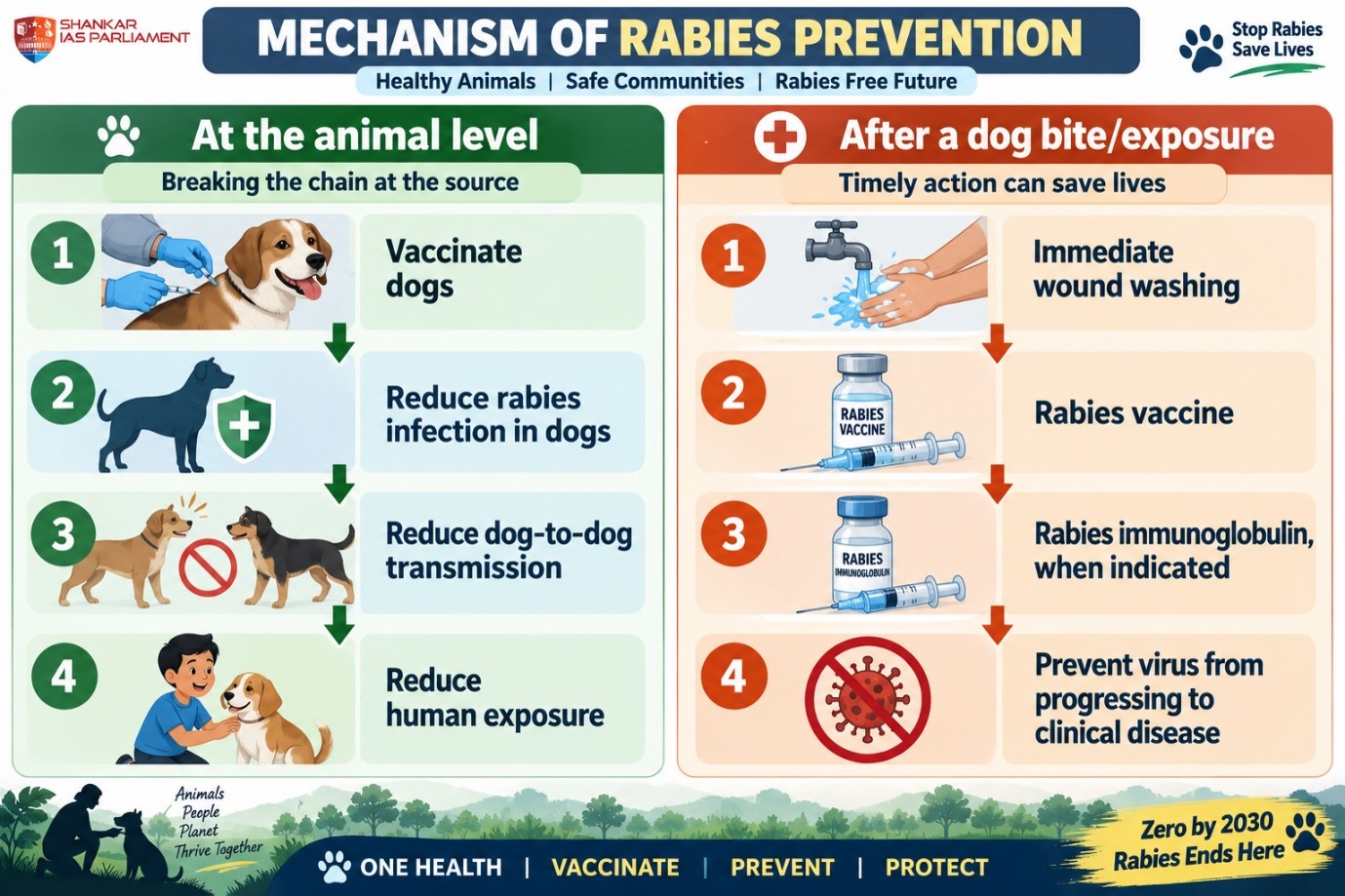
- Mass dog vaccination – Vaccination of dogs reduces disease transmission at its source.
- Dog population management – Control of the stray and free-roaming dog population.
- Surveillance – Rapid identification and investigation of suspected disease cases.
- Community awareness – Education of communities regarding disease prevention and responsible animal management.
- Post-Exposure Prophylaxis (PEP) – Ensuring access to appropriate treatment following exposure.
- Cross-sectoral Coordination – Health and animal or livestock authorities collaborate to achieve coordinated outcomes.
Reference
The Hindu | Bhutan Eliminates Dog-Transmitted Rabies



